

Hadrianus was one of the earliest well-documented members of the tortoise lineage. It occurs in Eocene deposits across the western interior of North America. Adult shells were vaulted and robust. Juvenile shells help researchers assess which features of the lower shell and rib-bearing plates may have changed with growth.
Quick facts
| Group | Turtles, early tortoise lineage |
|---|---|
| Age | Early and middle Eocene |
| Region | North America, western United States |
| Carapace length | 53 cm in the H. majusculus holotype |
| Type species | Hadrianus corsoni |
| Scientific name | Hadrianus |
| Diet | Diet has not been established from the fossils |
What can the fossils tell us?
The holotype of H. corsoni, ANSP 10050, preserves the front of the plastron. More complete fossils broaden the comparison of species-level traits.
The H. majusculus type carapace measures 53 cm long. This is the length of one shell and leaves the upper size limit of the genus open.
Four growth marks occur on a bone of UCB 76816. Converting shell marks into years depends on how often they formed.
A Wyoming plastron and a New Mexico shell
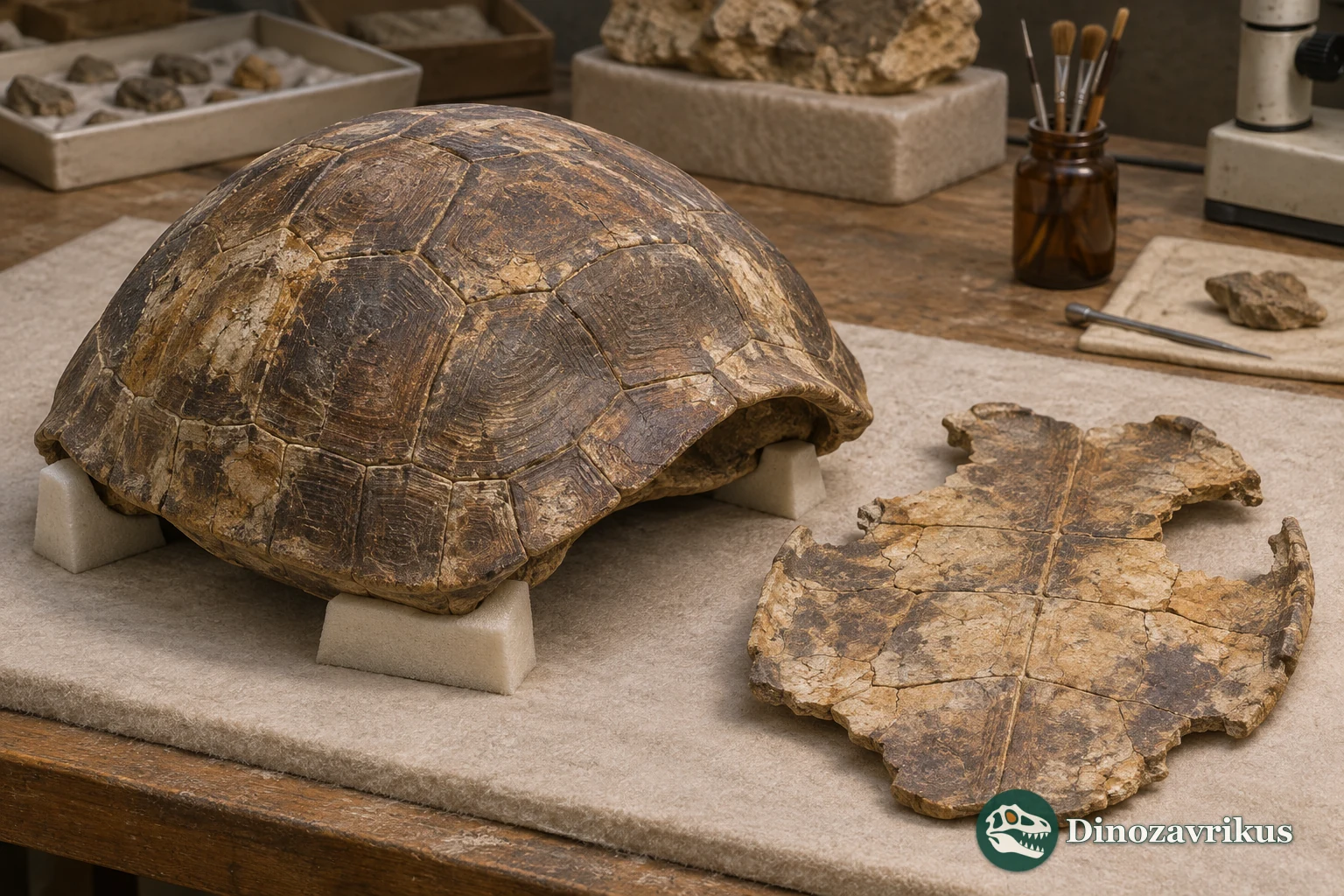
Joseph Leidy named Testudo corsoni in 1871 from the front of a plastron, ANSP 10050, from Wyoming’s Bridger Formation. The species is now Hadrianus corsoni. In 1904 Oliver Perry Hay described H. majusculus from a near-complete shell collected by David Baldwin in New Mexico in 1876. Hay recorded a carapace length of 53 cm and a width of at least 44 cm. The Yale specimen is cited as YPM 2793, or YPM VPPU 002793 in the modern revision.
Telling the species apart
In H. corsoni, the central bone of the front of the plastron is wider than it is long. The groove dividing the femoral and anal scutes is almost straight. The high carapace of H. majusculus has little of the wedge-shaped narrowing of the rib-bearing plates seen in many other tortoises. A 2018 revision identified these as the two diagnosable species among nine named North American forms. Several names based on incomplete shells from Utah and Wyoming fall within the variation of H. corsoni.
What the young shells show
Features of the ribs and plastron led researchers to identify UCB 76816, an incomplete shell from the early Eocene Willwood Formation, as H. majusculus. One bone preserves four growth marks from the shell scutes. The authors interpreted the specimen as juvenile. Some familiar tortoise characters can become more pronounced as the animal grows. Identifying a small shell involves comparisons with both adults and related aquatic turtles.
An early branch of the tortoise lineage
Shell anatomy places Hadrianus near the base of the branch leading to living tortoises. In the 2018 analysis, the central bones of the upper shell of H. majusculus were too poorly known to resolve its exact relationship to H. corsoni. Juvenile shells have also been compared with Echmatemys, an Eocene member of a mostly freshwater lineage. Their similarities contributed to the hypothesis that tortoises originated in North America. The comparisons leave the immediate ancestor unresolved.
Where the fossils occur
Early specimens of H. majusculus come from the San Jose Formation of New Mexico and the Willwood Formation of Wyoming. The Bridger and Uinta formations yield H. corsoni. One specimen from the Bridger Formation in the Smithsonian collections preserves parts of the limbs and their girdles as well as the shell. These remains expand the anatomical record, while the diet of Hadrianus is still undocumented.
Frequently asked questions
When did Hadrianus live?
The best-supported North American fossils are early and middle Eocene in age.
How large was Hadrianus?
The H. majusculus type specimen has a carapace 53 cm long. It is a measurement of a particular individual.
What remains of the type specimen of H. corsoni?
ANSP 10050 is the front of a plastron from the Bridger Formation. Leidy named the species using this fossil in 1871.
Does the resemblance to Echmatemys identify an ancestor?
The similarities help test a hypothesis about tortoise origins. They leave the precise ancestral species unresolved.