

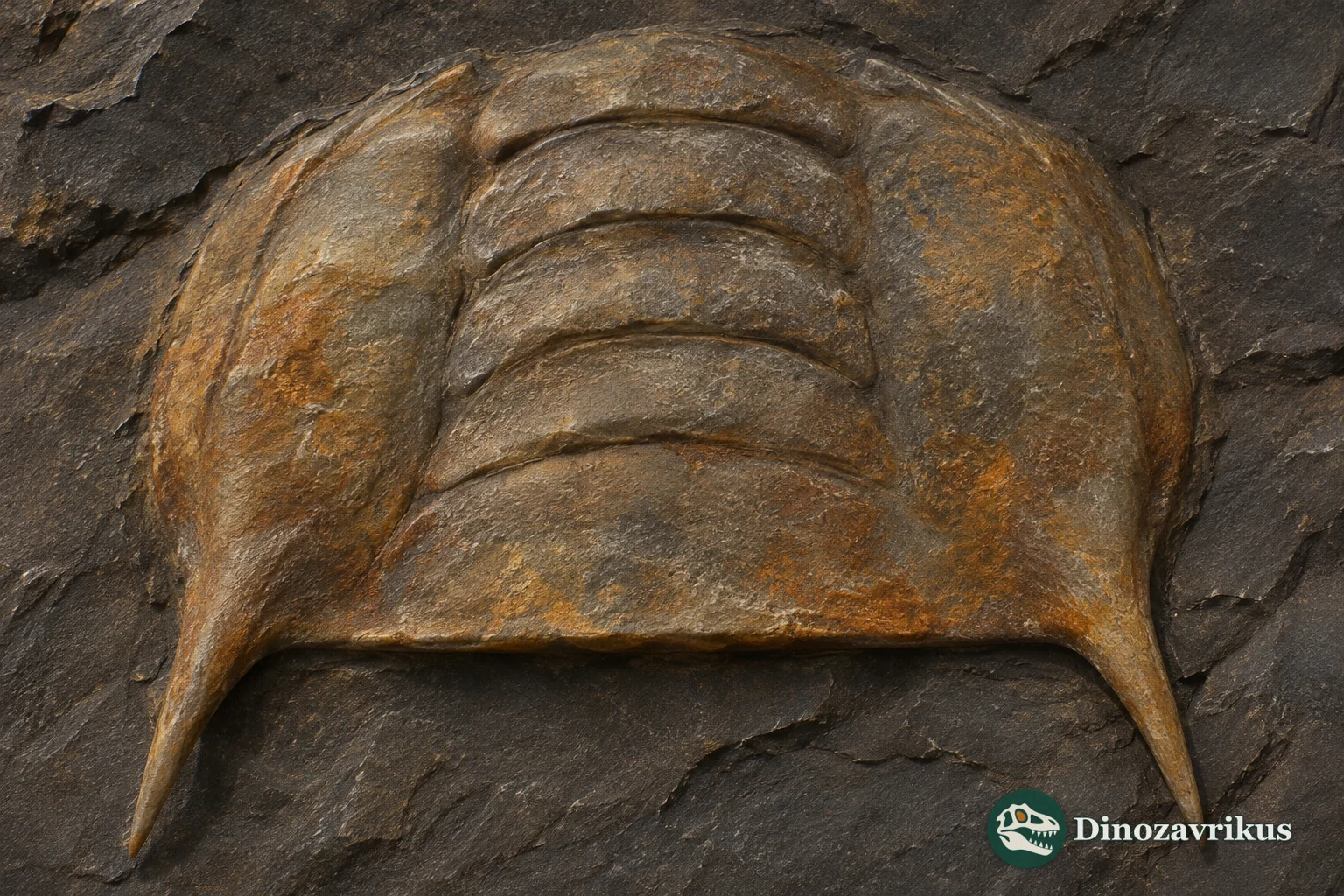
Hadrocephalites had a raised central lobe bordered by deep furrows on the head shield. Broad tail shields assigned to the genus carry a pair of spines. The two parts usually occur separately, so sorting cranidia and pygidia has been an important part of the taxonomic work.
Quick facts
| Group | Trilobites |
|---|---|
| Age | Early Middle Cambrian |
| Region | North America, South America |
| Diet | Unknown |
| Type species | Hadrocephalites lyndonensis |
| Holotype | Cranidium USNM 509470, Nevada |
What can the fossils tell us?
USNM 509470 preserves the raised glabella and the deep axial furrows used to identify the type species. It supplies no measurement of the whole animal.
The broad outline, central axis and two rear spines provide characters to compare. An isolated pygidium cannot by itself be linked to a particular cranidium.
The La Laja cranidium was assigned to Hadrocephalites on the form of its anterior border and suture. Its species was left open.
Nevada and the type species
Frederick Sundberg and Linda McCollum established Hadrocephalites in 2002. USNM 509470, the holotype cranidium of H. lyndonensis, comes from the Log Cabin Member of the Pioche Shale in Nevada. The same collection yielded additional head shields, a partial free cheek and incomplete pygidia.
The long, convex glabella lies between deep axial furrows. In the type species there is almost no field between the glabella and the anterior border. The broad tail shield has a pair of posterior spines. In H. lyndonensis, the terminal portion of the axis overhangs the rear margin, and pleural grooves continue towards the spines.
Matching heads and tails
Cranidia and pygidia from several species can be found in the same bed. Sundberg and McCollum revisited the original Kochaspis liliana material and chose cranidium USNM 15428a as its lectotype. They transferred the separately preserved pygidium USNM 15428b to an unnamed species of Hadrocephalites. Similarities among pygidia also led them to discuss a relationship with Kochiella.
Several species formerly assigned to Schistometopus were transferred to Hadrocephalites. The type specimen of Schistometopus is too incomplete to support the previous broad use of its name, so Sundberg and McCollum treated that genus name as doubtful.
A fragment from Argentina
North American material includes cranidia from Alberta’s Mount Whyte Formation. A La Laja Formation specimen from San Juan, Argentina, IANIGLA-PI 1376b, has a transverse anterior border crossed obliquely by the facial suture. Pratt and Bordonaro assigned it to Hadrocephalites while leaving the species unidentified. Its relatively smooth surface differs from that of several North American forms.
The disarticulated elements inform taxonomy and stratigraphic comparison. They give limited information about the size of a complete individual, and no direct evidence of diet.
Frequently asked questions
Where was the holotype found?
Cranidium USNM 509470 came from the Log Cabin Member of the Pioche Shale, Nevada.
What stands out on the head shield?
A long raised glabella, deep furrows at its sides and a short or absent preglabellar field.
Why did researchers change earlier tail identifications?
Some tail and head shields assigned to the same species had been found as separate pieces. Comparisons suggested that they belonged to different forms.
Is Hadrocephalites known from Argentina?
A La Laja Formation cranidium was assigned to Hadrocephalites, but not to a named species.