

Haopterus gracilis is known from one young pterosaur in China's Yixian Formation. Unlike many early Jehol finds, its skull survives alongside much of the front skeleton. Skull and wing measurements come from the fossil; its family placement changed after researchers revisited bones obscured by compression.
Quick facts
| Scientific name | Haopterus gracilis, Wang and Lü, 2001 |
|---|---|
| Holotype | IVPP V11726, a compressed skeleton with skull |
| Locality | Sihetun, Liaoning Province, China |
| Rock and age | Jianshangou beds, Yixian Formation, Early Cretaceous |
| Skull | About 145 mm long in a juvenile |
| Wingspan | Up to 1.35 m in the original estimate; adult size unknown |
| Relationships | The 2024 analysis placed it among istiodactyliforms |
What can the fossils tell us?
IVPP V11726 preserves most of the skull, front vertebrae, shoulder region and wing bones. The pelvis, much of the hind limbs and tail are missing.
A low 145 mm skull carries pointed teeth of differing forms. Tooth shape informs possible feeding, but no prey or stomach contents establish a specific meal.
The 2024 redescription used micro X-ray laminography to inspect overlapping elements. It refined observations of the same holotype rather than adding another specimen.
The original paper assigned Haopterus to Pterodactylidae. A 2024 phylogenetic analysis recovered it as an istiodactyliform within Pteranodontoidea.
The Sihetun fossil
An IVPP field team collected IVPP V11726 in 1998 from the Jianshangou beds of the Yixian Formation near Sihetun, western Liaoning. Wang Xiaolin and Lü Junchang named Haopterus gracilis in 2001. The genus honours palaeontologist Hao Yichun; the species name refers to the fossil's preservation and small foot bones.
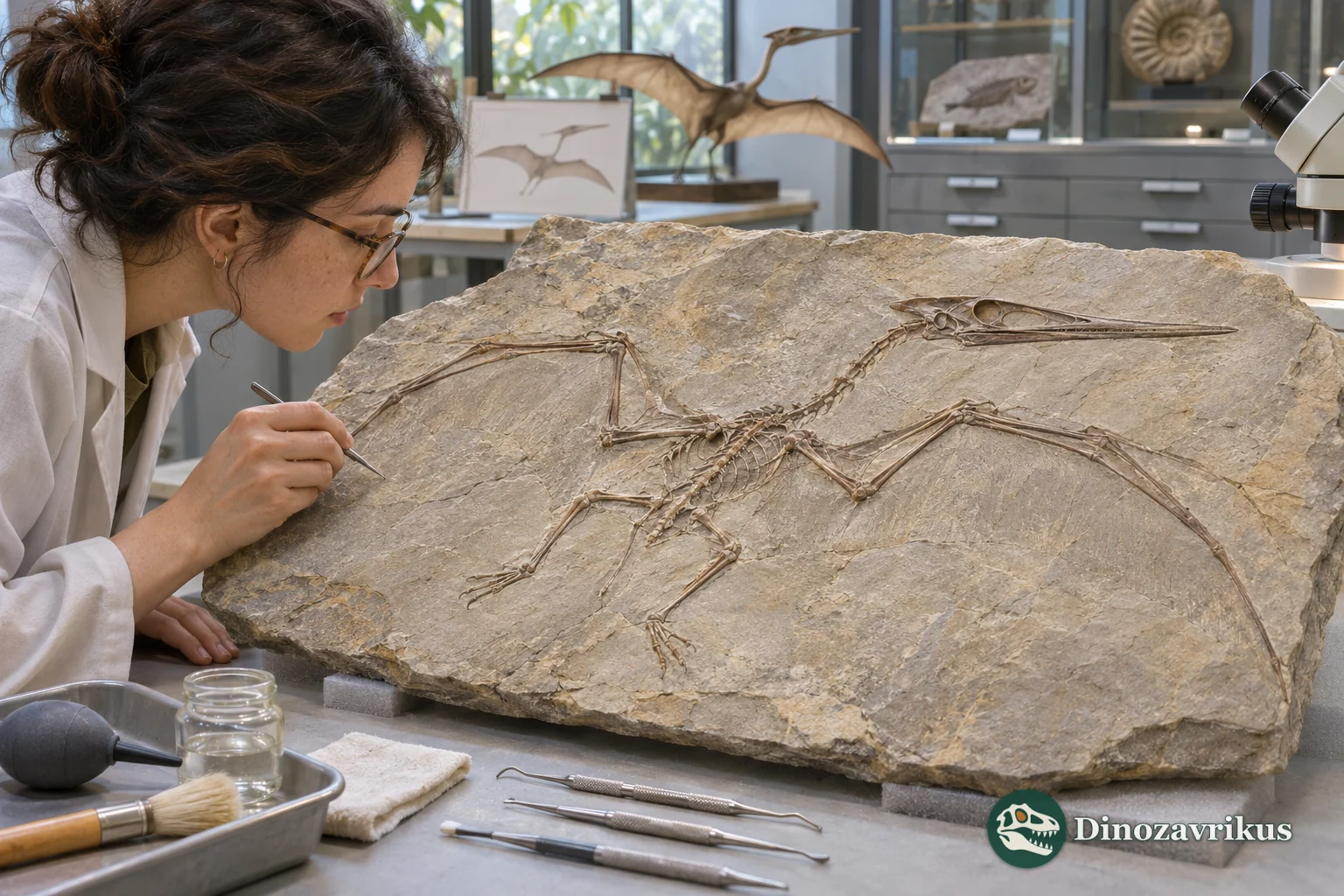
The slab contains an almost complete but compressed skull, cervical and front dorsal vertebrae, a sternum, shoulder elements and much of the wings. The pelvis, femora and most other hind-limb bones are absent. This was an early Jehol pterosaur find for which skull and wing anatomy could be examined together. Eosipterus from the same wider region lacks a skull, so it does not offer the same jaw comparison.
A low skull with pointed teeth
The skull of the only Haopterus specimen measures about 145 mm. It is low and elongated, ending in a pointed snout, without a bony crest at the rear. Front teeth are slender and pointed while teeth farther back differ in their bases. The original authors recorded twelve teeth in the upper and lower rows and measured wing elements including an ulna around 101–102 mm long.
The first description proposed fish eating from the sharp teeth. That is a feeding hypothesis, not a recovered meal: no prey or stomach contents were reported. The freshwater deposits establish the burial setting without documenting a particular hunt.
A juvenile and a new look inside the slab
The original authors regarded the specimen as immature and estimated a span of up to about 1.35 m. The 2024 redescription also treats IVPP V11726 as a juvenile. The figure therefore cannot be used as the measured maximum size of an adult Haopterus; no adult skeleton is known.
Compression and overlapping bones made details difficult to identify. Researchers used micro X-ray laminography in 2024 to inspect the skull, sternum, scapula and humerus and refine their anatomical description. This was a new study of the existing holotype, not the discovery of a second skeleton.
Changing hypotheses of kinship
The 2001 paper assigned Haopterus to Pterodactylidae. Subsequent studies proposed several alternatives. The broader 2024 analysis placed it among istiodactyliforms within Pteranodontoidea, while noting that its long front skull and extended mixed tooth row distinguish it from true istiodactylids.
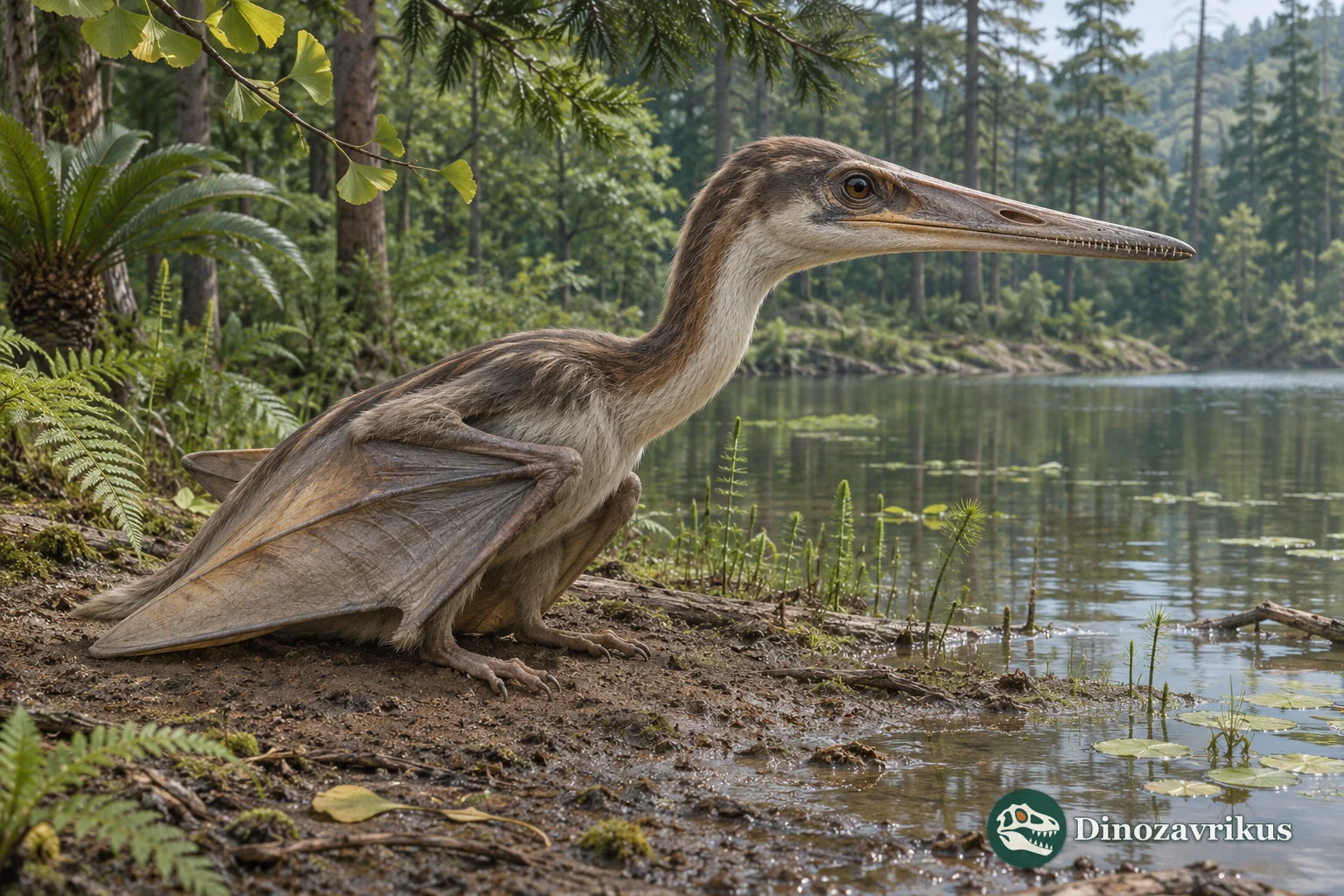
Mimodactylus has been recovered near Haopterus in an earlier analysis. That proximity is a hypothesis from compared characters, not an observable connection between their fossils. The cover's flying animal and the lakeshore scene reconstruct colour, soft tissues and behaviour beyond the preserved bones.
Frequently asked questions
Where was Haopterus found?
The only described specimen came from Sihetun in western Liaoning, in the Jianshangou beds of the Early Cretaceous Yixian Formation.
Did its skull survive?
Yes. Holotype IVPP V11726 includes an almost complete but strongly compressed skull about 145 mm long.
Was its 1.35-metre wingspan an adult measurement?
No. It was an estimate based on the juvenile holotype. The size of an adult is unknown.
Is fish eating proven?
No. Pointed teeth prompted that suggestion, but no direct prey remains or stomach contents were reported.