

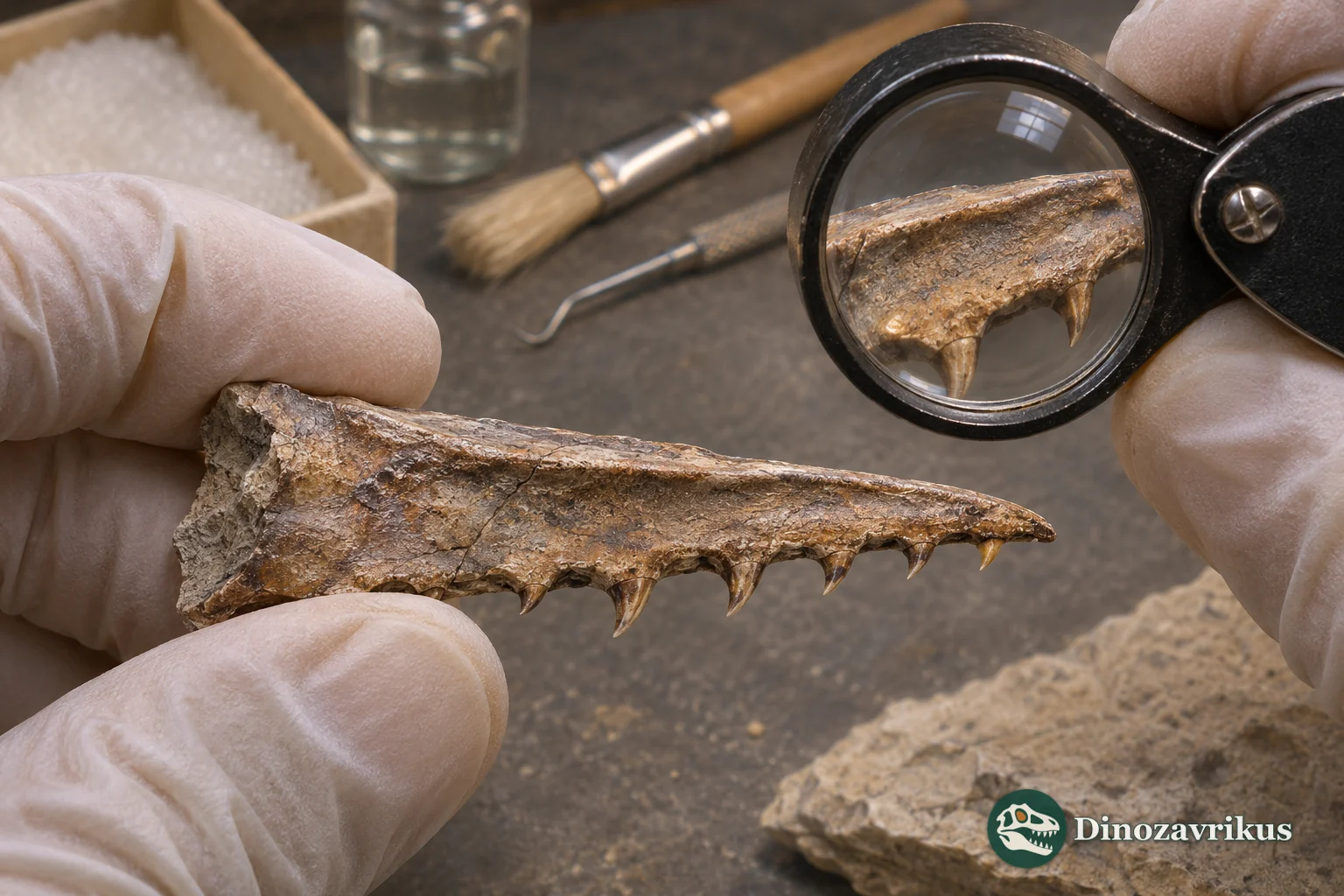
Harpactognathus gentryii was named from the toothed front of a skull in Late Jurassic Wyoming. Its thin bony crest and notched jaw margin survive, but no complete skull or wing belongs to the type. A roughly 2.5-metre span is comparative, and a humerus reported in 2025 from the same quarry is assigned to the species only tentatively.
Quick facts
| Scientific name | Harpactognathus gentryii, Carpenter and colleagues, 2003 |
|---|---|
| Holotype | NAMAL 101, front portion of the upper jaw |
| Locality | Bone Cabin Quarry area, Wyoming, USA |
| Rock and age | Morrison Formation, Late Jurassic |
| Distinctive anatomy | Thin midline crest and deep notch in the tooth margin |
| Wingspan | About 2.5 m by comparison with Scaphognathus |
| Additional bone | A quarry humerus was referred tentatively in 2025 |
What can the fossils tell us?
NAMAL 101 is a front skull fragment bearing a thin midline bony crest and a deep embayment of the dental margin. It preserves no complete skull, tail or wing.
A lower-jaw fragment from the quarry has more tightly spaced sockets. The original authors did not securely associate it with the type snout.
The 2.5-metre wingspan was inferred from Scaphognathus proportions. No wing bone is part of the named holotype.
A large Bone Cabin humerus described in 2025 resembles a scaphognathine and matches the inferred size. It was not found articulated with the type snout.
A small fragment from a large quarry
An anterior skull fragment, NAMAL 101, came from the Bone Cabin Quarry area of Wyoming. Kenneth Carpenter, David Unwin, Karen Cloward, Clifford Miles and Clark Miles named it Harpactognathus gentryii in 2003, honouring field volunteer Joe Gentry. The late Jurassic rocks belong to the Morrison Formation. The site's beds were correlated with the upper Salt Wash Member recognised elsewhere, rather than being a complete section of that member at this locality.
The type is a front snout, not a complete skeleton. It was among the first identifiable Morrison pterosaur cranial fragments. A thin bony crest runs along the preserved top margin; the tooth-bearing margin has a deep embayment. These visible features supported the authors' scaphognathine diagnosis.
Teeth and an unassigned lower jaw
Sockets for comparatively large, spaced teeth survive on the rostrum, but not every crown does. A taller soft-tissue crest is imaginable, yet only the low bony part is evidence. The missing back of the skull and all the unpreserved body parts cannot be drawn directly from NAMAL 101.
A lower-jaw fragment from the same quarry has more closely packed sockets. Carpenter and colleagues did not confidently unite it with the type. Nearby fossils need not represent one animal or even one species.
An estimated span and a later arm bone
The 2003 authors estimated a span of about 2.5 m by comparing the partial rostrum with proportions of Scaphognathus. They did not measure a Harpactognathus wing. Dearc offers a separate example of a large Jurassic pterosaur represented by a much more complete skeleton, so its size rests on different evidence.
In 2025 Michael Sprague and Matthew Mclain described a large humerus from Bone Cabin Quarry. Its shape indicates scaphognathine affinities and its size accords with the inference for Harpactognathus. The authors made a tentative referral only: the bone was not articulated with NAMAL 101 and comparable humeri are incompletely known. A pneumatic opening at its distal end is an observation about the humerus, not a feature directly observed in the type snout.
Floodplain setting and reconstructed life
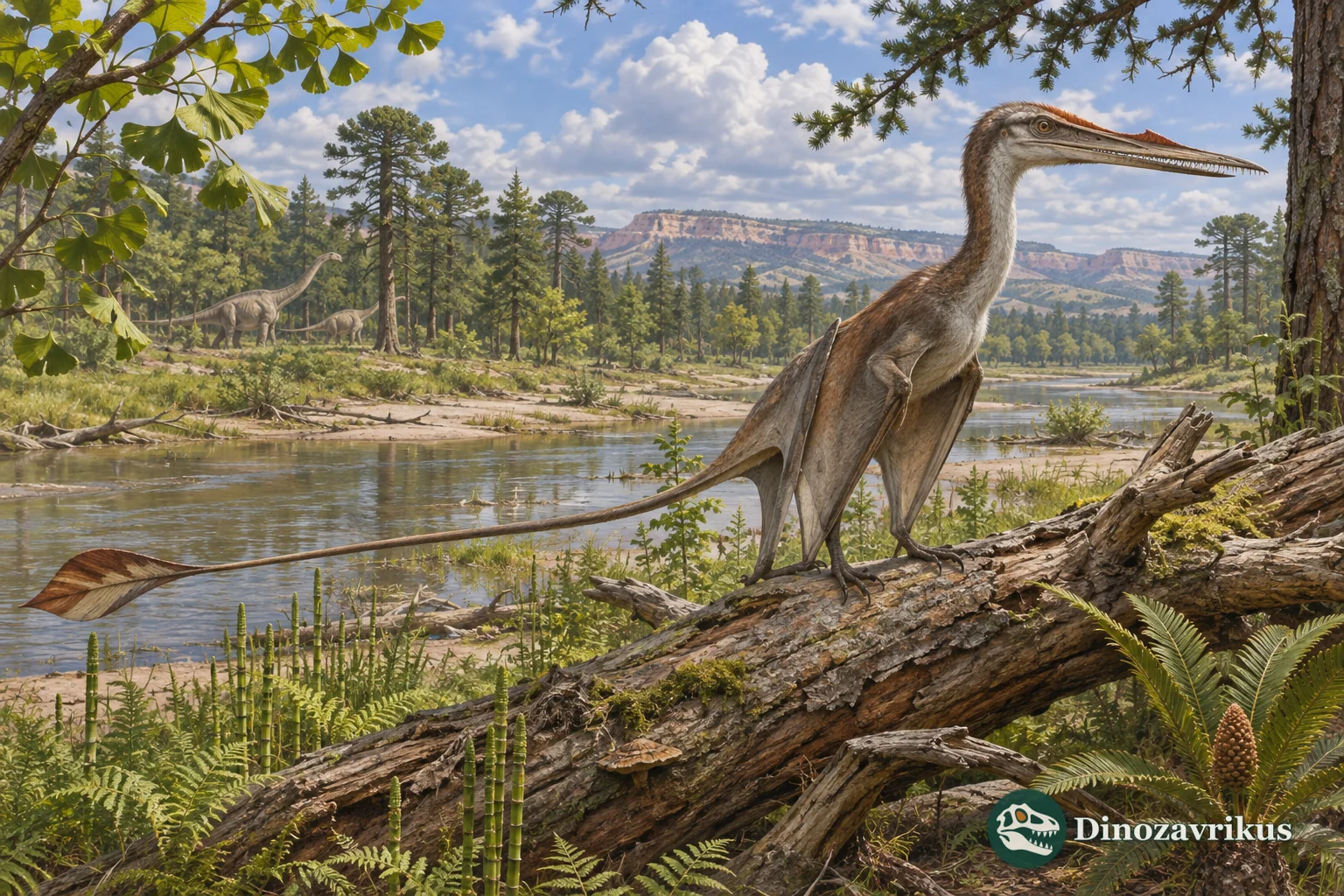
Morrison deposits record rivers and floodplains across western North America. They give a broad environmental context, not a feeding record for this individual. Teeth imply animal prey, but no direct food remains establish a species of prey or a particular hunting technique. Cuspicephalus from other Late Jurassic rocks illustrates pterosaur skull diversity without providing a model for this animal's whole body.
The cover and riverside scene show a possible long-tailed pterosaur. Tail shape, membranes, colour and pose are reconstructed from relatives; NAMAL 101 does not preserve them.
Frequently asked questions
Where was Harpactognathus found?
Holotype NAMAL 101 came from the Bone Cabin Quarry area in Wyoming, in the Late Jurassic Morrison Formation.
Is its complete skeleton known?
No. The reliably named type material is the front of the skull. A quarry humerus has only been tentatively referred to it.
Was its 2.5-metre wingspan measured from wings?
No. It was estimated from the snout using the proportions of another pterosaur, Scaphognathus.
What did it eat?
Its teeth suggest animal prey, but no direct food remains establish particular prey or hunting behaviour.