

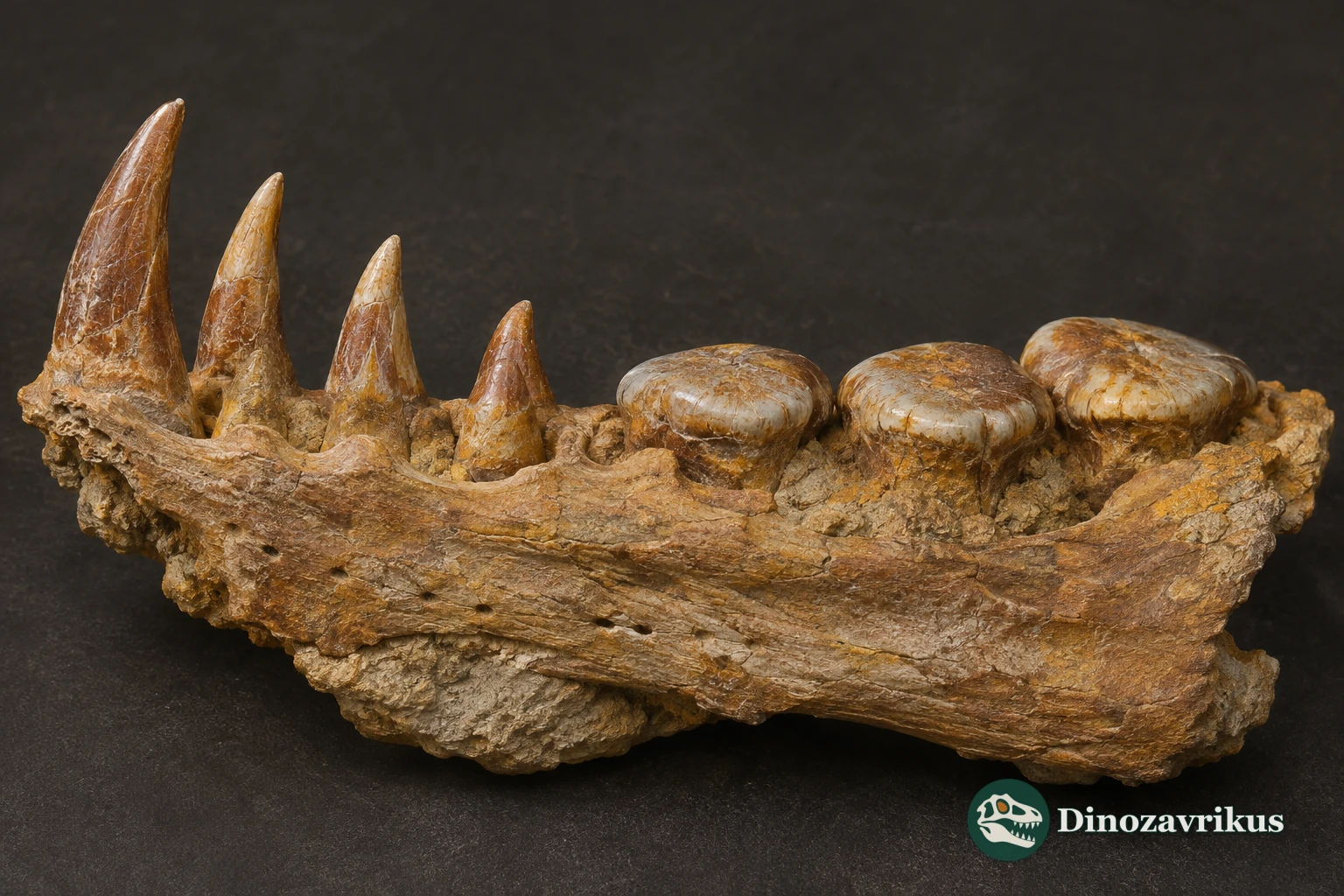
Hassiacosuchus haupti was a short-snouted alligatoroid from the middle Eocene of Germany. Pointed teeth at the front of its jaws gave way to broad, rounded crowns at the back. These rear teeth could crush hard foods, although the fossils do not establish what it regularly ate.
Quick facts
| Species | Hassiacosuchus haupti |
|---|---|
| Group | Alligatoroid |
| Age | Middle Eocene, Lutetian |
| Locality | Messel near Darmstadt, Germany |
| Principal fossil | Skull and lower jaw, specimen 4415 |
| Distinctive feature | Broad, rounded rear teeth |
What can the fossils tell us?
The type specimen was described from the Messel Pit. Lake sediments preserved animals that lived in the water and the surrounding area.
Pointed front teeth give way to broad and rounded rear ones. The wider crowns could have crushed hard foods.
The relative positions of bones at the front of the eye socket help separate Hassiacosuchus from similar North American alligatoroids.
Fossils from Messel
Karl Weitzel described Hassiacosuchus in 1935 from fossils found at the Messel Pit. The skull and associated lower jaw were registered as specimen 4415 in the Hessian State Museum in Darmstadt. Weitzel also illustrated a second skull from Messel that he attributed to a younger individual.
The material comes from sediments deposited in a middle Eocene lake. They record the place of burial, while the time the animals spent in the water is harder to infer.

What the rounded teeth could do
The original description recorded three broadened teeth at the rear of the upper jaw and four in the lower jaw. They have rounded crowns, while larger pointed teeth occur near the front. The different shapes are consistent with gripping food near the front and crushing it further back.
Shells and other hard items fit that interpretation, but tooth shape alone cannot identify the prey. Direct food remains or additional evidence, such as distinctive wear on the crowns, could help test it.
From similar teeth to differences in the skull
The rounded rear teeth resemble those of the North American Allognathosuchus. In 1966 Dietrich Berg placed the Messel animal in that genus as Allognathosuchus haupti.
In 2004 Christopher Brochu recommended retaining Hassiacosuchus for the Messel species. One point of comparison was the relationship of two bones in front of the eye socket. The lacrimal extends further forward than the prefrontal in Hassiacosuchus. Their positions are reversed in a skull used in the study to represent the type species of Allognathosuchus.
Frequently asked questions
When did Hassiacosuchus live?
The Messel finds are Lutetian in age, within the middle Eocene.
Where is the type specimen held?
The original description records the type as specimen 4415 in the Hessian State Museum in Darmstadt.
Did Hassiacosuchus eat molluscs?
Its broad rear teeth could handle shells and other hard foods. Tooth form alone cannot establish which animals it ate.
Why does the species have an alternative genus name?
Some researchers grouped the Messel species with Allognathosuchus after comparing their jaws. Later work supported keeping Hassiacosuchus as a separate genus.