

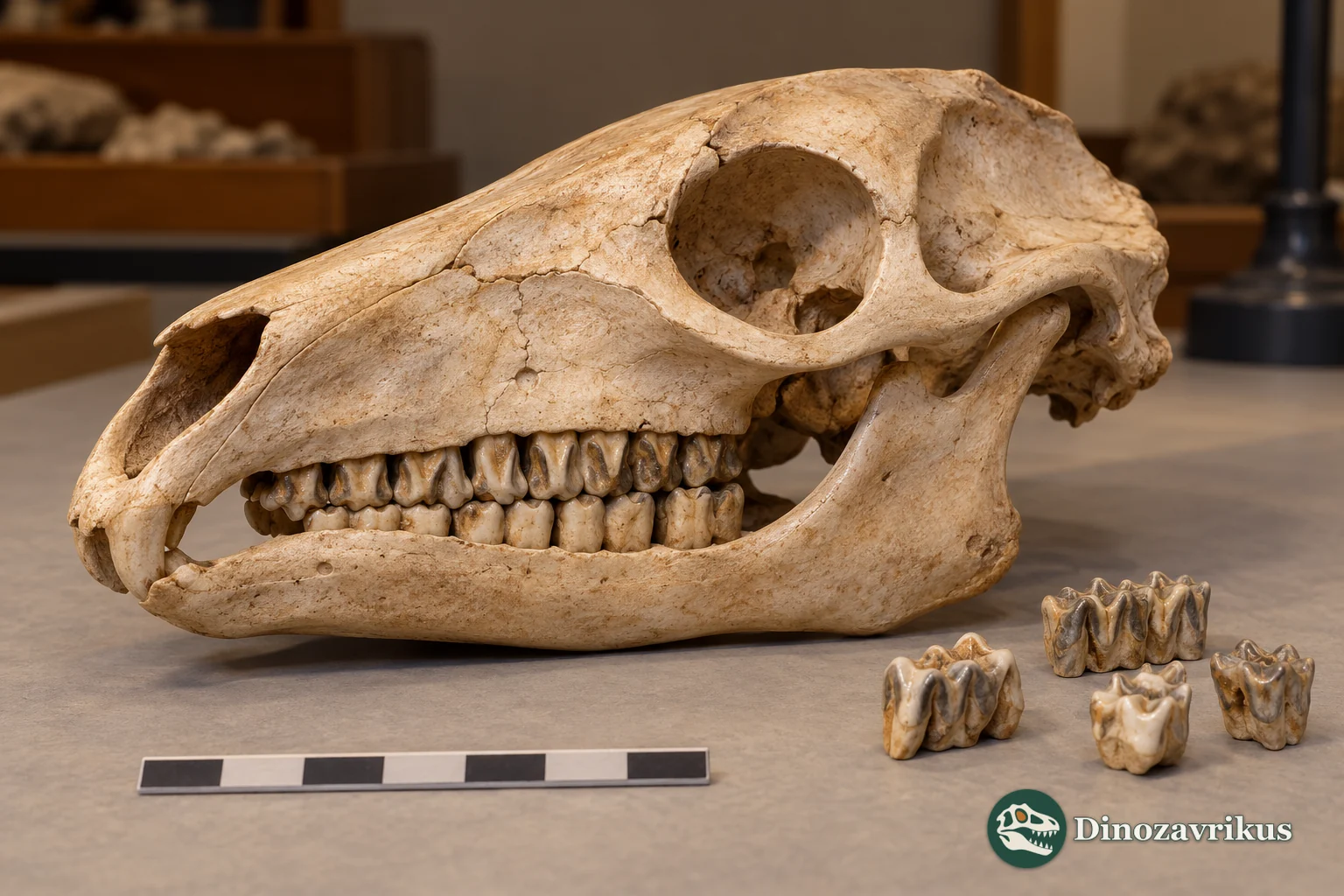
Hegetotherium was a South American notoungulate distinguished by large upper incisors that converged near the midline. A substantially complete skull and mandible of H. mirabile provide direct evidence for the unusual muzzle and cheek teeth, while many other finds are isolated teeth or fragments.
The genus belongs in the ancient mammal catalogue. Its contemporary notoungulate Interatherium offers a useful contrast: the two belonged to different families and their skulls show distinct dental arrangements.
Quick facts
| Scientific name | Hegetotherium Ameghino, 1887 |
|---|---|
| Type species | Hegetotherium mirabile Ameghino, 1887 |
| Group | Notoungulata, family Hegetotheriidae; usually Hegetotheriinae |
| Age | Miocene; exact intervals vary among species and localities |
| Range | Argentina and Bolivia; some referred records need taxonomic review |
| Important material | Skulls, jaws, teeth and some associated postcranial bones |
| Feeding proposal | Wood-boring grubs were proposed from skull anatomy, not directly observed |
| Open issue | Species synonymy and the paraphyly of the genus in a 2019 analysis |
What can the fossil evidence tell us?
McCoy and Norris described YPM VPPU 015542, a substantially complete skull and lower jaw with associated postcranial elements. It documents the muzzle, incisors and cheek teeth, but does not turn all isolated finds into one skeleton.
The enlarged upper first incisors, high-crowned cheek teeth and grooves on molars can be inspected directly. Their combination helps diagnose material; a single isolated tooth is less informative than a row preserved in its jaw.
Seoane and Cerdeño synonymized four names with H. mirabile, returned H. novum from Prohegetotherium, and found the genus paraphyletic in their analysis. H. cerdasensis was separately named from Bolivia in 2016.
Large incisors and cranial features led McCoy and Norris to propose that H. mirabile may have opened wood to reach grubs. No stomach contents or direct feeding traces establish that behaviour.
Name, type species and museum material
Florentino Ameghino established Hegetotherium in 1887; H. mirabile is its type species. The genus and its species were repeatedly reinterpreted as palaeontologists compared teeth collected from different beds. A later name is not a separate biological species merely because it once appeared in a list: it must be supported by diagnostic differences.
The detailed cranial study by Dakota McCoy and Christopher Norris centred on YPM VPPU 015542, a substantially complete skull and mandible from the Santa Cruz Formation, with associated postcranial elements. They also compared specimens from Yale Peabody Museum and the American Museum of Natural History. The Smithsonian holds a different H. mirabile skull collected in Patagonia by Barnum Brown in 1899. That specimen is a museum record, not the name-bearing holotype.
Miocene localities and age
The best-known Argentine material of H. mirabile comes from the Santa Cruz Formation of Patagonia. H. novum is associated with Colhuehuapian faunas in Chubut. A separate species, H. cerdasensis, was named from the Cerdas beds of Bolivia, an early middle Miocene assemblage; some material from nearby Nazareno was referred to it cautiously.
These faunal ages are established by stratigraphic position and the accompanying mammal assemblage. South American land-mammal ages are biochronological units, not exact dates for each bone. The genus-wide interval therefore depends on which species and referred records a study accepts.
Species and changing synonymies
In their 2019 revision of Hegetotherium and Pachyrukhos, Federico Seoane and Esperanza Cerdeño recognized H. mirabile as the only hegetothere in the Santa Cruz Formation. They treated H. convexum, H. anceps, H. minum and H. andinum as synonyms of H. mirabile. This means their comparative study did not find enough diagnostic separation to retain those names as distinct species.
The same revision removed H. novum from Prohegetotherium and returned it to Hegetotherium, after an earlier classification had moved it elsewhere. H. cerdasensis, described from Bolivia in 2016, is distinguished in part by the smooth buccal surface of the lower third molar where H. mirabile bears a sulcus. The Bolivian material includes associated craniodental elements, isolated teeth and small bone fragments, not a complete skeleton.
The 2019 phylogenetic analysis recovered Hegetotheriidae as monophyletic but found Hegetotheriinae and Hegetotherium paraphyletic in the sampled tree. A paraphyletic result describes the sampled relationships; it does not by itself erase the genus name. It does show why family and subfamily labels should be tied to the analysis being discussed.
Skull, incisors and locomotion
The upper first incisors of H. mirabile were enlarged, forward-projecting and convergent near the midline. McCoy and Norris contrasted this shape with the chisel-like incisors of rodents. The cheek teeth were high-crowned and continuously growing, features also seen in other hegetotheriids. A deep zygomatic arch and a shortened muzzle contribute to the distinctive skull profile.
The teeth were set in the jaw in a distinctive arrangement, and the cheek teeth bear grooves and other features compared among species. Such details help classify isolated remains, but wear changes crown relief through life and can make comparisons between specimens difficult. Postcranial remains support a terrestrial animal, yet available material does not provide a measured running speed or a full account of its gait.
Diet: plant eater or wood-boring feeder?
Small hegetotheres have often been compared with rabbits or rodents because of their general size and some limb similarities. These comparisons are ecological analogies, not evidence of close relationship. McCoy and Norris proposed a different feeding mechanism for H. mirabile: its incisors and skull may have helped break into fallen wood to reach xylophagous grubs and other organisms.
The proposal is based on functional interpretation of cranial anatomy. It is not supported by preserved stomach contents, diagnostic coprolites or a documented feeding trace. The authors also noted complications, including the relatively large estimated mass of H. mirabile compared with living mammalian wood-borers. Its diet could have included more than one resource. The hypothesis is worth testing, but it should not be presented as a demonstrated menu.
Body size and limits of reconstruction
For H. mirabile, published estimates place body mass at roughly 6–8 kilograms. This is a comparative model-based estimate, not a direct measurement of a complete skeleton; it should not be transferred automatically to H. cerdasensis or H. novum. Tooth dimensions in the Bolivian species are measurable in millimetres, but they do not directly give body length or mass.
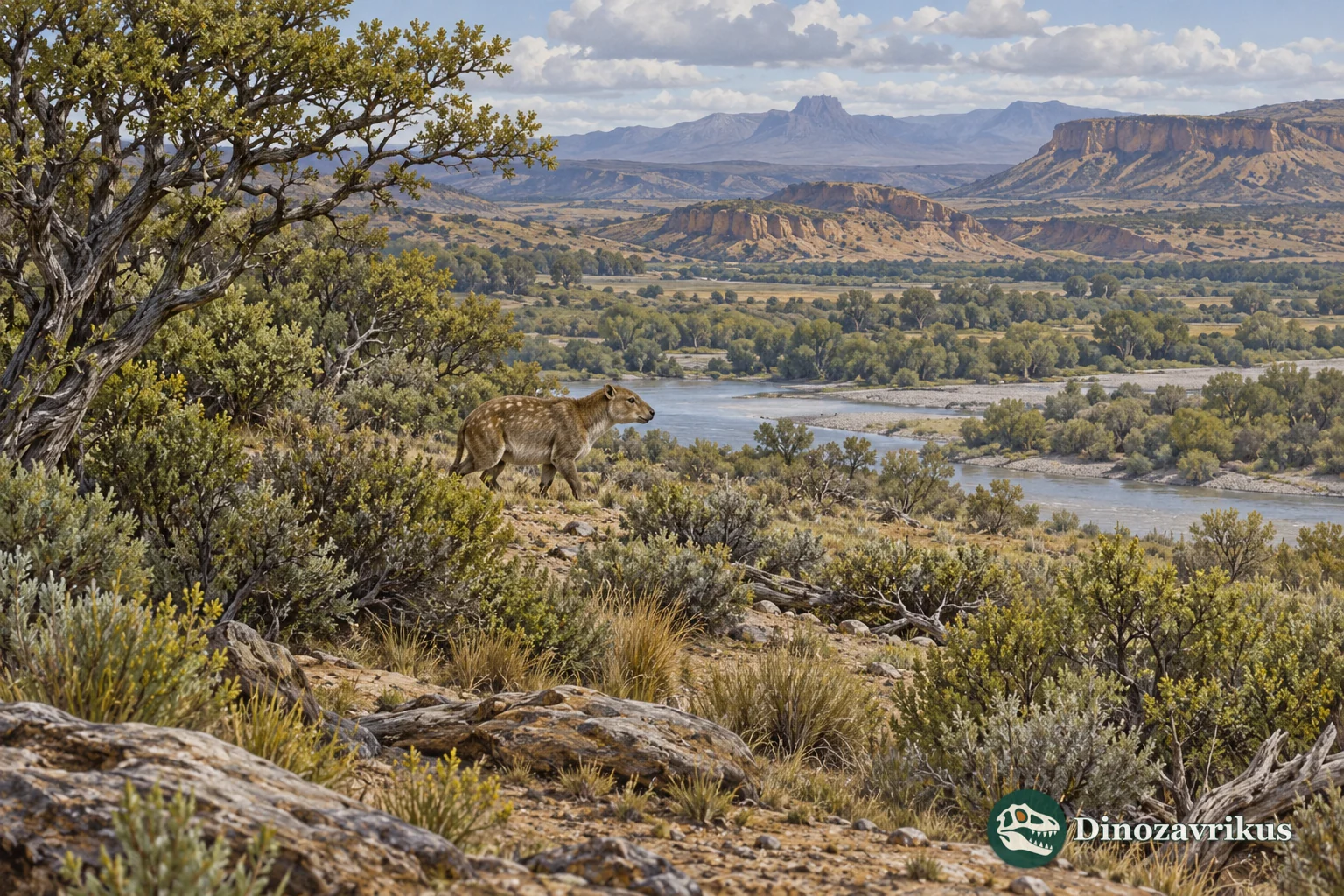
No evidence establishes coat colour, breeding behaviour, social structure or seasonal movement. The life illustration on this page is an artistic reconstruction. The skull supports the shape of the muzzle and teeth; fur, soft tissues and colour are not preserved.
Frequently asked questions
When did Hegetotherium live?
Its accepted species come from Miocene South American faunas, but their intervals differ among the Santa Cruz Formation, Colhuehuapian deposits and the Cerdas beds.
What made its incisors unusual?
The upper first incisors of H. mirabile were enlarged and converged near the midline. Their form differs from the chisel-like incisors of rodents.
Is the wood-boring diet proven?
No. It is a functional hypothesis based on skull and tooth anatomy; direct feeding traces or stomach contents have not established it.
Which names were synonymized with H. mirabile?
Seoane and Cerdeño’s 2019 revision treated H. convexum, H. anceps, H. minum and H. andinum as synonyms of H. mirabile.