

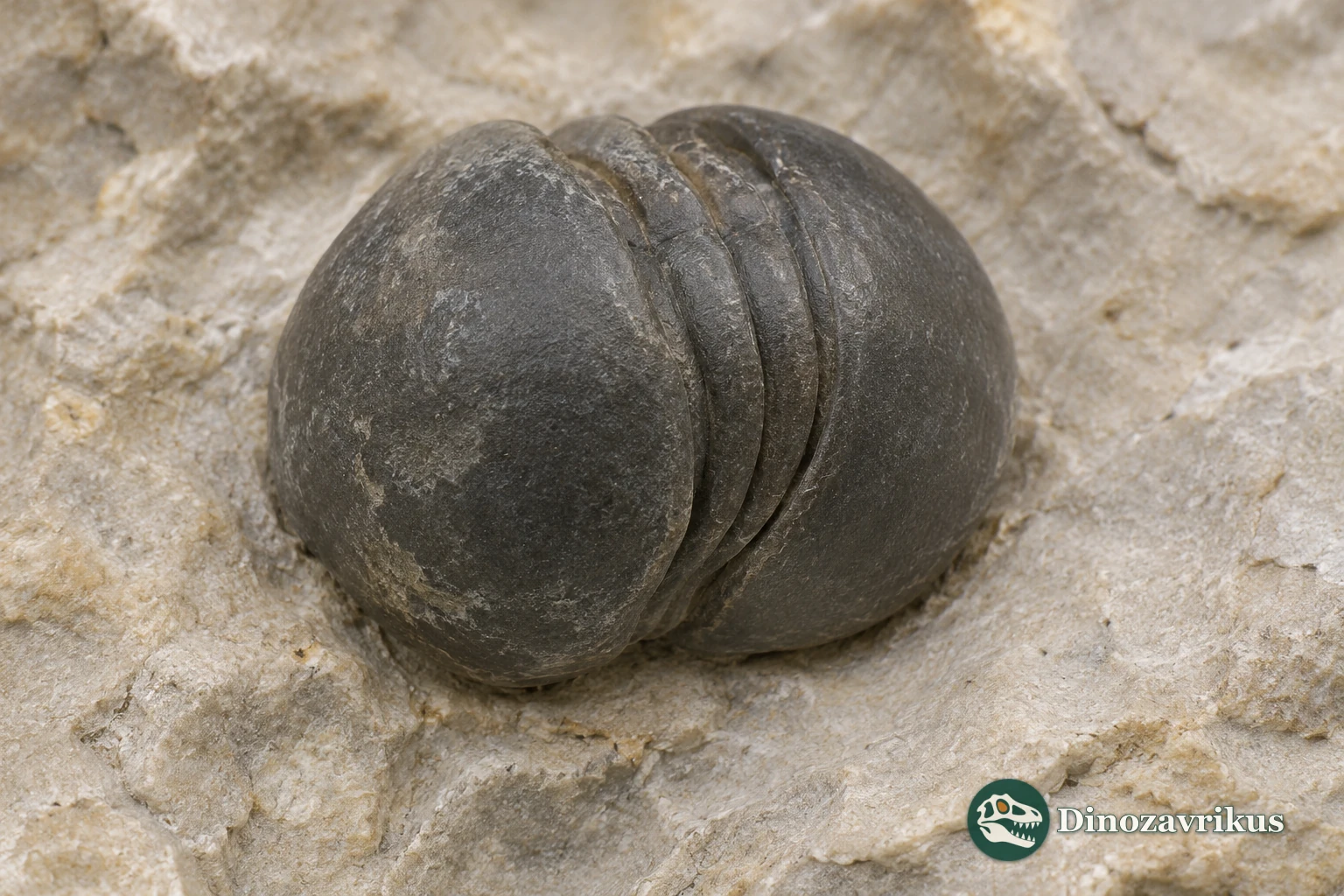
Two Helioproetus shells from Apricke in Germany’s Sauerland were preserved in different positions. One is extended. The other is curled with the head and tail shields drawn together. Seven movable segments can be seen in the enrolled fossil and in a separate specimen preserving the head and thorax.
Quick facts
| Group | Proetida |
|---|---|
| Age | Late Devonian, Famennian |
| Named by | Rudolf and Emma Richter, 1919 |
| Type species | Helioproetus ebersdorfensis |
| Thorax | Seven segments in described specimens |
| Adult eyes | Absent |
What can the fossils tell us?
A separate specimen from Apricke preserves the head with seven thoracic segments attached.
Both shields are strongly vaulted. Their rims come close together in the enrolled specimen.
That trace led researchers to infer a sighted ancestor. No actual eyes are preserved on young Helioproetus.
Naming Helioproetus
Rudolf and Emma Richter established Helioproetus in 1919. The type species is Proetus (?subgenus) ebersdorfensis, described by Rudolf Richter in 1913. Several species have also appeared under the name Typhloproetus. The revision of the Apricke fossils treated Helioproetus as a distinct genus.
Adult Helioproetus lacked eyes and cheek spines. Its cheeks are nearly smooth, in contrast to the conspicuous eye surfaces of a different Devonian proetid, Crassiproetus.
Shells from Apricke
In H. carintiacus, the head has broad fixed cheeks on either side of a narrow, raised glabella. The strongly vaulted tail has a short, tapering axis and faint transverse grooves.
SMF 57450 is extended and preserves six visible segments. Seven can be seen in the enrolled shell SMF 57453 and in a separate specimen preserving the head and thorax. A later revision suggested that the enrolled shell may belong to a juvenile, so the mature segment count remains uncertain.
Facial sutures in juveniles
Small silicified remains of H. costifusus were found near Saalfeld in Thuringia. A series of fossils of different sizes records development after the earliest larval stage, including changes in the glabella and facial suture.
In the smallest cranidia, part of the suture runs where it would border the eye region of a sighted trilobite. The authors inferred a sighted ancestor. Similar suture patterns also led them to suggest that the younger H. carintiacus in the same section might have descended from H. costifusus.

Frequently asked questions
Did Helioproetus have eyes?
The adult head shields are eyeless. A trace of the juvenile facial suture suggests that its ancestors had eyes.
How many thoracic segments can be seen in the fossils?
Seven are preserved in the enrolled shell and in a separate head-and-thorax specimen. The mature segment count remains uncertain.
Where was the enrolled specimen found?
SMF 57453 comes from Upper Devonian deposits at Apricke in the Sauerland, Germany.
What fossils show how Helioproetus grew?
Silicified shields of different sizes from near Saalfeld preserve changes in furrows and sutures as the head developed.