

Helmetia expansa was a rare Middle Cambrian arthropod whose broad, thin dorsal shield spread over much of its body. The serrated margin, prominent head spines and a tail shield carrying several more spines give it a striking outline, but many details remained poorly known for more than a century. A 2025 redescription examined 36 museum specimens and documented short antennae, 15 pairs of biramous limbs and two fossils interpreted as possible moults.
Charles Doolittle Walcott first described Helmetia in 1918 from the Burgess Shale. The ancient arthropod catalogue places it among Cambrian animals whose relationships have been revised as old collections are studied with new methods.
Quick facts
| Scientific name | Helmetia expansa Walcott, 1918 |
|---|---|
| Group | Concilitergan arthropod with a broad flattened exoskeleton |
| Age | Middle Cambrian, about 505 million years ago |
| Localities | Walcott and Raymond quarries, Burgess Shale, British Columbia |
| Type specimen | Lectotype USNM 83952, Smithsonian National Museum of Natural History |
| Studied material | 36 specimens reviewed in 2025; one is identified only to genus |
| Measured size | Holotype about 196 mm; some specimens are incomplete |
What can the fossils tell us?
The study reviewed 36 specimens at the Royal Ontario Museum and Smithsonian: 35 were assigned to Helmetia expansa and one only to Helmetia sp. The holotype USNM 83952 is about 196 mm long; other reported lengths depend on completeness and plate orientation.
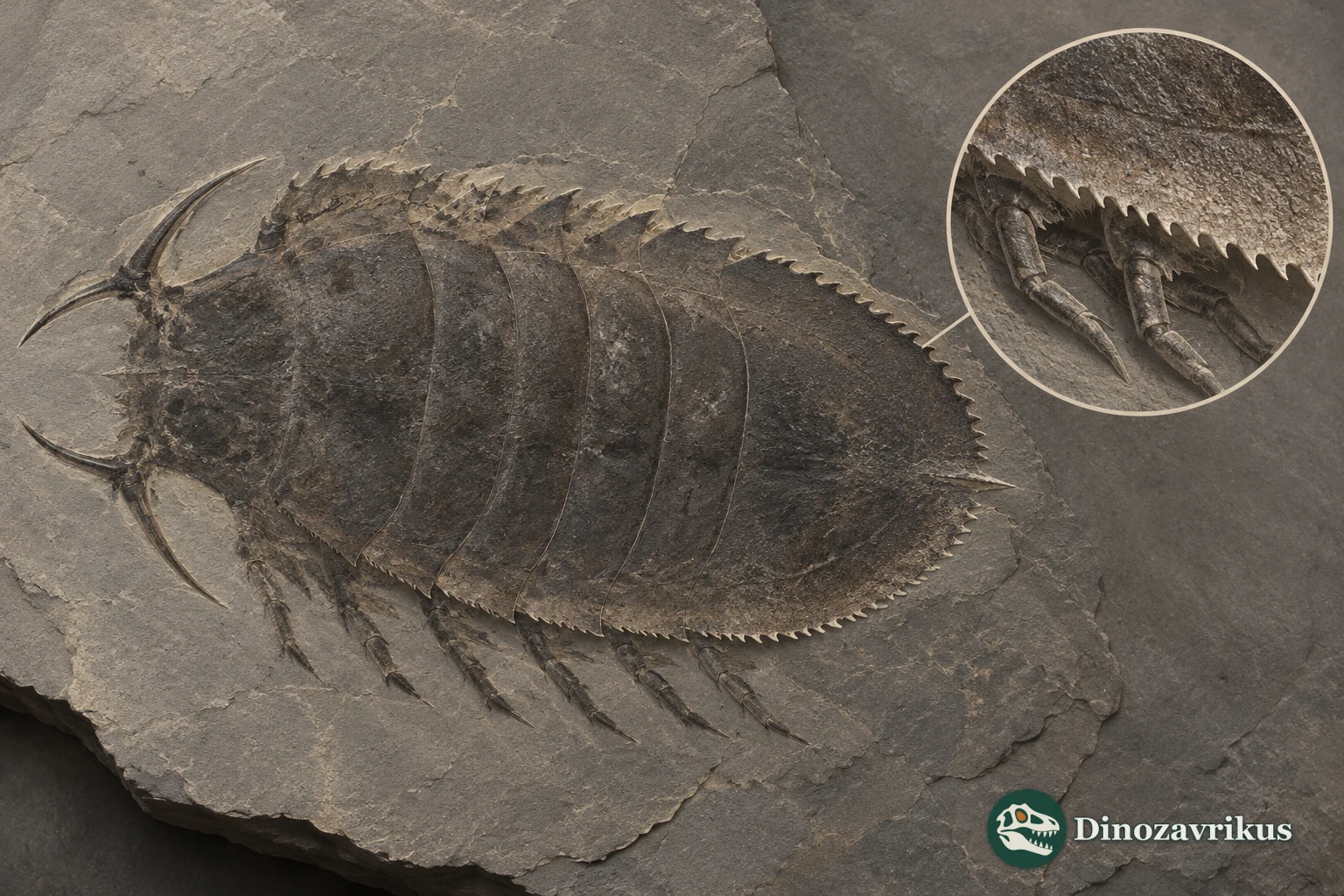
The broad, thin dorsal exoskeleton has a serrated margin, prominent anterolateral head spines, six thoracic tergites and a large pygidium. The 2025 revision describes short antennae and 15 pairs of biramous limbs, although compression obscures their positions on many slabs.
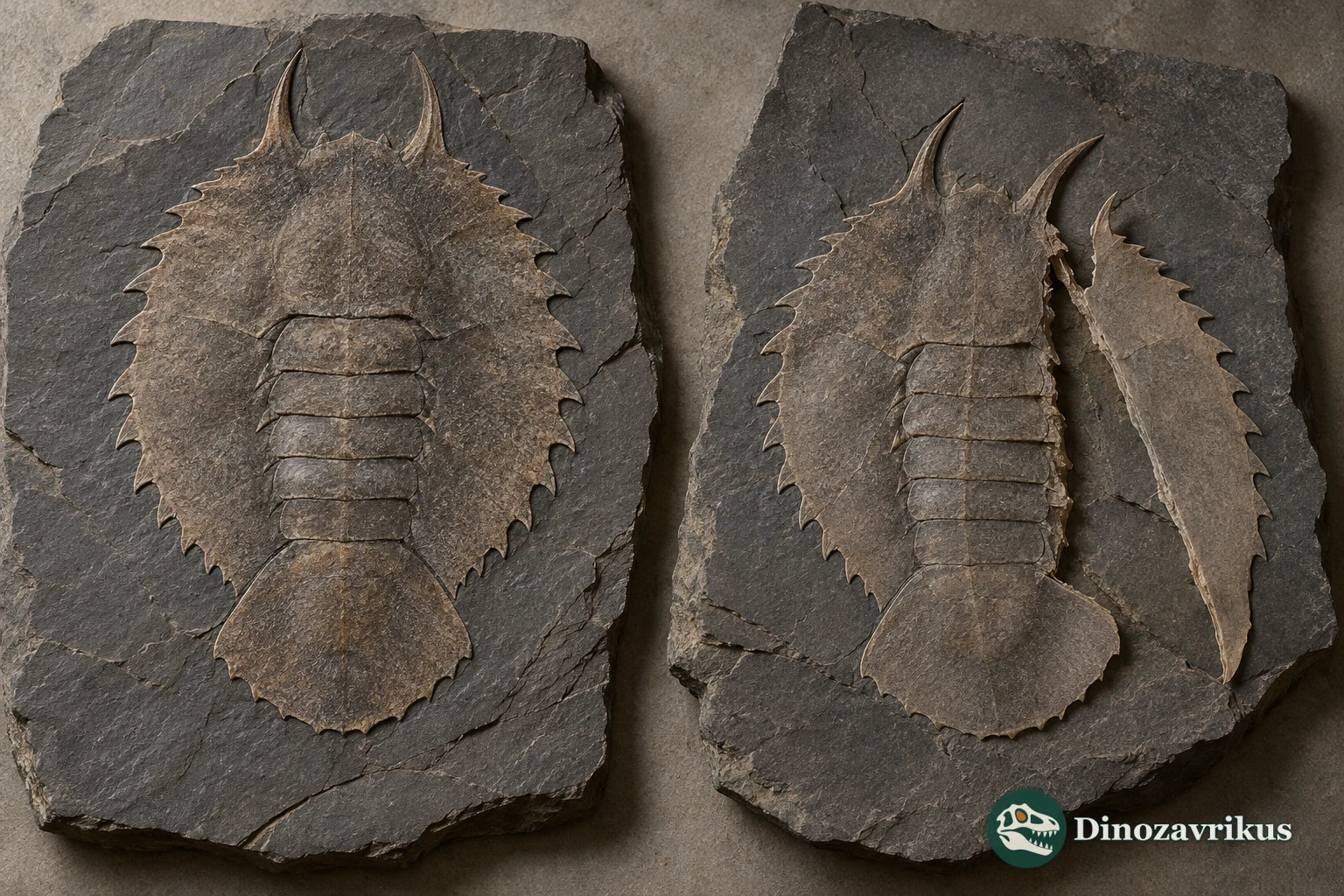
The revision identifies the first direct evidence of moulting in concilitergans. The absence of dorsal ecdysial sutures led the authors to propose release along the margin, comparable in outline to horseshoe-crab moulting; this is an interpretation of fossil arrangements.
The 2025 analysis recovered Arthroaspis as the earliest branching concilitergan and formalised Helmetiidae and Tegopeltidae. This result depends on the study's character definitions and sample, not simply on the broad shield shape.
From Walcott's type to a 36-specimen revision
Walcott described Helmetia expansa in 1918. Its lectotype, USNM 83952, is held at the Smithsonian National Museum of Natural History. The genus name refers to Helmet Mountain in the Canadian Rockies; the species epithet means spread out or expanded, a reference to its broad body. For decades, brief reviews and phylogenetic analyses repeated the outline known from the type material, while small limbs and internal structures remained difficult to assess.
In 2025, a comprehensive redescription compared 23 specimens in the Royal Ontario Museum collections with 13 at the Smithsonian. Thirty-five were assigned to H. expansa, while one incomplete ROM specimen was identified only as Helmetia sp. The study included fossils from both the Walcott and Raymond quarries on Fossil Ridge. Earlier museum summaries that say the species had never been re-examined predate this work.
A broad shield and a segmented centre
The non-mineralised dorsal exoskeleton is wide, flat and thin, with a serrated edge. The head shield bears strong anterolateral spines. Behind it are six broad thoracic tergites, each with a spine projecting from its rear corner, followed by a large pygidium. In the 2025 description, that terminal shield carries two pairs of lateral spines and one median terminal spine. The total silhouette is therefore a connected dorsal covering, not a row of independent plates.
The new study identified short antennae and 15 pairs of homonomous biramous limbs. Their inner branches are slender endopods; the outer branches have a broad lobe with thick lamellae. These delicate structures are not equally visible in every fossil. The fact that a limb is missing from one slab does not establish that it was absent in life.
What do the measurements describe?
The Smithsonian holotype USNM 83952 measures about 196 mm. ROM 61038 preserves a nearly complete individual about 130 mm long, while ROM 61136 is incomplete at the front and measures about 187 mm with its posterior shield unfolded. These values describe preserved outlines in different orientations. They are not body-mass estimates, and the incomplete, unfolded specimen should not be treated as a standard body length.
Such differences illustrate why fossil measurements need a specimen number and a description of what is included. A broad shield can fold or rotate during burial, and the narrow appendages may extend beyond its margin. No reliable mass estimate follows from these flattened fossils alone.
Possible evidence of moulting
Two specimens in the 2025 study were interpreted as the first direct evidence of moulting in concilitergans. In living arthropods, the old external skeleton has to separate or split before the animal can leave it. In a fossil slab, however, separation can also arise from decay, burial or later preparation. The researchers compared the arrangement and condition of the preserved shields to distinguish a likely exuvia from a randomly broken specimen.
They found no dorsal ecdysial sutures and proposed that Helmetia may have escaped through the margin of its broad shield, in a manner comparable to modern horseshoe crabs. This is a hypothesis about how the fossil arrangement formed. It does not record the animal actively moulting, and the analogy concerns a possible process rather than close ancestry.
Conciliterga and changing relationships
The 2025 revision placed Helmetia within Conciliterga, a group characterised by a broad, variably flattened dorsal exoskeleton. It formalised Helmetiidae for Helmetia, Rhombicalvaria, Haifengella and Kuamaia, and Tegopeltidae for Tegopelte, Skioldia and Saperion. Its phylogenetic analysis recovered Arthroaspis bergstroemi from the early Cambrian Sirius Passet of Greenland as the earliest branching concilitergan.
This is the result of a particular character matrix and set of anatomical interpretations, not a final tree of every arthropod. A broad shield alone is not enough to establish close relationship; segment boundaries, spines, limb structure and internal anatomy all matter. The revised grouping also changes how researchers compare Helmetia with Tegopelte and other flattened Cambrian forms.
Ecology and what the fossils leave unknown
ROM's older ecological account proposed slow swimming and possible suspension feeding from the flat body and filamentous limb branches. The 2025 revision supplies a more detailed limb description, but lamellae alone do not demonstrate a particular feeding action. No identified gut contents establish a diet, and the fossils do not preserve colour or swimming speed. Active pursuit of fast prey seems difficult to reconcile with the broad, non-streamlined shield, but this remains a functional inference.
Helmetia is known from marine deposits in the Burgess Shale and was rare in both the Walcott and Raymond quarry samples. Its distribution across those localities does not mean every animal lived in exactly the same microhabitat or at the same moment. These fossils belong to the marine ecosystems of the Cambrian Period, where soft-bodied preservation reveals structures usually lost from the fossil record.
Evidence, inference and reconstruction
| Direct evidence | Broad serrated exoskeleton, head and pygidial spines, six thoracic tergites and limb impressions |
| Research inference | Concilitergan placement, suspension feeding and marginal moulting |
| Uncertain | Exact movement, diet, swimming speed and detailed life history |
| Artistic reconstruction | Colour, soft tissues and a particular living posture |
Frequently asked questions
When did Helmetia expansa live?
Helmetia is known from the Middle Cambrian Burgess Shale, about 505 million years ago, including the Walcott and Raymond quarries.
How large was Helmetia?
The holotype USNM 83952 is about 196 mm long. Other fossils are incomplete or differently oriented, so their measurements are not directly interchangeable.
What did the 2025 redescription add?
It compared 36 museum specimens, described 15 pairs of biramous limbs and identified two fossils as possible evidence of moulting.
Did Helmetia filter food from the water?
Suspension feeding has been proposed from its broad body and filamentous limb branches, but no fossil directly records a feeding event or identifies its food.