

Heterohyus was an Eocene apatemyid mammal whose most distinctive feature is visible in nearly complete skeletons from Messel, Germany: the second and third fingers of the forelimb are unusually long. That anatomy inspired the idea that it reached invertebrates hidden in wood, but no fossil records a feeding event.
The genus is included in the ancient mammal catalogue. Its specialized hand can be compared with that of another apatemyid, Labidolemur, while the two genera still need to be considered on their own fossil evidence.
Quick facts
| Scientific name | Heterohyus Gervais, 1848 |
|---|---|
| Group | Apatemyidae; extinct placental mammals |
| Age | Eocene; records come from several intervals and faunas |
| Geographic range | Europe, with related apatemyid records elsewhere |
| Best-known species | H. nanus from Messel, Germany |
| Known remains | Teeth and jaws; nearly complete skeletons of H. nanus |
| Forelimb feature | Especially elongated second and third fingers |
| Size of H. nanus | About 14 cm body length plus a 15–17 cm tail, per Messel site facts |
| Diet | Probably invertebrates; bark-probing remains an inference |
What can the fossils tell us?
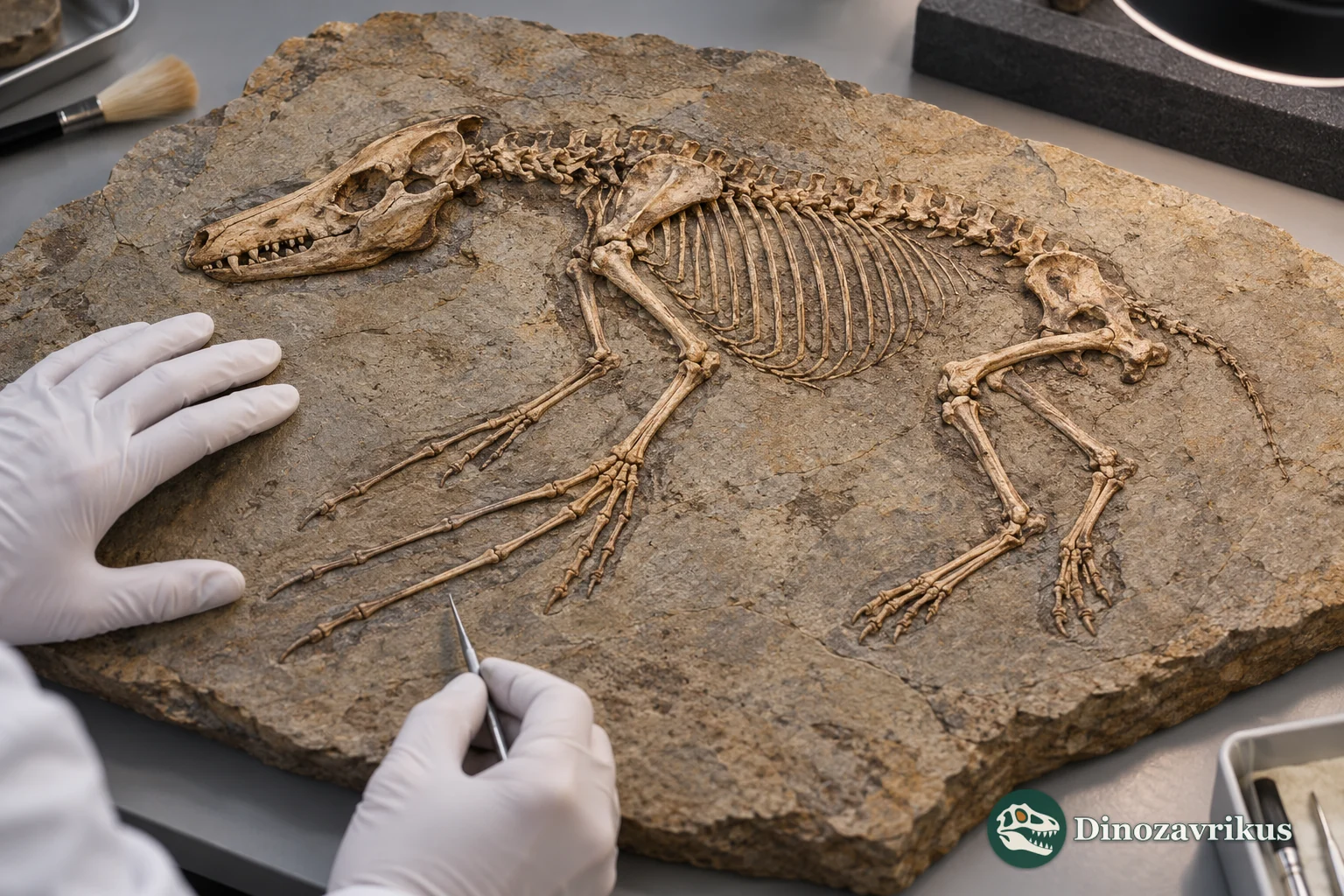
Nearly complete Heterohyus nanus skeletons from the Messel oil shale preserve the tail, limb proportions and elongated fingers. They provide direct anatomical evidence, although soft tissues and behaviour remain only partly known.
The second and third forefinger elements are especially elongated. This anatomy is compatible with extracting invertebrates from wood, but the fossils do not preserve the act of feeding or identify a specific prey item.
Prominent incisors may have helped open bark. This is a functional interpretation based on anatomy and comparison with living mammals; it does not prove that Heterohyus fed in exactly the same way.
Gervais named Heterohyus for a mandible from Lutetian Bouxwiller. The historical specimen was already unlocated in a 1921 review. The better-preserved Messel skeletons belong to H. nanus, not to the genus type specimen.
The name and its changing taxonomy
Paul Gervais introduced Heterohyus in 1848 for a lower jaw from Lutetian deposits at Bouxwiller, in Alsace. The fragment preserved cheek teeth and the root of a large incisor extending beneath the molars. In 1921, Pierre Teilhard de Chardin reported that the original specimen could not be located. He compared its published illustration with later fossils and treated names such as Necrosorex and Heterochiromys as referring to the same genus.
Museum catalogues later reassessed several European names. The Basel type catalogue, for example, lists Heterochiromys fortis as Heterohyus armatus, H. gracilis under its current combination, and both Calamodon europaeus and Phenacodus minor as H. europaeus. These are synonymy decisions based on named type fossils; they do not mean all specimens came from one individual.
The Messel skeletons
Nearly complete skeletons of H. nanus are known from the middle Eocene oil shale at Messel. In 1990, Wighart von Koenigswald described three such specimens and compared the skull, teeth and limbs. Later work also discussed a Messel specimen with unusual preservation of soft parts. The site is dated to about 47 million years ago; that age belongs to the geological context, not to an exact individual event.
The skeletons show a small body, a long tail and strongly unequal finger lengths. The Messel site factsheet gives a body length of about 14 centimetres and a tail length of 15–17 centimetres for H. nanus. Those measurements should not be generalized to every species assigned to Heterohyus.
Long fingers and a feeding hypothesis
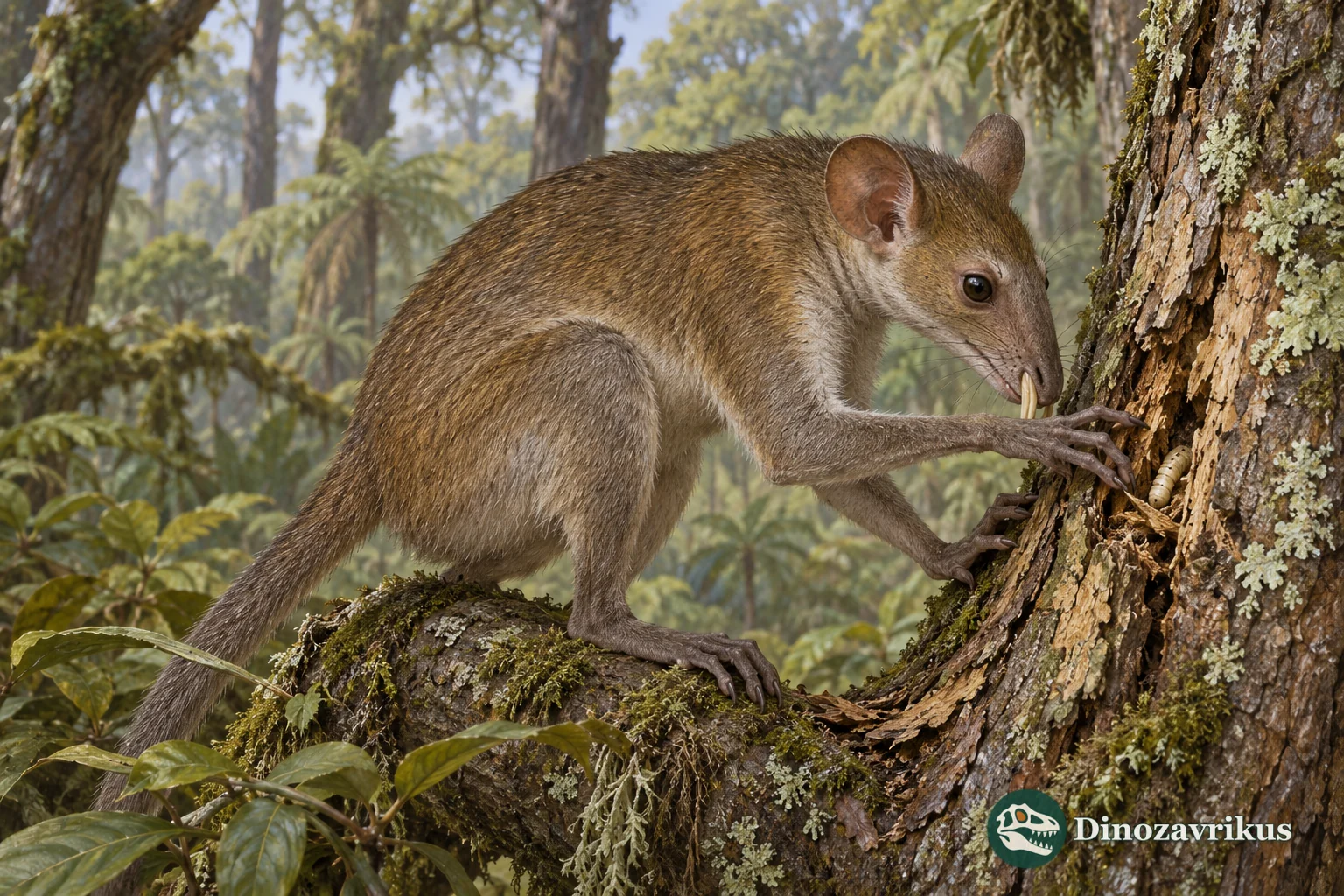
The second and third fingers of the forelimb are especially elongated, including their metacarpal bones. Together with the large front teeth, this led researchers to compare Heterohyus with living mammals that open bark and extract hidden invertebrates. This is a functional hypothesis, not a directly observed action: neither prey inside the mouth nor diagnostic gut contents have been reported for the genus.
Similar specializations evolved independently in distantly related mammals. A comparison with the aye-aye of Madagascar or striped possums of New Guinea does not imply close ancestry. Finger proportions also vary among apatemyids, so one feeding reconstruction should not automatically be assigned to every species.
Age, range and relationships
The genus name first applied to Lutetian fossils from Bouxwiller. Later species were described from Egerkingen, the Quercy phosphorites and other European sites. H. nanus is associated with middle Eocene Messel. Other records come from separate regional faunas, so the broad Eocene range of the genus should not be read as one continuous species range.
Heterohyus belongs to Apatemyidae. Higher relationships among apatemyids and other placental mammals have changed across phylogenetic analyses. Similar teeth or hands in rodents and primates reflect specializations, not a relationship established by one anatomical resemblance. The fossil record is clearest about the hand of H. nanus; it is less complete for species known mainly from jaws and teeth.
What can and cannot be reconstructed
Messel skeletons allow discussion of limb and tail proportions, and in rare cases of soft-tissue preservation. Other species remain known chiefly from dental material. The fossils do not establish an exact coat colour, voice, social structure or seasonal menu. Extracting larvae from bark is plausible as a functional interpretation but has not been confirmed by preserved food.
The cover shows a small mammal on a tree trunk to convey the proposed association between its elongated fingers and woody surfaces. Body posture, coat and the feeding scene are artistic choices. Fossils establish the finger anatomy and approximate size of H. nanus, not a specific feeding event.
Frequently asked questions
When did Heterohyus live?
The genus is known from the Eocene. H. nanus comes from Messel oil shale dated to about 47 million years ago, while other species belong to different regional and stratigraphic contexts.
Why is Heterohyus called long-fingered?
The second and third fingers of the forelimb are especially elongated in H. nanus. Their bones are preserved with other parts of the skeleton, allowing direct comparison of their proportions.
What did Heterohyus eat?
It probably ate invertebrates, and researchers have proposed that it extracted them from wood. This remains an inference from the teeth and fingers; no stomach contents or prey remains confirm it.
Is Heterohyus closely related to the aye-aye?
The similar feeding hypothesis does not show close relationship. Long fingers and large incisors evolved independently in Heterohyus and the aye-aye.