

Hongshanopterus lacustris lived in Early Cretaceous northeast China. The original specimen preserves a skull exposed from below and several neck vertebrae. A second specimen described in 2025 adds a lower jaw and many isolated teeth. Together they reveal more of the head, but no complete wing skeleton has been reported for the species.
Quick facts
| Scientific name | Hongshanopterus lacustris, Wang and colleagues, 2008 |
|---|---|
| Holotype | IVPP V14582, a skull and cervical vertebrae |
| New material | A second skull, lower jaw, vertebrae and teeth described in 2025 |
| Locality | Western Liaoning Province, China |
| Rock and age | Jiufotang Formation, Early Cretaceous |
| Teeth | Laterally compressed triangular crowns, extending far back along the jaw |
| Wingspan | Not measured: no full wing is known |
What can the fossils tell us?
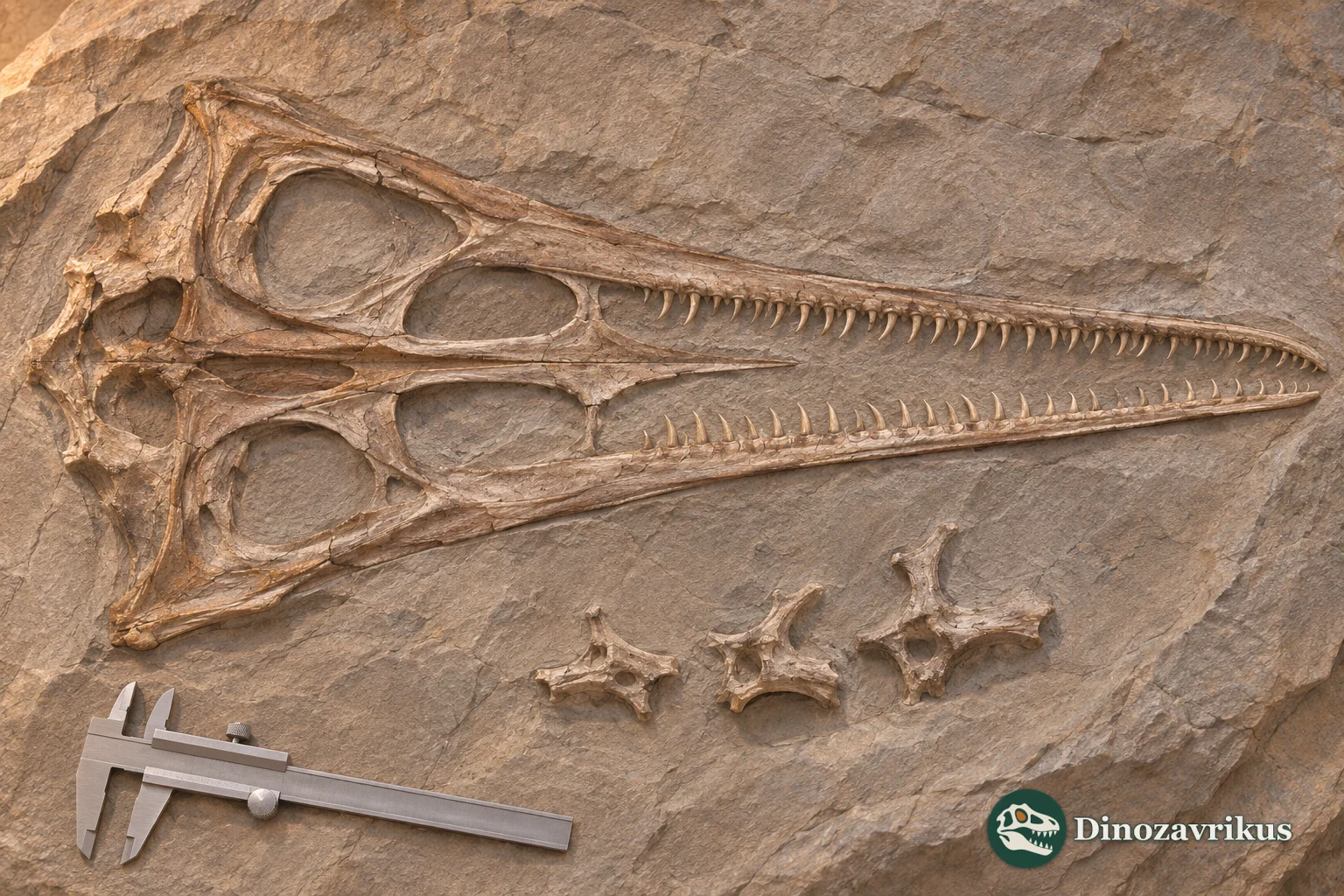
IVPP V14582 preserves a skull exposed from below and isolated cervical vertebrae. Its palate and upper tooth row can be studied; no wing is present.
The specimen described in 2025 includes much of a skull, a mandible, several neck vertebrae and isolated teeth. It improves cranial comparisons without yielding a wingspan.
The triangular compressed crowns and long tooth row are directly described features. Their form informs relationships but does not identify a particular prey item.
The 2008 description assigned Hongshanopterus to Istiodactylidae. Later analyses sometimes placed it just outside the family; the 2025 material supports a close affinity.
A skull seen from below
Wang Xiaolin, Diogenes de Almeida Campos, Zhou Zhonghe and Alexander Kellner named Hongshanopterus lacustris in 2008. Holotype IVPP V14582 came from the Dapingfang area of western Liaoning and is held by China's Institute of Vertebrate Paleontology and Paleoanthropology. The skull is exposed in palatal view, accompanied by isolated cervical vertebrae. That view reveals the palate and upper tooth row while other surfaces are obscured or compressed.
The genus name refers to the Hongshan archaeological culture of the wider region. The species name lacustris points to lacustrine deposits in the Jiufotang Formation. A lake burial setting does not itself demonstrate that this individual caught fish.
Teeth and a changing family placement
The teeth are flattened from side to side, with triangular crowns; some bend backwards. They extend farther behind the front of the upper jaw than in several other istiodactylids. Those characters helped the original authors assign the genus to Istiodactylidae as an early branching member.
Later analyses drew the boundary of the family differently, sometimes placing Hongshanopterus close to but outside it. The 2025 study of new material supported a close relationship with istiodactylids. Nurhachius from the same formation offers a comparison for teeth and neck vertebrae; a phylogenetic placement remains an inference from compared characters.
A second specimen changes the record
In 2025 Yizhi Xu, Shunxing Jiang and Xiaolin Wang described another Hongshanopterus specimen. It includes most of the skull, a lower jaw, several cervical vertebrae and numerous isolated teeth. The specimen adds direct information about jaw and neck anatomy beyond the original palate-view skull.
Neither specimen preserves a complete wing. Their fossils therefore cannot yield a measured wingspan or directly document tail shape. Tooth form permits discussion of possible feeding but no prey remains establish a particular meal. Haopterus from older Yixian deposits preserves wing bones, so its size estimate rests on different evidence and cannot be applied to Hongshanopterus.
What an image must infer
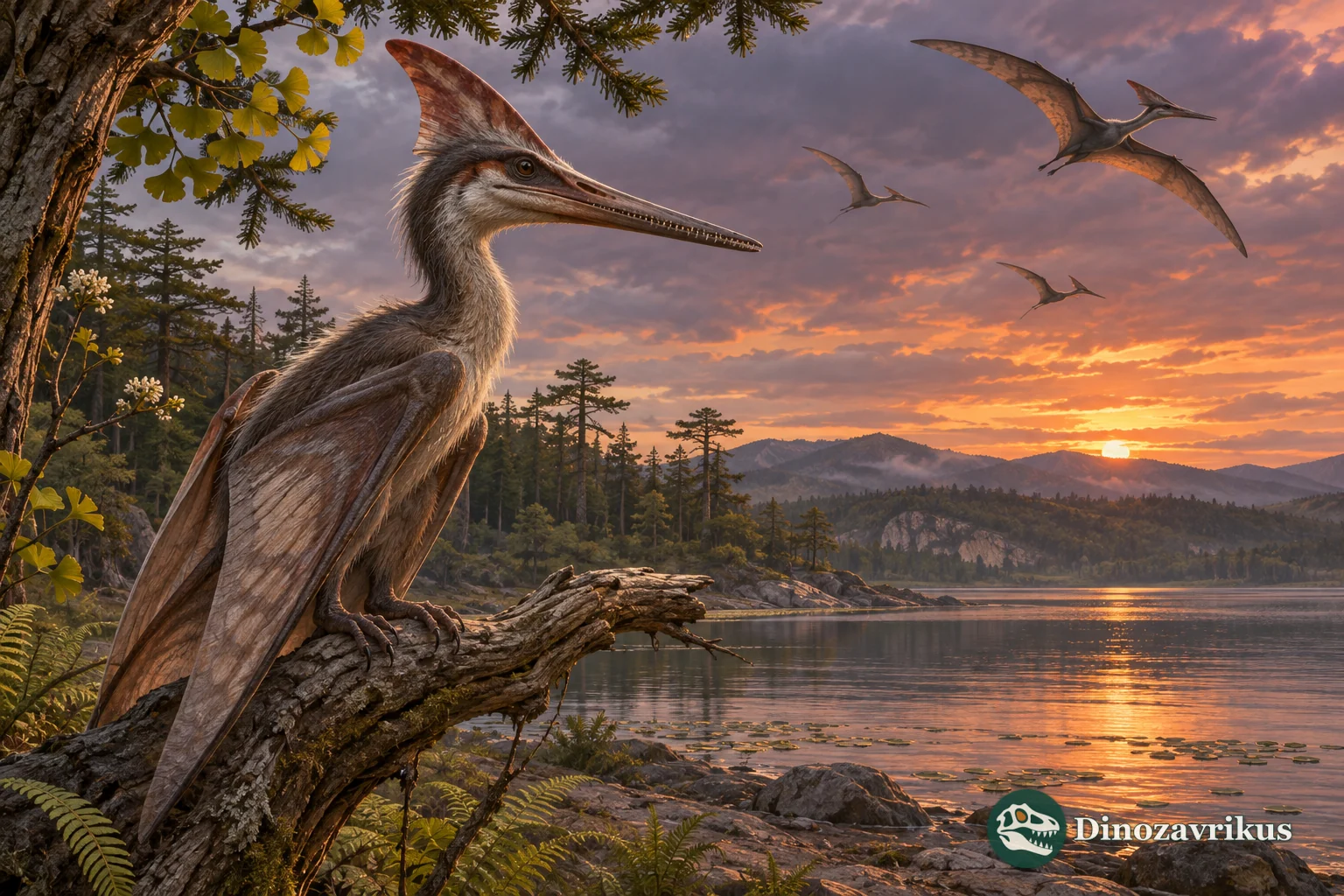
The cover and shore scene show a plausible pterodactyloid with a long toothed snout. Colour, body covering, wing proportions, behaviour and full-body size are reconstructed. The preserved skulls support features of the head, not a measured complete silhouette.
Frequently asked questions
How many Hongshanopterus specimens are described?
The 2008 name rests on skull and vertebrae IVPP V14582; a second skull, jaw, teeth and vertebrae were described in 2025.
What is distinctive about its teeth?
Their triangular crowns are flattened from side to side, and the upper tooth row extends unusually far back.
Is its wingspan known?
No. The reported specimens do not include a complete wing from which to measure it.
Was it an istiodactylid?
The original study placed it in that family. Some later analyses placed it just outside; new material supports close affinity without settling every branching detail.