

Hutchemys was a North American softshell turtle with a heavily ossified lower shell. For years, shells and other bones behind the head supplied most of the evidence for the type species. Paleocene skulls from North Dakota revealed a short, triangular snout, unlike the drawn-out snouts of some related turtles.
Quick facts
| Group | Turtles, plastomenid softshells |
|---|---|
| Age | Late Cretaceous and Paleocene |
| Region | North America, United States |
| Type species | Hutchemys rememdium |
| Scientific name | Hutchemys |
| Diet | Exact diet is uncertain |
What can the fossils tell us?
Micro-CT data from the North Dakota skulls revealed details of the palate and jaws. The snout distinguishes the type species from some other plastomenids.
At the front of the lower shell a rectangular area of bone joined its neighbours along sutures. This feature helps identify Hutchemys.
Some shell traits vary within the North Dakota sample. A suite of features associated with increased ossification still distinguishes the younger H. arctochelys.
A skeleton with the head missing
Hutchemys rememdium was named in 2009 from YPM PU 16795, a nearly complete skeleton apart from the head, from Montana. The same specimen served as the type of Plastomenoides lamberti. Names based on that one specimen refer to the same species. The type came from the Medicine Rocks area. Its age within the Paleocene is inferred from the regional sequence of deposits and fossil faunas.
A short snout and a heavy plastron
In 2024, Léa Girard and colleagues described the skulls NDGS 10019 and NDGS 10029 and several incomplete jaws from the Sentinel Butte Formation. Micro-CT models reveal a short, triangular snout and broad chewing surfaces. NDGS 10019 measures 65.7 mm from the snout tip to the base of the occipital joint. In Aspideretoides, another North American softshell, the shell likewise supplies several independent clues to relationships. In Hutchemys, a large rectangular bony callosity in the front of the plastron is sutured to the adjacent bones, even though the upper shell lacks a peripheral bone ring.
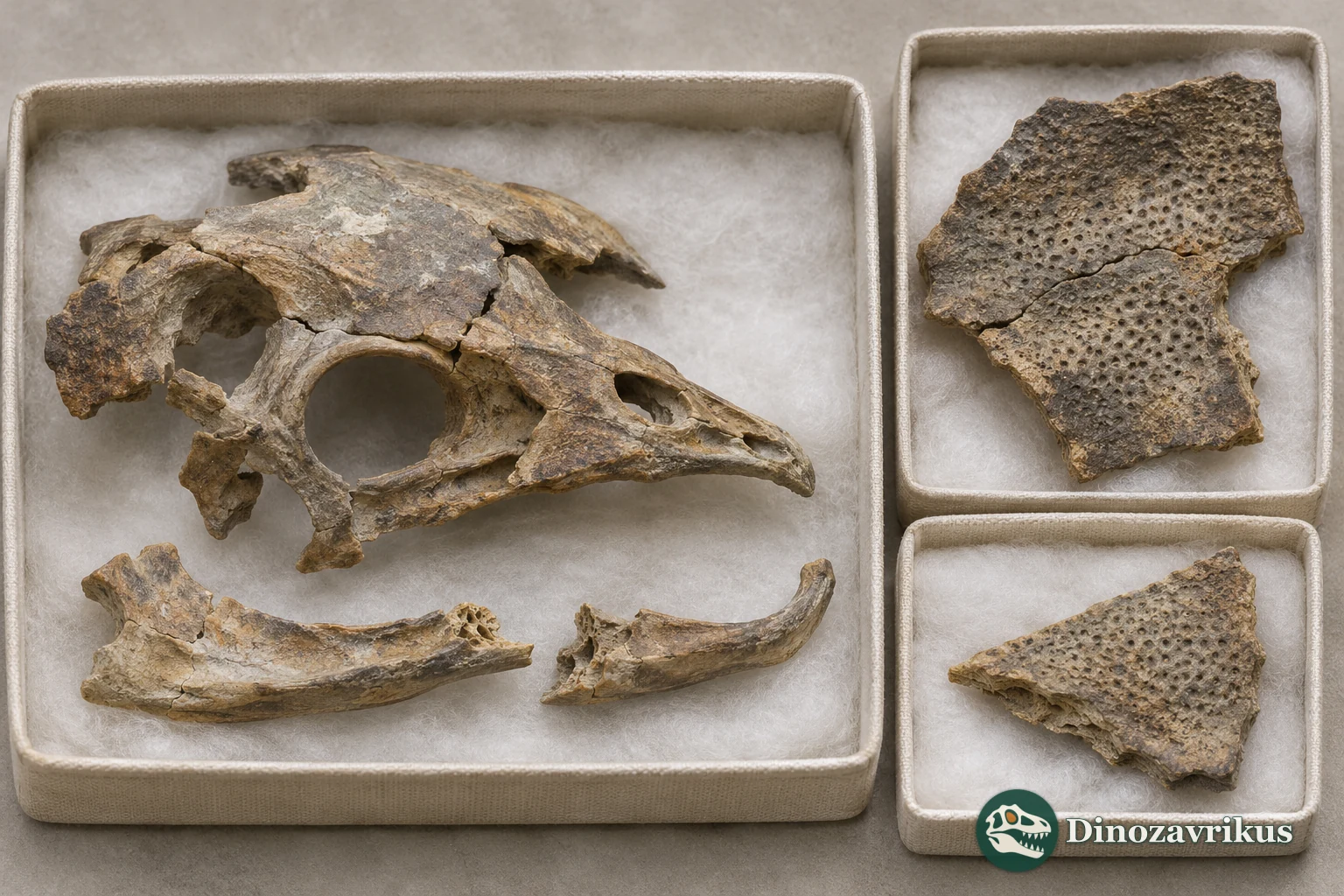
What counts as a separate species
The North Dakota sample shows that details of the plastron vary within a species. Younger H. arctochelys shells remain distinguishable by more extensive bone development, including textures on inner surfaces of the shell. The 2024 analysis also suggests that the heavy lower shell evolved twice within plastomenids, once in the Hutchemys lineage and once in another branch. This is an evolutionary inference tested with characters of the plastron.
Records before and after the extinction
Material referred to H. sterea includes Late Cretaceous fossils from the Hell Creek and Lance formations and early Paleocene remains. H. tetanetron is known from the early Paleocene of Montana. The type species, H. rememdium, occurs in younger Paleocene deposits in Montana, North Dakota and Wyoming. The Cretaceous species walkerorum was originally included in Hutchemys, but its placement in the genus was questioned in the 2024 revision.
Frequently asked questions
Why is Hutchemys a softshell?
It lacked the usual ring of peripheral bones and the scute grooves of many turtles. Its plastron nevertheless formed a substantial bony shield.
Did the type skeleton have a skull?
The type preserves the skeleton behind the head. Skulls of the type species were later documented from North Dakota.
What age are its fossils?
The genus is represented in Late Cretaceous and Paleocene rocks of North America. The type species is Paleocene.
Do the skulls establish what it ate?
The skulls reveal the shape of the chewing surfaces. They provide no direct record of particular foods.