

Hydrodamalis was an extinct genus of large dugong relatives in the North Pacific. Its best-known species is Steller's sea cow, H. gigas, observed alive by Georg Steller near the Commander Islands in 1741. Fossil species also come from California and Japan. The cover reconstructs H. gigas, not the exact appearance of every member of the genus.
The earlier Dusisiren and Metaxytherium help frame this lineage, without making each named species a proven direct ancestor. A separate Steller's sea cow account covers the historical hunting of the last population; this profile follows the broader genus and its fossil evidence.
Quick facts
| Group | Sirenia, Dugongidae, Hydrodamalinae |
|---|---|
| Genus name | Hydrodamalis Retzius, 1794 |
| Type species | H. gigas, Steller's sea cow |
| Other studied forms | H. cuestae in the eastern and H. spissa in the western North Pacific |
| Fossil span | Pliocene forms and Pleistocene H. gigas |
| Last known population | Commander Islands, lost around 1768 |
What can the fossils tell us?
A study found shared characters in H. spissa and H. gigas but differences from eastern Pacific H. cuestae. Similarity does not prove direct ancestry.
A partial skeleton was assigned to H. gigas. Uranium-series dating gave 127,000 ± 8,000 years for a bone, not an origin date for the genus.
A museum inventory found composite Steller's sea cow skeletons. Body-size comparisons must first check which bones belong together.
Names and species across the North Pacific
Steller described a living animal, but the species epithet gigas dates to Zimmermann's 1780 name Manati gigas. Retzius introduced Hydrodamalis in 1794 with H. stelleri. Priority preserves the older species epithet in the current combination Hydrodamalis gigas. Those historical names refer to the same Steller's sea cow.
Daryl Domning described Californian H. cuestae in his 1978 revision of North Pacific sirenians. The Japanese H. spissa was described from Hokkaido. These fossils extend the history of Hydrodamalis beyond the Commander Islands, but do not by themselves establish a simple, direct sequence of ancestors.
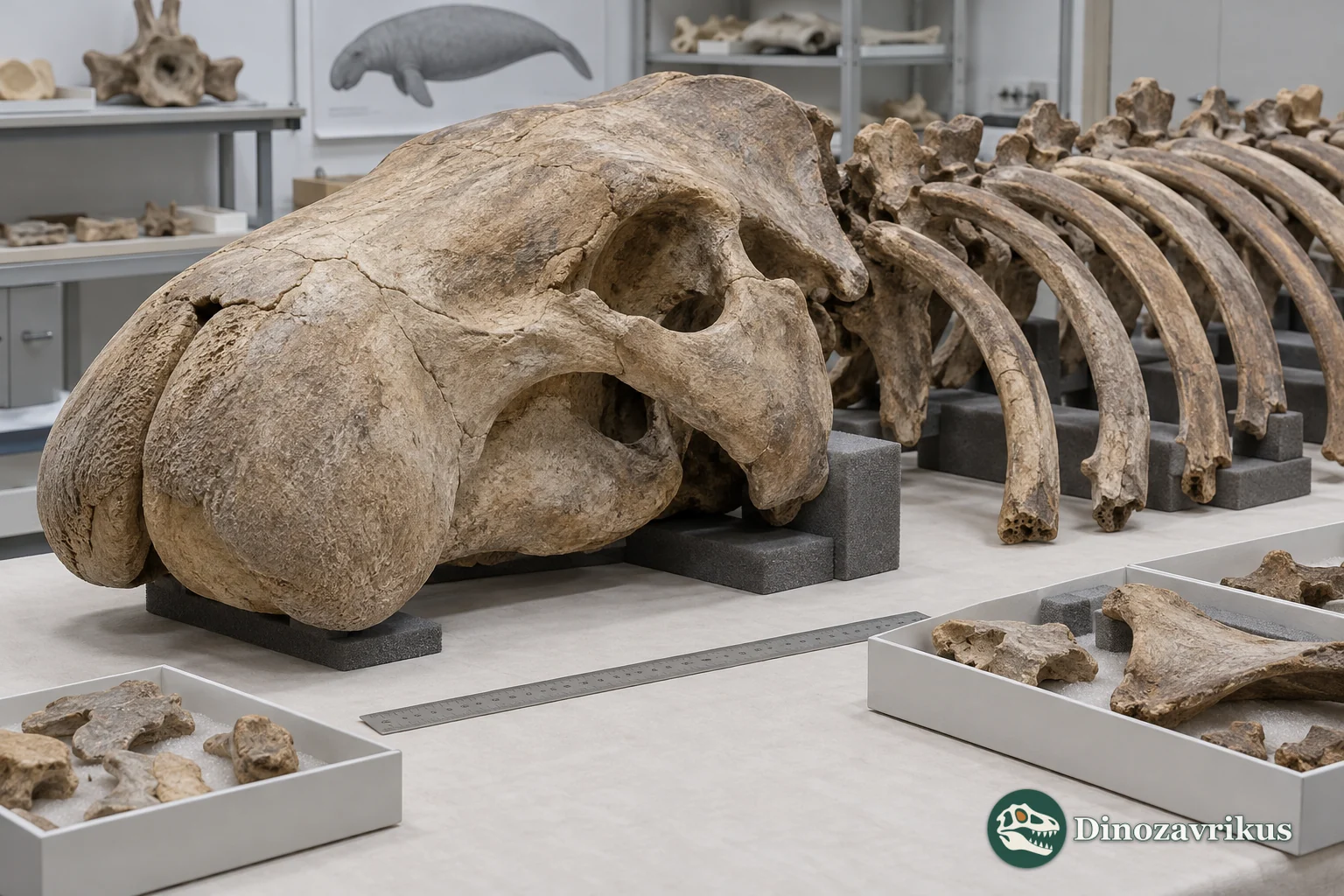
Skulls, tooth loss and a Pleistocene skeleton
A comparison of natural endocranial casts found shared features in Japanese H. spissa and H. gigas, including aspects of the olfactory bulbs and optic-nerve path. Eastern Pacific H. cuestae differed from the Japanese form. The study supports close relationships within Hydrodamalinae without identifying the exact parent population of the historical species.
H. gigas lacked ordinary teeth. A partial skeleton in a Pleistocene shore deposit on Amchitka was also toothless and assigned to that species. Uranium-series dating of its bone gave about 127,000 ± 8,000 years. That dates one animal, not the emergence of the species or continuous occupation of the island.
Measured animals, museum collections and extinction
Steller measured one female at about 7.4 meters. This is a historical observation of one animal, not a maximum for the genus. An inventory of Commander Islands material found that some assembled skeletons contain bones from multiple individuals, so their full length cannot automatically be treated as a living animal's measurement.
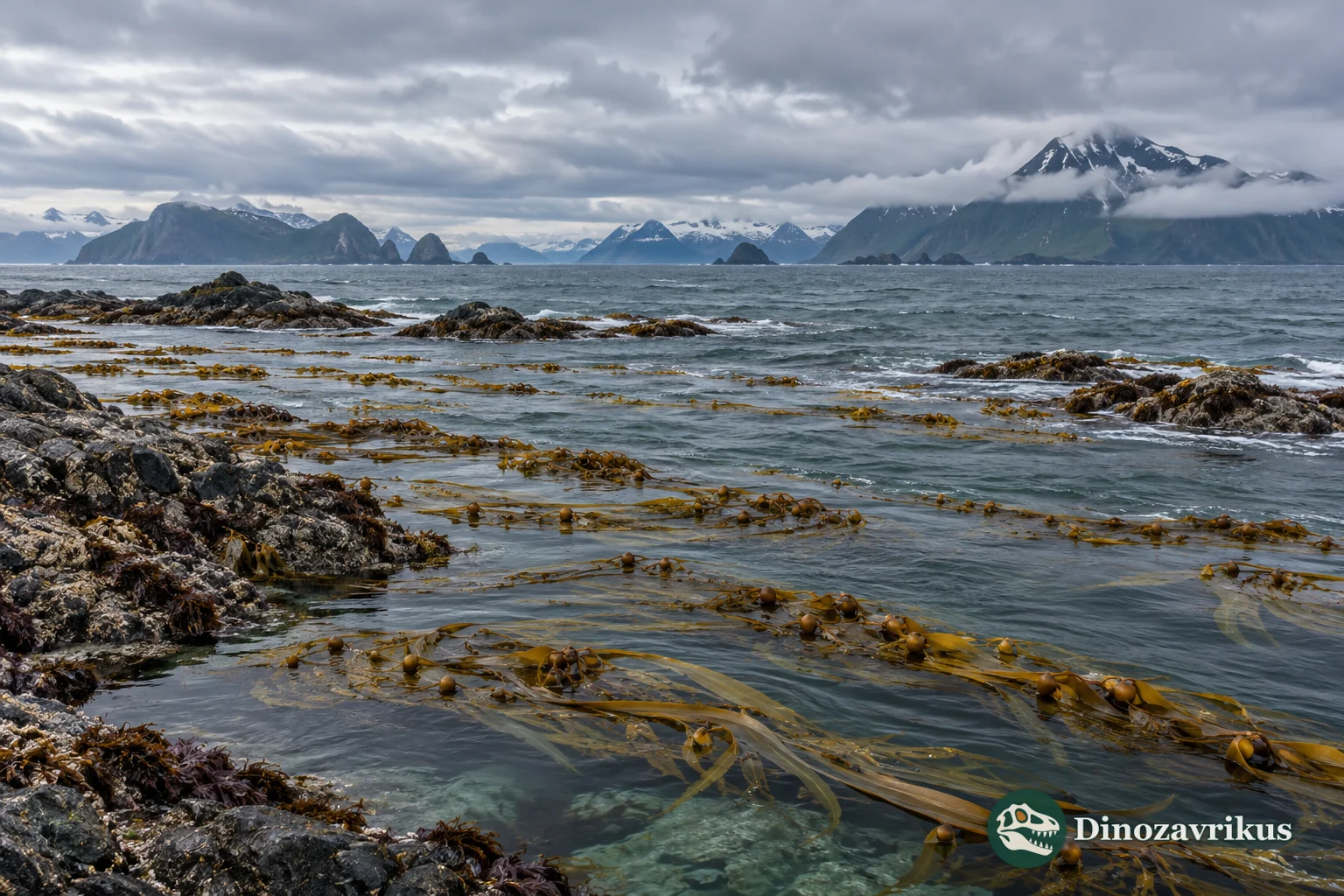
Steller observed H. gigas feeding on large coastal algae in shallow water. Genomic studies explore changes in abundance before historical observation, while hunting explains the disappearance of the last Commander Islands population around 1768. The interpretive coastline image depicts a possible feeding setting, not a photograph of Amchitka or Bering Island.
Frequently asked questions
Was Hydrodamalis only Steller's sea cow?
No. The genus also includes fossil H. cuestae from California and H. spissa from Japan.
How old is the Amchitka skeleton?
A bone dated to about 127,000 ± 8,000 years. That figure belongs to one Pleistocene animal.
Was the Japanese species certainly a direct ancestor of H. gigas?
No. Endocranial casts show similarities, but cannot identify a direct parent population.
Why can a mounted skeleton give a misleading length?
Some Steller's sea cow mounts combine bones of multiple individuals. Steller's roughly 7.4-meter measurement concerned one living female.