

Hystricurus is a lower Ordovician genus of trilobites recognised by a combination of a narrow, waisted glabella, very large eyes and spines on the rear of the tail shield. Its history is a useful example of type-based revision: older authors assigned many incompletely known hystricurids to the genus, while later comparisons moved some of them elsewhere. The genus belongs in the ancient arthropod catalogue alongside other trilobites whose names depend on matching incomplete shields.
Quick facts
| Scientific name | Hystricurus Raymond, 1913 |
|---|---|
| Type species | Hystricurus conicus (Billings, 1859) |
| Group | Arthropoda, Trilobita, Hystricurinae |
| Age | Lower Ordovician; species records span regional intervals |
| Type specimen | Holotype GSC 516, Beauharnois Formation, Quebec |
| Typical material | Separate cranidia, free cheeks, thoracic parts and pygidia |
| Diagnostic features | Large eyes, waisted glabella and rear pygidial spines |
| Size and diet | No reliable genus-wide length or direct diet evidence |
What can the fossils tell us?
Billings described Bathyurus conicus in 1859. Raymond later designated it as the type species of Hystricurus. The Geological Survey of Canada holotype is GSC 516; its identification was clarified by comparison with later material from the Beauharnois Formation.
The cranidium has a short frontal area, a waisted glabella and very large palpebral lobes. The pygidium bears defined axial rings and posterior pleural spines. Their number and development vary among species.
Adrain and colleagues processed bed-by-bed material from the House and Garden City formations in Utah and Idaho. The samples improved species comparisons, but a count of sclerites is not a count of complete animals.
Fossils establish marine occurrence and hard-part anatomy. They do not establish a precise diet, colour, swimming speed, reproductive behaviour or a reliable total body length for the genus.
A name fixed by a Quebec trilobite
Elkanah Billings described Bathyurus conicus in 1859 from Quebec. Percy Raymond established Hystricurus in 1913 and used Billings's species as its type. The name is therefore tied to the holotype GSC 516, housed by the Geological Survey of Canada, rather than to any trilobite with a generally similar outline.
The type was long difficult to interpret because it is a single poorly preserved specimen. Adrain, Lee, Westrop, Chatterton and Landing compared it with additional material from the Ogdensburg Member of the Beauharnois Formation and showed how its short frontal area, waisted glabella and large palpebral lobes matched better documented forms. They also clarified the limits of the subfamily Hystricurinae and separated genera that had formerly been grouped under a broad concept of hystricurids.
The 2003 work was a major revision, not a final catalogue of every historical name. Several species still needed fuller description, and some old geographic records were explicitly treated as requiring new material. Taxonomic placement should therefore be attached to the particular specimen and publication being discussed.
Large eyes and a distinctive tail shield
The central lobe of the head shield, the glabella, narrows toward the front and has a pinched, violin-like outline. The anterior part of the cranidium is relatively small. The compound eyes and their supporting palpebral lobes are conspicuous, while the posterior fixed cheeks extend laterally. In H. conicus, coarse tubercles and a short genal spine help distinguish it from the similar H. oculilunatus.
The pygidium carries three or four clearly defined axial rings, a terminal piece with a pair of tubercles or short spines, and prominent posterior pleural spines. Adrain and colleagues noted that the large spines can extend across adjacent pleural bands in larger specimens. Small pygidia and isolated thoracic elements helped them trace how this unusual structure is formed. Other species differ in spine strength and distribution, so one reconstruction should not be treated as the exact appearance of every named species.
Bed-by-bed collections in Idaho and Utah
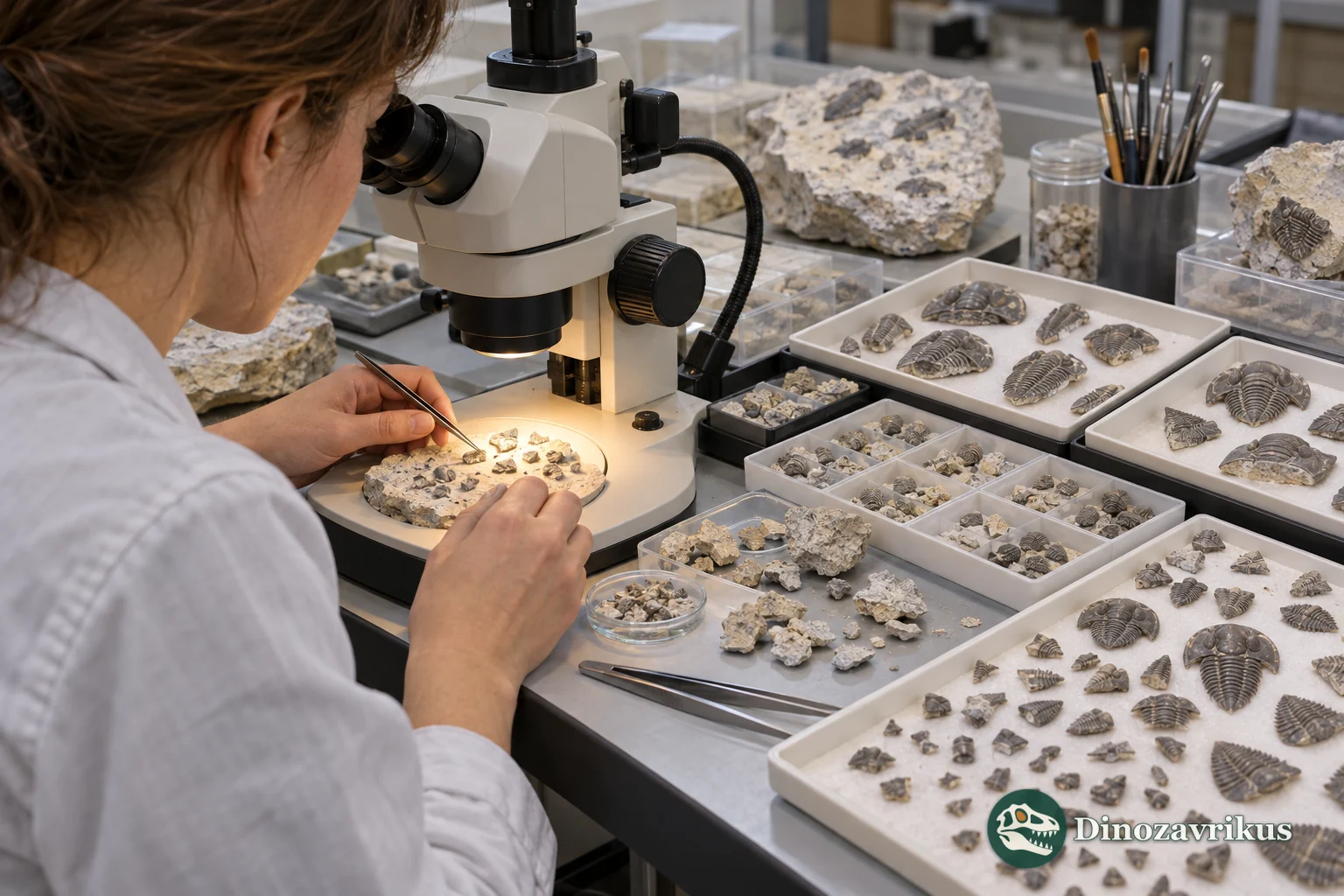
A major step in refining the genus came from field work in the Garden City Formation of Idaho and the House and Fillmore formations of Utah. Researchers measured sections, revisited historical collecting sites and processed silicified fossils from individual horizons. Some illustrated specimens and holotypes are housed in the Paleontology Repository at the University of Iowa.
At one Garden City horizon the researchers processed more than 90 kilograms of rock, yielding an estimated sample of thousands of trilobite sclerites. Those pieces are not thousands of complete animals. In the House Formation, sampling across dozens of levels revealed changes in trilobite species through the section and exposed problems in older correlations built from sparse collections.
These formations record shallow marine carbonate settings. Their trilobite communities included hystricurids, Symphysurina and asaphids. The nearby boundary-interval record is discussed in the profile of Symphysurina; co-occurrence in some regional sections does not imply identical ranges or ecology.

Age and regional range
The documented genus is lower Ordovician, but its occurrences should not be collapsed into one short interval. The type species is known from the Beauharnois Formation in Quebec; other named species come from western Laurentian formations in Idaho and Utah, and separate records have been described from areas such as China and Spitsbergen. Some early claims of very broad ranges for individual species were later questioned because the fossils were incomplete or poorly illustrated.
In western United States sections, hystricurids are abundant in parts of the regional Skullrockian interval. Younger lower Ordovician horizons contain other species, including H. oculilunatus. Regional stages and trilobite zones are useful for local correlation, but their names do not automatically map onto a single global timescale. These rocks belong to the evolving seas of the Ordovician Period.
Size, ecology and limits of reconstruction
There is no reliable total length that applies to the genus. Published descriptions often concern separate cranidia or pygidia, and the available material varies by species. A measured head or tail shield should not be converted to full body length without an articulated specimen or a justified comparison with a close relative.
The fossils establish marine occurrence and a mineralised dorsal exoskeleton. They do not directly identify a meal, swimming speed, reproductive strategy or colour. Large eyes reveal the size of the visual field, not when the animal was active. Tail spines are anatomical structures, not proof of a particular predator or defensive encounter.
In the evidence hierarchy, the preserved shields and their stratigraphic positions are direct observations; species diagnoses, regional correlations and phylogenetic placements are research conclusions. The animal's soft limbs, colour and exact posture remain artistic choices.
Frequently asked questions
When did Hystricurus live?
Named species are known from the Lower Ordovician in several Laurentian regions. Their horizons differ, so the genus range is not the age of one type specimen.
What is the type species?
Hystricurus conicus, first described by Billings in 1859 as Bathyurus conicus. Its holotype is GSC 516 in the Geological Survey of Canada collection.
Why does Hystricurus have such noticeable spines?
Large posterior pleural spines on the pygidium are part of the published genus diagnosis. Their number and prominence vary among species, and larger specimens can show spines extending across adjacent pleural bands.
What did Hystricurus eat?
No direct evidence of a meal or gut contents has been published for the genus. The fossils preserve the dorsal shell much better than feeding behaviour.