

Iberoccitanemys was a Late Cretaceous side-necked turtle from southwestern Europe. The genus was proposed after comparison of a French shell with specimens from central Spain. More material from northern Spain then linked those shells to a species originally assigned to a different genus.
Quick facts
| Group | Turtles, side-necked, bothremydids (Bothremydidae) |
|---|---|
| Age | Late Cretaceous (late Campanian to late Maastrichtian) |
| Region | Europe (Spain and southern France) |
| Type species | Iberoccitanemys convenarum, treated as a junior synonym of I. atlanticum in 2021 |
| Holotype | MDE-Cas2-259, nearly complete shell of the originally designated type species |
| Shell length | 34 cm in specimen HUE-4913 |
| Scientific name | Iberoccitanemys |
| Diet | Exact diet unknown |
What can the fossils tell us?
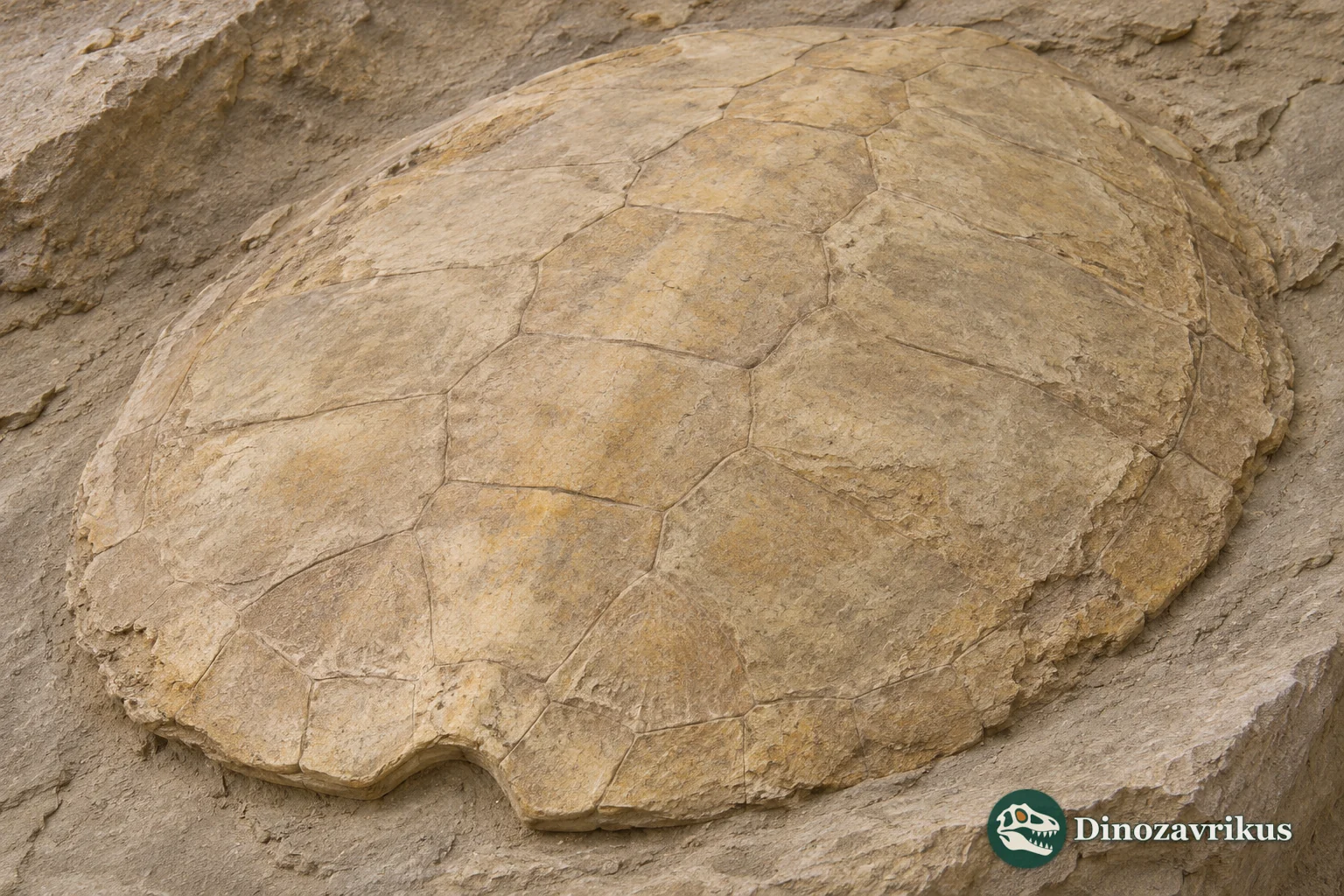
MDE-Cas2-259 preserves the upper and lower shell. It anchors the name convenarum and provides a reference for comparing shells found in Spain.
HUE-4913 is 34 cm long and retains the sutured pelvis attachment and the midline series of bones. It establishes how those parts fit together, while the head remains unknown.
More shell material from Laño helped refine the diagnosis of atlanticum. In 2021 the authors applied this earlier name to fossils formerly called convenarum.
Comparing the French and Lo Hueco shells
MDE-Cas2-259 is a near-complete shell from Cassagnau, southern France, in the late Maastrichtian Marnes d’Auzas Formation. It was described as Elochelys convenarum in 2002. Adán Pérez-García, Francisco Ortega and Xabier Murelaga later compared it with HUE-4913 and HUE-994 from Lo Hueco in the Spanish province of Cuenca.
HUE-4913 has a shell 34 cm long and a pelvis sutured to it, a feature of side-necked turtles. In the studied specimens six bones form a row down the middle of the carapace. Farther back, plates associated with the ribs meet along the midline. The front edge and the shape of some scutes vary across shells. Comparing these shared and variable characters helped establish the genus in 2012.
How Laño changed the name
A turtle from Laño in northern Spain was described as Polysternon atlanticum in 1996. The type specimen of that name is MCNA 6316, a bone from the front of the shell. Its referral to Polysternon remained uncertain. More material from the same quarry offered a way to test it.
In 2021 Pérez-García and colleagues re-examined the Laño fossils and refined the diagnosis. They moved the species into Iberoccitanemys and concluded that I. convenarum was a junior synonym of I. atlanticum. That interpretation recognises one species in Spain and southern France from the late Campanian through the late Maastrichtian.
The other turtles at Lo Hueco
Several turtle forms can be compared in the Lo Hueco deposits. Iberoccitanemys occurs there alongside Foxemys, another bothremydid. The available Iberoccitanemys fossils give a detailed view of the shell and its variation. The shape of the head and the precise diet remain unknown.
Frequently asked questions
What does the name Iberoccitanemys mean?
It refers to the Iberian Peninsula and southern France. The Greek word emys means freshwater turtle.
How large was the shell found at Lo Hueco?
The shell of HUE-4913 measures about 34 cm. That figure describes one specimen.
Why do both convenarum and atlanticum appear in the literature?
The French and Spanish fossils were named independently. The 2021 revision treated them as the same species and retained the earlier name atlanticum.
What identifies it as a side-necked turtle?
In HUE-4913 the pelvis is joined to the shell by bony sutures, a characteristic feature of side-necked turtles.