

Iberomesornis was a small Early Cretaceous bird from the Las Hoyas wetland in Spain. It had a short bony tail with a fused tip and a shoulder girdle with long coracoids. The bones of the foot retained a more ancestral arrangement and remained separate.
Quick facts
| Group | Enantiornithines (Enantiornithes) |
|---|---|
| Age | Early Cretaceous (late Barremian) |
| Region | Europe (Cuenca, Spain) |
| Diet | No direct evidence |
| Type species | Iberomesornis romerali |
| Holotype | LH-22, a partial articulated skeleton |
| Locality | Las Hoyas, near La Cierva |
| Tail | Short bony tail ending in a large pygostyle |
What can the fossils tell us?
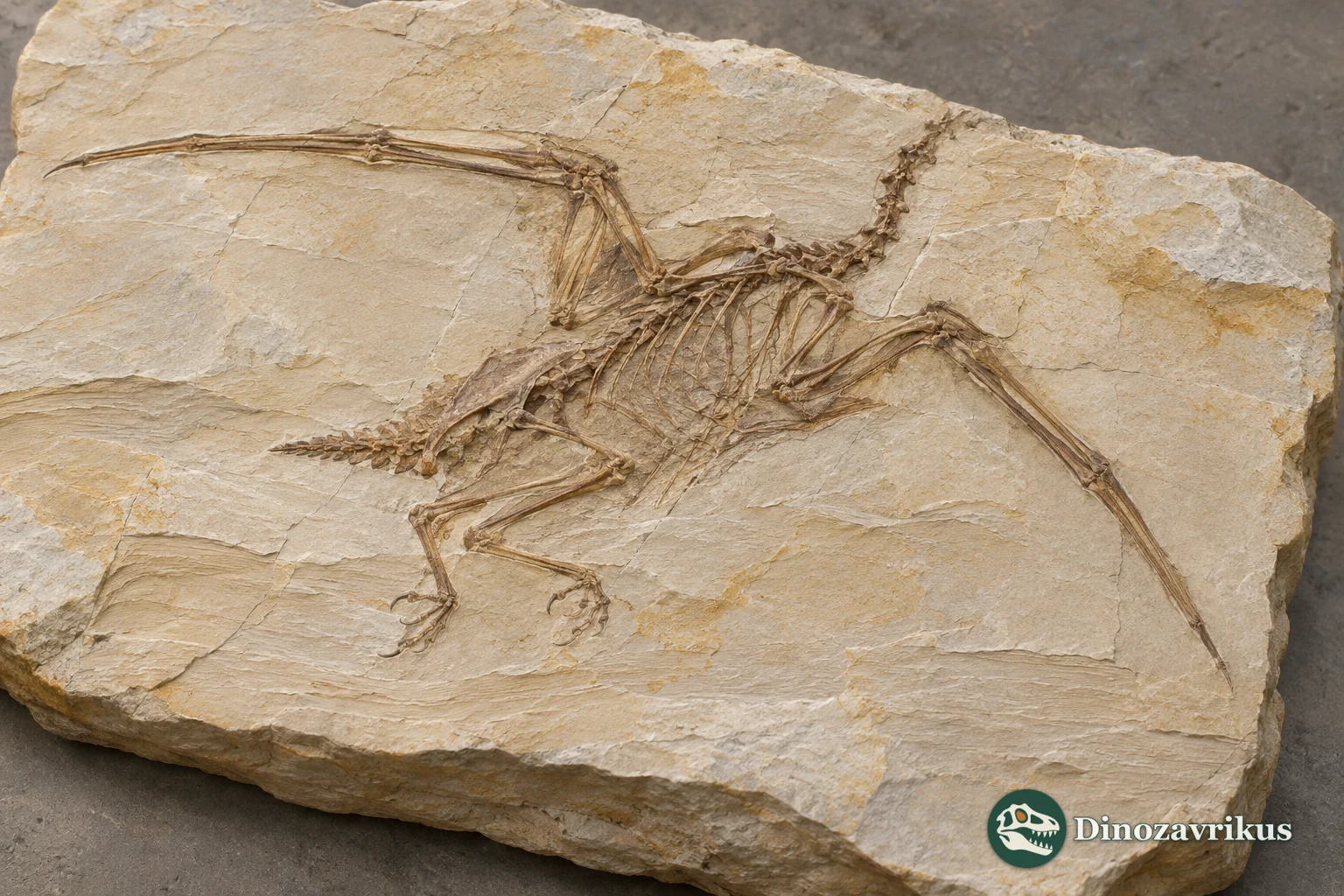
The slab shows free vertebrae followed by a pygostyle. The original number and shape of the tail feathers remain unknown.
These bones record the structure of the shoulder girdle. Much of the hand is missing, which limits reconstruction of the wing.
The metatarsals retain a more ancestral arrangement. Their condition can be evaluated alongside the more derived shoulder and tail.
A skeleton on a Las Hoyas slab
The fossil entered the scientific literature in 1988, and José Luis Sanz and José Fernando Bonaparte named the species in 1992. The generic name means an intermediate bird from Iberia. The species honours Armando Díaz Romeral, who discovered the specimen.
The holotype LH-22 belongs to the Las Hoyas collection. The slab preserves much of the trunk, tail and limbs. The skull, front of the neck and much of the hands are missing. A femur about 15 mm long gives a sense of the size of the bird.
Changes in the shoulder, tail and foot
The wishbone and elongated coracoids represent a more derived arrangement in the shoulder. The coracoids connected the shoulder to the sternum. A series of free tail vertebrae ends in an elongated pygostyle formed from fused vertebrae. This arrangement provides support for tail feathers whose exact form is unknown.
The metatarsals remain separate. In 2000, Paul Sereno used more of the skeleton exposed by preparation to reassess its anatomy and place it among the enantiornithines. The larger Concornis from the same locality offers another example of the variety in wings and feet among Early Cretaceous birds.
Frequently asked questions
Where was Iberomesornis found?
The type skeleton came from fine limestone at Las Hoyas in Cuenca, Spain.
Which parts are missing from the fossil?
The skull, front of the neck and much of the hands are absent.
What is a pygostyle?
It is a bony structure formed from fused vertebrae at the tip of a bird's tail. It supports the tissues associated with tail feathers.
How small was the bird?
Its skeleton is comparable in size with a small modern bird. The femur is about 15 mm long.