

Ichthyotitan severnensis was a giant ichthyosaur from the very end of the Triassic, known from two unusual lower-jaw bones found on the Somerset coast of England. Their size suggests an animal about 25 m long, but that figure comes from comparing isolated bones, not measuring a complete skeleton. The fossils make Ichthyotitan one of the most striking marine vertebrates of the period while showing how uncertain giant-size estimates can be when only fragments survive.
Quick facts
| Type species | Ichthyotitan severnensis |
|---|---|
| Age | Late Rhaetian, about 202 million years ago |
| Locality | Somerset coast, south-west England: Blue Anchor and Lilstock |
| Holotype | BRSMG Cg3178, an incomplete right surangular from the lower jaw |
| Known material | Two isolated surangulars found about 10 km apart |
| Estimated length | About 25 m by comparison with other jaw bones; not measured from a complete skeleton |
Evidence guide
Holotype BRSMG Cg3178 from Blue Anchor and specimen BRSMG Cg2488 from Lilstock are large parts of the right and left surangulars. Their size and unusual shape support a distinct species, but neither is a complete jaw or skeleton.
Both bones came from the Westbury Mudstone Formation of the Late Rhaetian. This is a geological age assigned from the rock sequence, not a direct date measured from either bone.
Researchers compared parts of the surangular with corresponding bones in better-known ichthyosaurs. A complete Ichthyotitan skeleton has not been found to test the proportions or confirm a precise length.
Histology of the holotype shows active outer bone formation and no external fundamental system. The authors interpret this as a still-growing subadult or early adult, not an animal known to have reached its final size.
How two finds received one name
The first of the two key bones was collected near Lilstock in 2016. It is an incomplete left surangular, from the rear part of the lower jaw. Its unusual form and enormous size drew attention, but a single isolated bone was not enough to establish a new genus and species.
The holotype, BRSMG Cg3178, came from Blue Anchor, roughly 10 km west along the coast. It is a more complete right surangular. Ruby Reynolds first noticed part of it on a boulder in 2020; later searching and collection of additional pieces involved Justin Reynolds, other family members and researchers. In 2024 Dean Lomax, Paul de la Salle, Marcello Perillo, Justin and Ruby Reynolds, and James Waldron named the material Ichthyotitan severnensis.
The genus name combines Greek words for fish and titan; the species name refers to the Severn Estuary near the discoveries. The holotype is held by Bristol Museum and Art Gallery. BRSMG Cg2488 from Lilstock is referred to the same species. Matching unusual features in two large bones from one formation make the taxon more persuasive than a name based on a single isolated find alone.
A bone that carries the diagnosis
The surangular forms much of the rear section of the lower jaw. Several connected fragments of the holotype preserve rear and parts of the middle and front sections. Researchers described a sharply upturned rear end, a massive ridge, an unusual coronoid process and a nearly circular cross-section at a particular point. Together these features distinguish the material from the compared bones of Shonisaurus and other ichthyosaurs.
This does not mean every fragment from Somerset belongs to Ichthyotitan. The authors discussed other isolated bones from nearby sites, but did not assign them all to the type material. A secure identification requires diagnostic anatomy, not just impressive size or a similar geological age.
Where the 25-metre estimate comes from
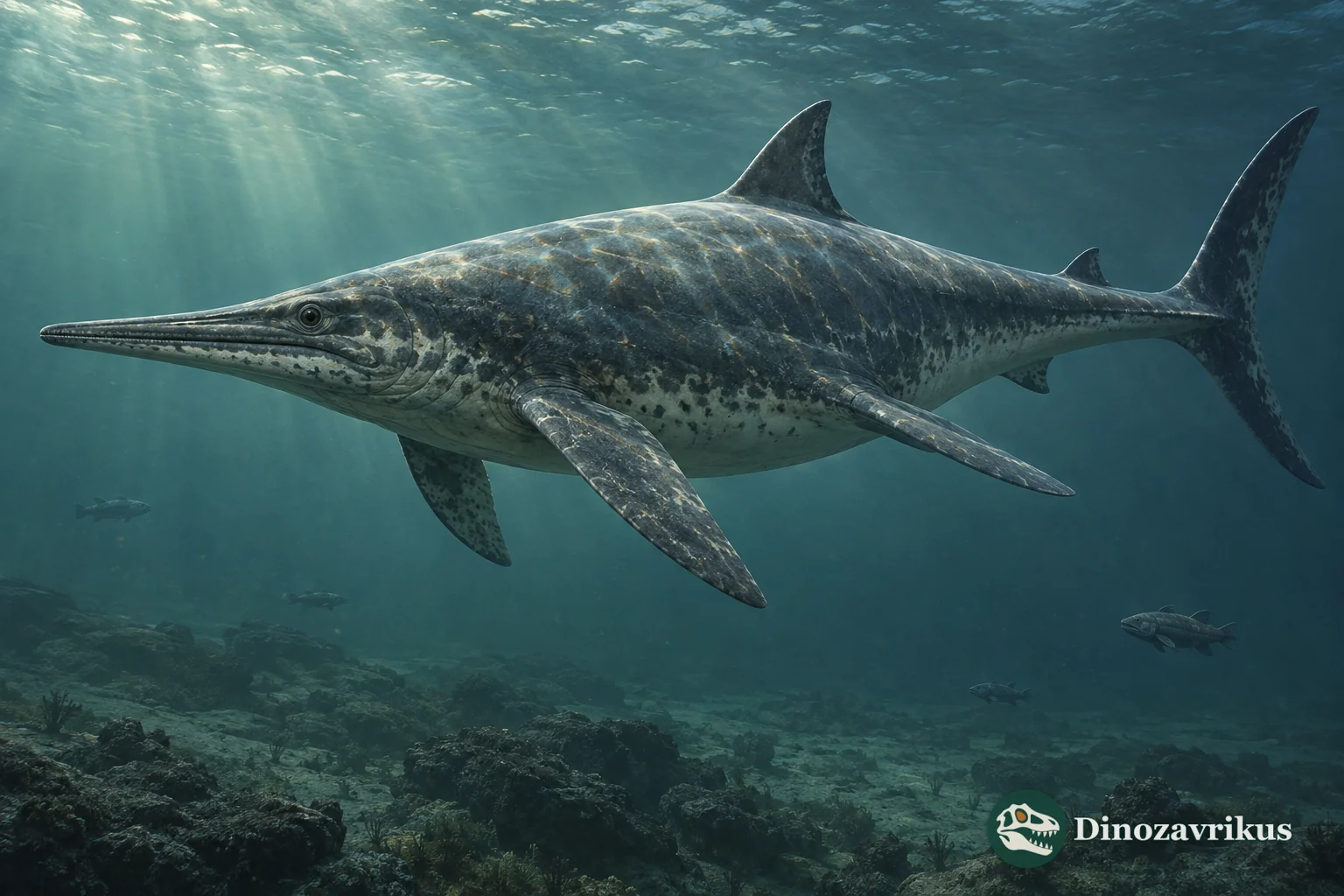
The estimate near 25 m comes from scaling: dimensions of parts of the jaw bone were compared with corresponding sections of surangulars in more complete ichthyosaurs. The study used comparisons with Ophthalmosaurus and Besanosaurus. Different comparison points produce a similarly large range, but the result remains a model with limited precision.
There are concrete reasons for caution. Bone proportions vary among species, and an incomplete specimen can make the position of a process difficult to identify. The better-preserved Blue Anchor bone allowed the researchers to revise one landmark used for the Lilstock specimen. It is safer to say that Ichthyotitan may have been around 20–25 m long, while noting that no complete skeleton has confirmed those body proportions.
Comparisons with other giants, including Shonisaurus and Cymbospondylus, provide a sense of scale without turning an estimate into a direct measurement. Ichthyotitan is known from jaw bones, not a connected sequence of vertebrae, limbs and tail.
Age, growth and possible relationships
Both bones came from the Westbury Mudstone Formation of the Late Rhaetian, around 202 million years ago. This is among the latest records of giant ichthyosaurs before the Triassic–Jurassic boundary extinction.
Microscopic examination of the holotype adds evidence about growth. Researchers found no external fundamental system, a feature commonly associated with growth cessation, while the outer bone still showed active formation. They concluded that the animal was still growing and may have been a subadult or young adult. The jaw therefore did not necessarily belong to a fully grown individual.
A possible relationship to shastasaurids has been discussed because of the giant size, Late Triassic age and comparisons with known members of that group. Yet the preserved material does not establish a family-level placement with confidence. Ichthyotitan is best treated as a large ichthyosaur of uncertain position until more complete remains are found.
What the fossils say about its life
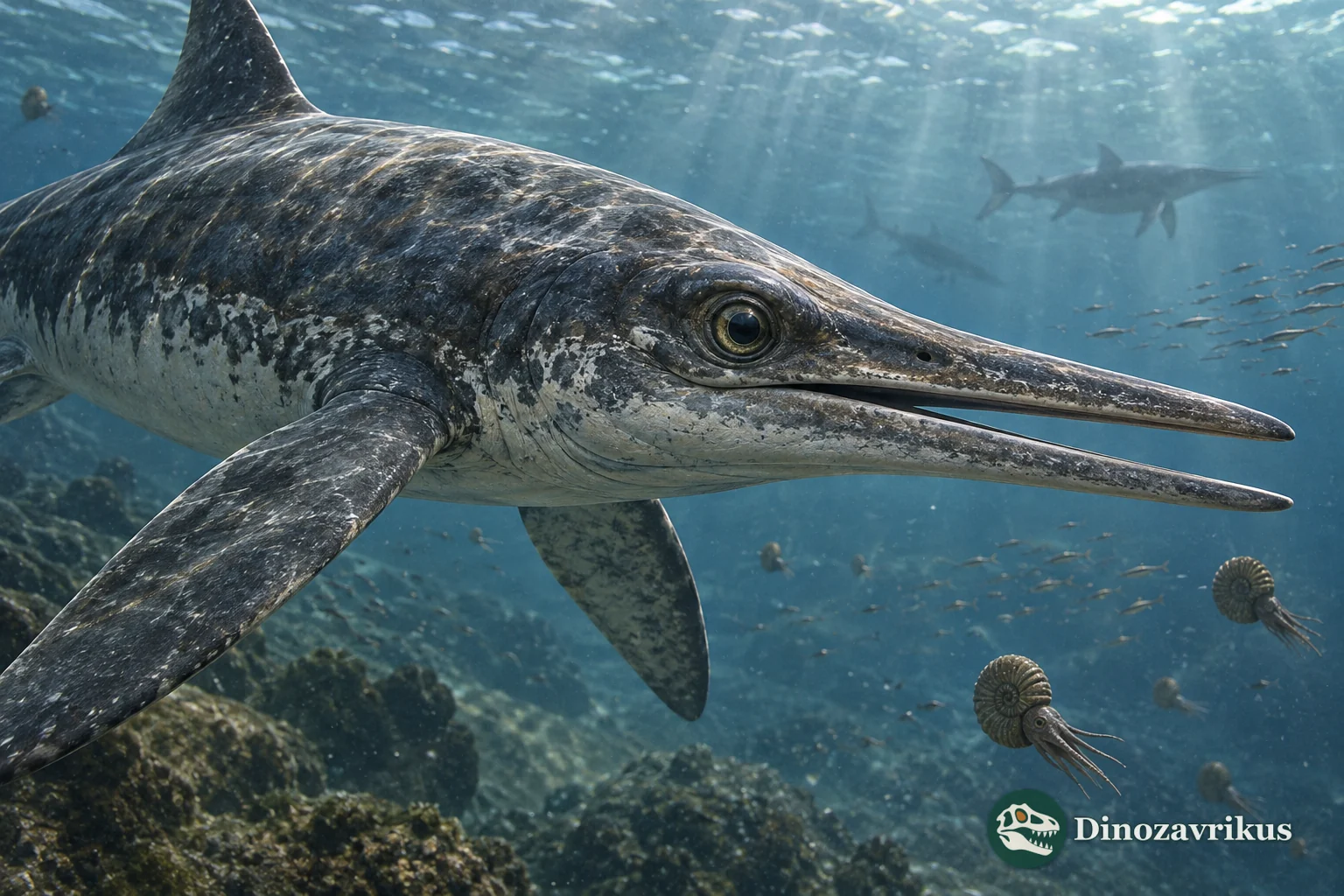
The jaw directly documents part of the lower-jaw anatomy and supports an animal of very large size. The rocks identify a marine setting and a time when these ichthyosaurs lived. The fossils do not reveal a specific prey species, swimming speed, colour, soft-tissue outline or reproductive biology. No stomach contents are known for Ichthyotitan.
Images of the animal are artistic reconstructions based on the general ichthyosaur body plan and limited material. They help readers imagine its setting, but do not reproduce a known individual. Another fragmentary Triassic form, Himalayasaurus, shows why an inferred giant body should not be confused with a complete measured skeleton.
Frequently asked questions
When did Ichthyotitan live?
It lived in the Late Rhaetian of the Late Triassic, about 202 million years ago. Its fossils came from the Westbury Mudstone Formation in Somerset.
What skeleton has been found?
No complete skeleton is known. The species was described from two large surangulars, one from Blue Anchor and one from Lilstock.
Was Ichthyotitan really 25 metres long?
About 25 m is a comparative estimate based on jaw-bone dimensions, not a measured total length. A complete skeleton has not been found to confirm it.
How is its age known?
Both bones came from rocks assigned to the Late Rhaetian. The age comes from their position in the geological sequence, not a direct date on the bones.