

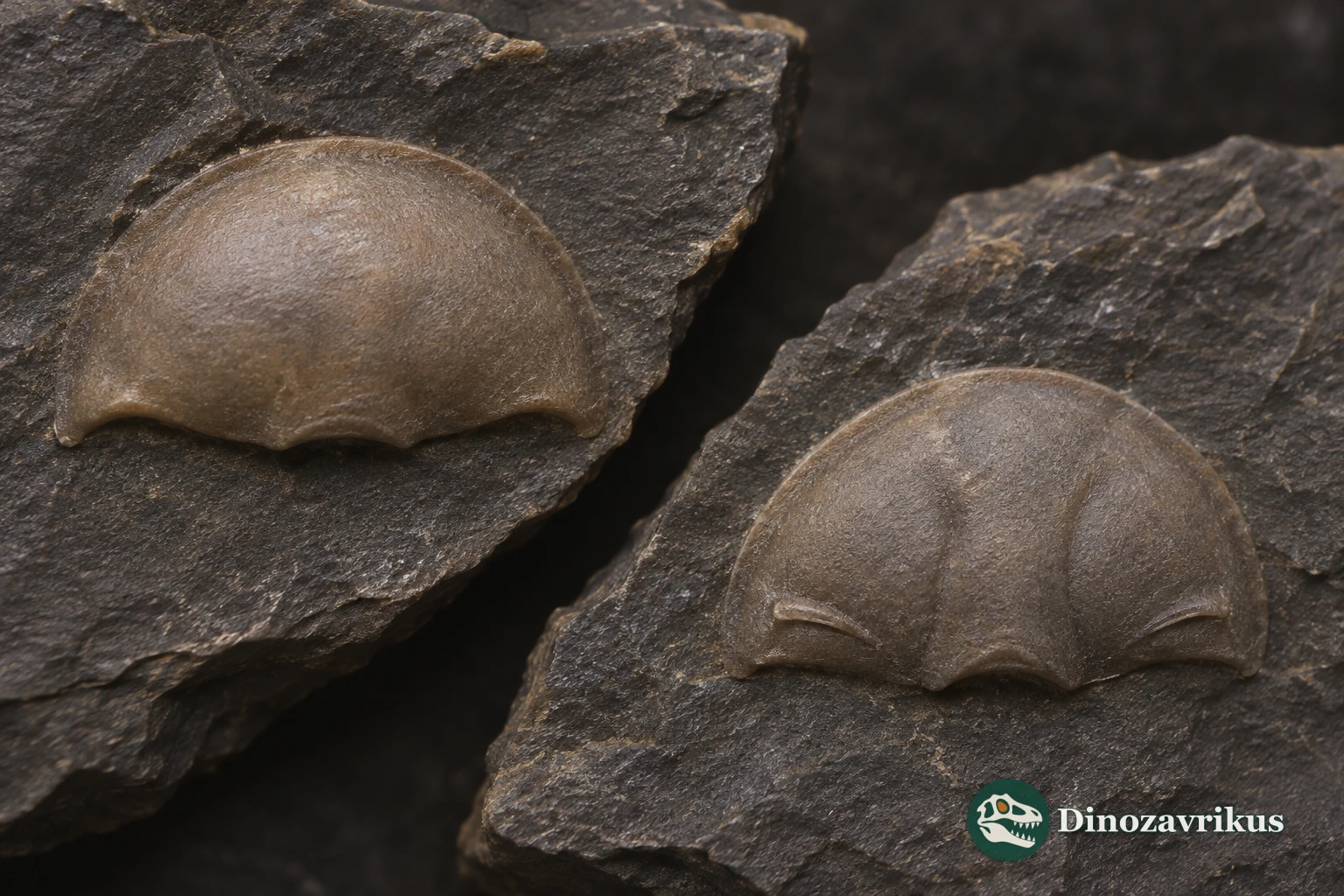
Idiomesus was a small late Cambrian trilobite. The type species lacks eyes and has very faint furrows on the head shield. Other species assigned to the genus retain small eyes or more prominent furrows. Those discoveries changed where researchers placed Idiomesus in the trilobite family tree.
Quick facts
| Group | Ptychaspidid trilobites |
|---|---|
| Age | Late Cambrian |
| Genus named | Percy Raymond, 1924 |
| Type species | Idiomesus tantillus |
| Holotype | Cranidium YPM 4726, Vermont |
| Eyes | Reduced or absent, depending on the species |
What can the fossils tell us?
The type species lacks developed eyes. Comparison with related forms shows which structures were reduced.
The depth of the head furrows and the route of the facial sutures also vary among species.
Pygidia with four rings or five or more rings were assigned to one species, but their connection to its type material remains unclear.
A head shield from Vermont
Percy Raymond established the genus in 1924. The type species, Idiomesus tantillus, comes from the Gorge Formation at Highgate, Vermont. Its holotype, YPM 4726, is a cranidium, the central portion of the upper head shield.
Its small size, faint furrows and absence of eyes originally suggested an affinity with the blind trilobites grouped in the Shumardiidae. In 1986, Rolf Ludvigsen and Stephen Westrop examined additional head and tail shields. The new material included species with eyes and supported placement in the same family as Ptychaspis.

How the eyes and facial sutures vary
Some species retain small eyes and distinct glabellar furrows. In others the head is smoother and the eyes are absent. The path of the facial sutures also varies. These lines could open as the head shield separated during moulting. Reduction of the eyes and smoothing of the head shield could evolve independently in different small trilobites.
The puzzle of the detached pygidia
Alberta pygidia previously assigned to I. intermedius have a strongly tapered axis with at least five short rings. Material from the Mackenzie Mountains has a straighter-sided axis with four comparatively long rings.
No pygidia have been recovered from the type area of I. intermedius in Pennsylvania and Maryland. Silicified Utah samples from the Notch Peak Formation contain comparable cranidia and free cheeks, but no pygidia that could be confidently associated with them. The authors used Idiomesus cf. I. intermedius for the Utah fossils, leaving their exact species open.
Frequently asked questions
Were all species of Idiomesus blind?
The type species lacks eyes, while some other species retain small eyes.
Where was the I. tantillus holotype found?
In the Gorge Formation at Highgate, Vermont. It is catalogued as YPM 4726.
Why was the genus reassigned?
Additional head and tail shields made it possible to compare both sighted and blind forms. The combination of characters supported placement in Ptychaspididae.
Why did the Utah fossils receive an open identification?
Their cranidia resemble I. intermedius, but the samples lack confidently associated pygidia for comparison with material elsewhere.