

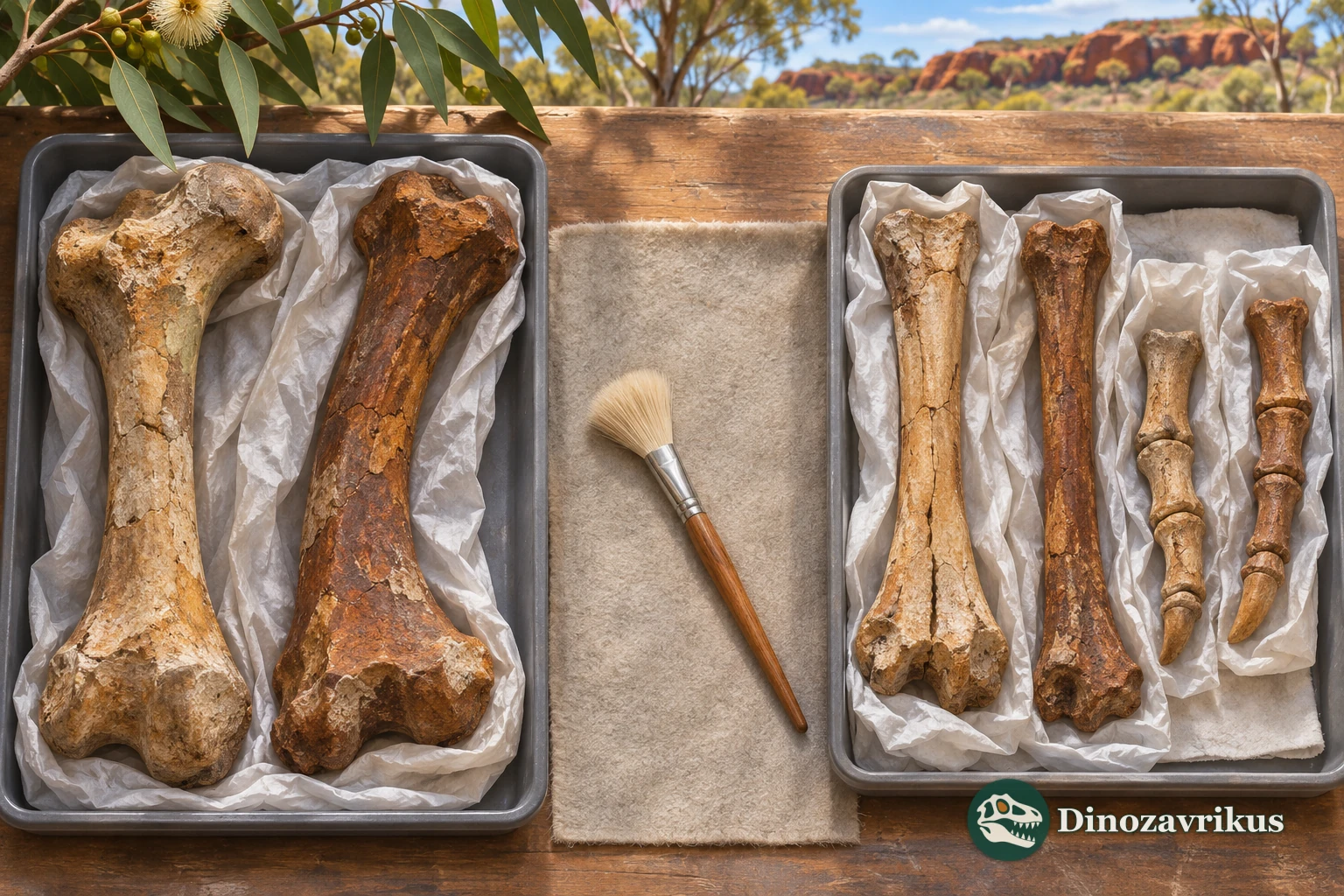
Several large flightless birds lived in Miocene central Australia. The first species of Ilbandornis was named from a thigh bone and a second from a foot bone. A much larger series of fossils was needed to link the different parts of the legs to the two species.
Quick facts
| Family | Dromornithidae |
|---|---|
| Age | Middle to late Miocene |
| Localities | Alcoota, Bullock Creek and Ongeva, Australia |
| Type specimen | CPC 13850, right femur |
| Genus named | Patricia Vickers-Rich, 1979 |
| Type species | Ilbandornis woodburnei |
| Second species | Ilbandornis lawsoni, with a history of differing generic assignments |
| Locomotion | Terrestrial and flightless |
What can the fossils tell us?
The two types represent different parts of the leg. Researchers linked further elements to each species by comparing repeated shape differences in the Alcoota fossils.
Shorter tarsometatarsi and broader ankles characterise I. woodburnei. I. lawsoni has more elongated lower limbs. The measurements provide no running speed.
A referred skull yielded a digital model of its brain cavity. The model allows a shape comparison with Dromornis and gives no direct record of diet.
Two type specimens from Alcoota
Patricia Vickers-Rich erected Ilbandornis in 1979. The type species, Ilbandornis woodburnei, is based on CPC 13850, a right femur from Paine Quarry in the Alcoota area. Part of the trochanter, a projection at the upper end of the bone, is broken away. The quarry is in the late Miocene Waite Formation.
The type of Ilbandornis lawsoni, CPC 13852, is a right tarsometatarsus with a damaged upper joint. It also comes from Alcoota. Vickers-Rich queried the generic assignment in the original description. The species has also been placed in Genyornis, while several later studies use Ilbandornis lawsoni.
Matching thigh, shin and foot
Trevor Worthy and Adam Yates compared large series of limb bones from Alcoota. The bones assigned to I. woodburnei combine a shorter tarsometatarsus with a wider lower tibiotarsus and a broader groove on the femur where the kneecap moves. I. lawsoni has an especially long tarsometatarsus and a narrow lower shin. These patterns helped the researchers match separately collected elements to each species.
The first bones of the three forward toes overlap in length. Their shapes, including relative joint widths and overall slenderness, provide another line of comparison. The longer lower legs of I. lawsoni imply different limb proportions. A precise standing height or running speed would require more than those ratios.
A skull from Bullock Creek
A skull from the middle Miocene Bullock Creek deposits, QVM:2000:GFV:20, was referred to I. woodburnei. In 2021, Warren Handley and Trevor Worthy used CT scans to reconstruct the internal cavity. The region corresponding to the hindbrain was proportionally longer and narrower than in the examined specimens of Dromornis.
An endocast captures the shape of the cavity inside the skull. It allows comparisons across the family, while the bird’s particular foods remain unknown. Anatomical studies have grouped Ilbandornis with relatively gracile dromornithids such as Barawertornis. Dromornithids belong within the broader lineage that also includes landfowl and waterfowl.
The central Australian fossil record
The Alcoota bone beds contain a dense mixture of birds and other vertebrates in the lower Waite Formation. Material from the older Bullock Creek fauna and younger Ongeva fauna has also been attributed to the two Ilbandornis species. These assignments suggest both lineages persisted through several million years of the Miocene.
The much later Pleistocene fossils of the dromornithid Genyornis newtoni belong to a different record. Secure occurrences of Ilbandornis are Miocene.

Frequently asked questions
Which bone defines Ilbandornis woodburnei?
The type is a right femur, CPC 13850, from Paine Quarry in the Alcoota area of the Northern Territory.
How can its legs be distinguished from those of Ilbandornis lawsoni?
The type species had shorter tarsometatarsi and broader lower shin bones. The outlines of the femoral groove and toe joints also differ.
Has an Ilbandornis skull been found?
A Bullock Creek skull was referred to I. woodburnei. CT scans provided a digital model of its brain cavity for comparison with other dromornithids.
When did Ilbandornis live?
Its fossils have been assigned to the middle and late Miocene. The type comes from the late Miocene Waite Formation at Alcoota.