

Inabtanin alarabia is based on a partial skeleton from Jordanian phosphate deposits. It preserves portions of the jaws and neck together with much of one wing. Researchers estimated a wingspan near five metres and used CT scans of the humerus to investigate how the wing may have borne flight loads. Those scans support a functional interpretation, not a direct observation of its flight.
Quick facts
| Scientific name | Inabtanin alarabia, Rosenbach and colleagues, 2024 |
|---|---|
| Holotype | YUPC-INAB-6-001–010, a partial adult skeleton |
| Locality | Inab-6 near Russeifa, Jordan |
| Rock and age | Muwaqqar Formation, Maastrichtian, Late Cretaceous |
| Jaws | Parts of a long toothless beak |
| Size | Estimated wingspan around 5 m |
| Relationships | Azhdarchoid; precise family placement unresolved |
What can the fossils tell us?
YUPC-INAB-6-001–010 includes toothless jaw pieces, cervical vertebrae, shoulder bones and wing elements. Soft tissue and a complete body are absent.
The authors estimated a wingspan of about five metres by comparing preserved wing elements. This is a calculation, not a direct measurement of an outstretched fossil wing.
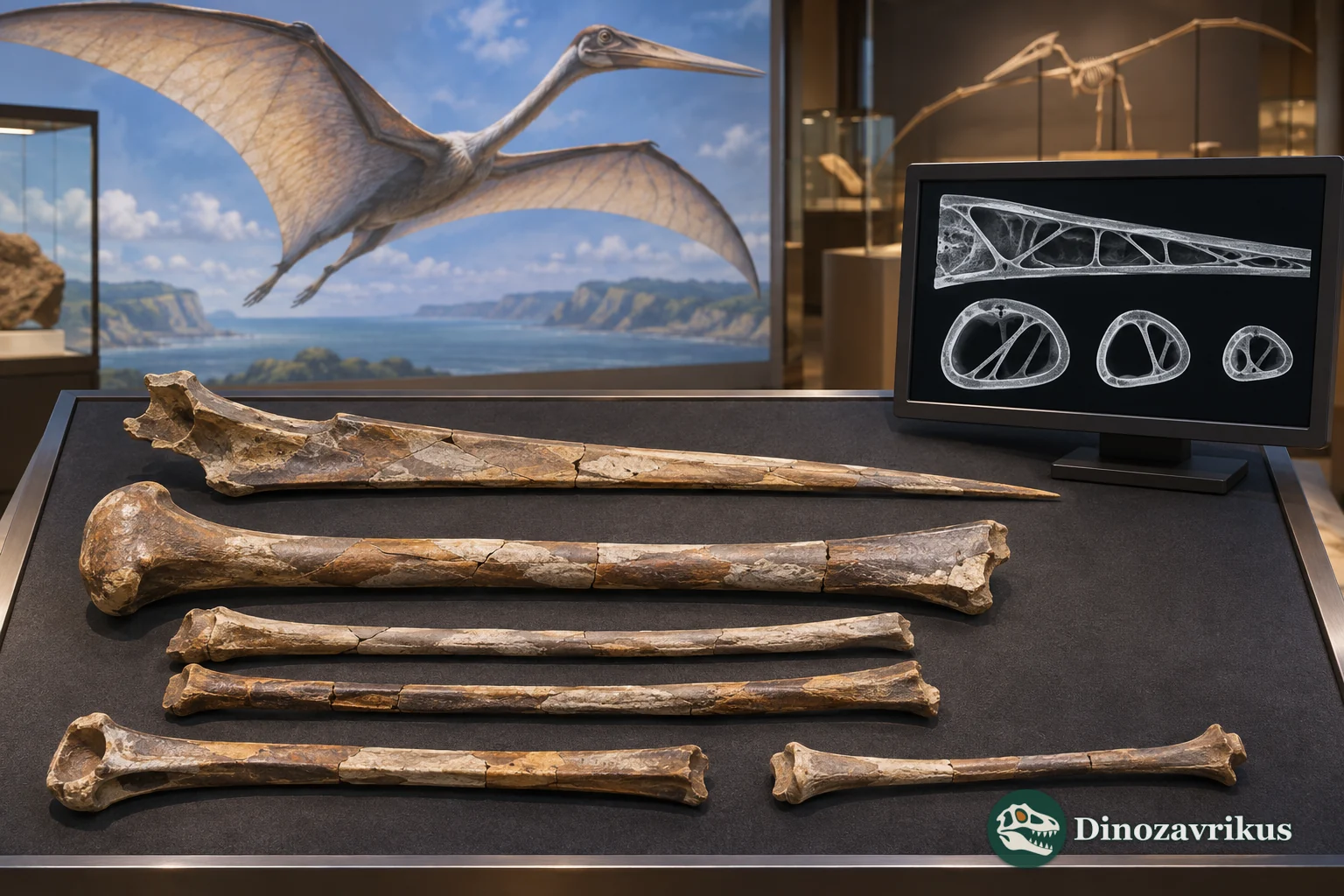
Computed tomography revealed thin internal struts in the humerus. Their arrangement was compared with modern flying birds to discuss loading in flight.
The authors proposed that Inabtanin could use substantial flapping flight. Bone structure cannot establish its only flight mode or the frequency of wingbeats.
A fossil from Jordanian phosphate deposits
The holotype was found at the Inab-6 locality near Russeifa. Its Muwaqqar Formation rocks date to the Maastrichtian near the end of the Cretaceous. The specimen combines upper and lower jaw pieces, early cervical vertebrae, a scapulocoracoid, a left humerus and much of the right wing. Several long wing bones make a size estimate possible, although the skeleton is incomplete.
The genus name draws on Arabic words associated with grapes and a dragon; alarabia refers to the Arabian Peninsula. The preserved jaws lacked teeth. They do not reveal colour, soft tissues or a specific diet. The original study recognised an azhdarchoid but did not resolve a precise family through a full phylogenetic analysis.
Wing bones and a five-metre estimate
The authors estimated a wingspan of roughly five metres from the preserved wing bones. The number is inferred from proportions: neither a complete outstretched wing nor the outline of its flight membrane survives. The study also considered the much larger Arambourgiania, whose wingspan estimate rests on different material.
CT scanning exposed a network of thin supports inside Inabtanin's humerus. Their orientation matters to resistance under load. The authors compared this structure with wing bones of living birds and suggested that Inabtanin could have relied substantially on flapping, while much larger pterosaurs might have spent more time soaring. This is an inference from anatomy, not an observation of wingbeats or a measured travel route.
What the locality does not establish
The animal was buried in marine deposits, but burial at sea does not prove that it always lived above open water. Toothlessness likewise does not identify its prey. Inabtanin preserves bones useful for flight comparisons; Huanhepterus instead offers a densely toothed snout. Their fossils answer different questions and come from different places and times.
Reading the reconstruction
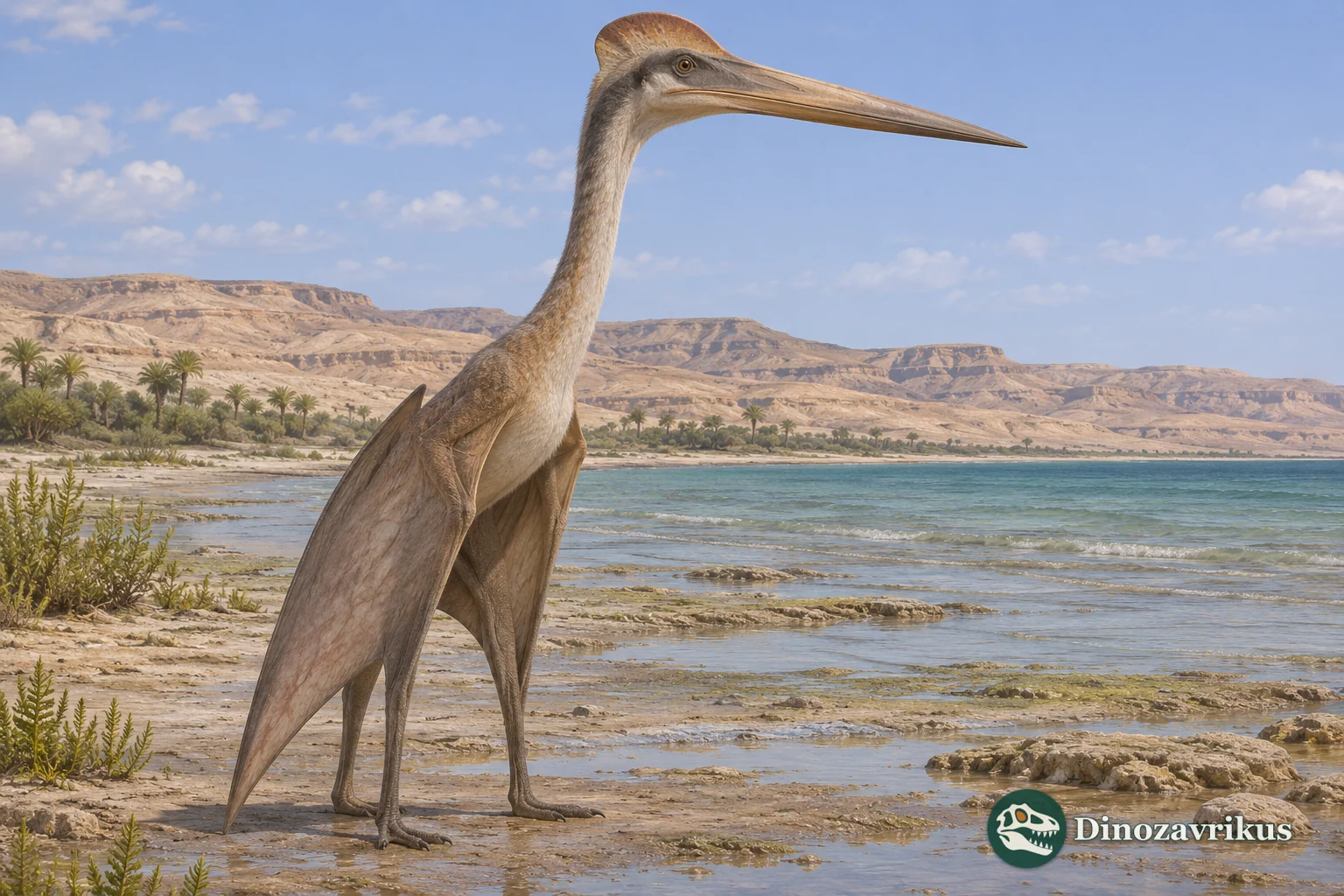
The cover and shoreline scene are artistic interpretations of a living pterosaur. The fossil supports the existence of a toothless beak and large wing bones, while colouring, soft tissues and behaviour remain choices for the illustration.
Frequently asked questions
Where was Inabtanin found?
At the Inab-6 locality near Russeifa, Jordan, in Maastrichtian rocks of the Muwaqqar Formation.
How large was its wingspan?
Researchers estimated about five metres using preserved wing bones. A complete wing was not available for direct measurement.
Did it have teeth?
The described portions of the upper and lower jaws are toothless. They do not establish an exact diet.
Do scans prove that it constantly flapped?
No. The internal structure of the humerus supports a proposal about active flapping but cannot reveal the animal's exact flight routine.