

Huanhepterus quingyangensis was discovered in a Gansu quarry in northwestern China. Its long, narrow jaws carried many fine teeth, and part of the neck and wings survived nearby. Only one damaged specimen is known. Even the age assigned to its rock layer has changed since its original description.
Quick facts
| Scientific name | Huanhepterus quingyangensis, Dong, 1982 |
|---|---|
| Holotype | IVPP V9070, a partial skull and skeleton preserved in part as impressions |
| Discovery | May 1978, Sanshilipu quarry, Gansu Province, China |
| Rock and age | Zhidan Group; initially called Late Jurassic, later considered probably Early Cretaceous |
| Jaws | Long narrow rostrum with numerous slender teeth |
| Size | Rostrum about 33 cm; complete wingspan unmeasured |
| Relationships | Pterodactyloid with ctenochasmatid affinities |
What can the fossils tell us?
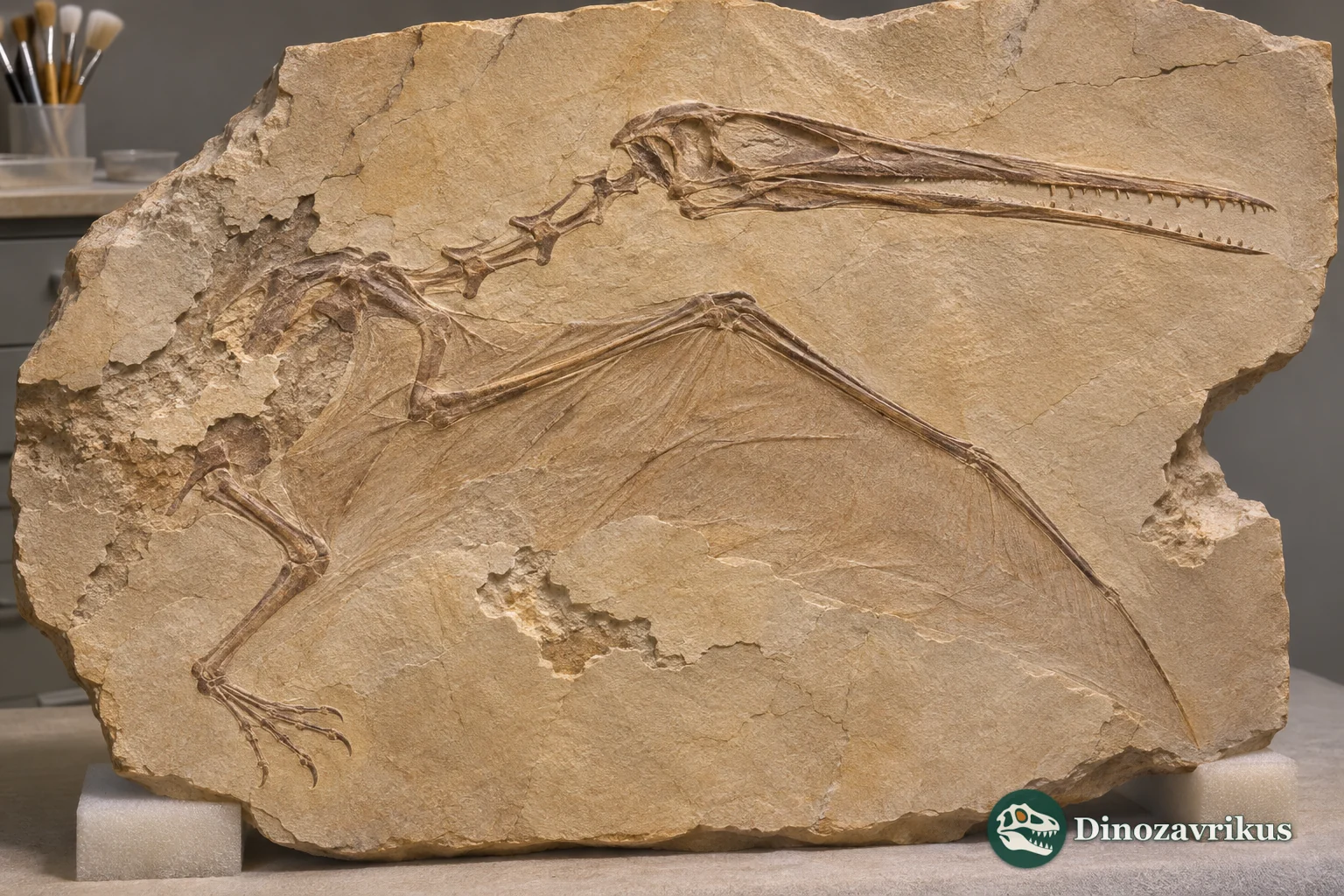
IVPP V9070 preserves mainly impressions of part of the body, the front of the skull, cervical vertebrae and pieces of the wings. Quarry blasting damaged the specimen.
A later comparison estimated a 330 mm rostrum and about 25–27 teeth on each side of a jaw. The fossil establishes tooth shape, not a particular prey item.
Dong assigned the fossil to Late Jurassic strata in 1982. Later stratigraphic work has suggested an Early Cretaceous age; the specimen itself lacks a precise numerical date.
The original description compared Huanhepterus with toothed ctenochasmatids. A revision of Gegepterus compared their snouts, tooth spacing and neck vertebrae.
A quarry on the Huanhe River
In early May 1978, stone workers encountered vertebrate fossils at the Sanshilipu quarry on the left bank of the Huanhe River near Qingyang, Gansu. Blasting damaged part of the skeleton. The surviving material became holotype IVPP V9070 at the Institute of Vertebrate Paleontology and Paleoanthropology. Dong Zhiming named the species in 1982 after the river and Qingyang County.
The specimen includes the front of the skull and impressions of bones from mainly one side of the body. Its described material includes posterior neck vertebrae and parts of the shoulder, wing and hind limb. Several long bones have damaged ends, limiting estimates of the complete animal.
What the snout and teeth show
The snout was long and narrow, with a low ridge on its upper surface. The slender teeth curved slightly. A later comparison estimated the rostrum at about 330 mm and counted roughly 25–27 teeth on each side of a jaw. The skull was estimated at more than half a metre long, but this is an extrapolation from incomplete material.
Dong compared the species with ctenochasmatids. A later study of Gegepterus compared tooth density and cervical proportions. Dense teeth can inform feeding hypotheses, but no gut contents or identifiable prey are reported for Huanhepterus. Hongshanopterus is another Chinese toothed pterosaur, represented chiefly by skull material with differently shaped teeth.
Why its age remains debated
The original description placed the fossil-bearing strata in the Late Jurassic. Later studies reconsidered the Zhidan Group and related Ordos Basin layers, proposing an Early Cretaceous age for the locality. The original paper gives no direct numerical date for IVPP V9070. Comparisons with other pterosaurs therefore need to state which stratigraphic interpretation they use.
Limits of a complete reconstruction
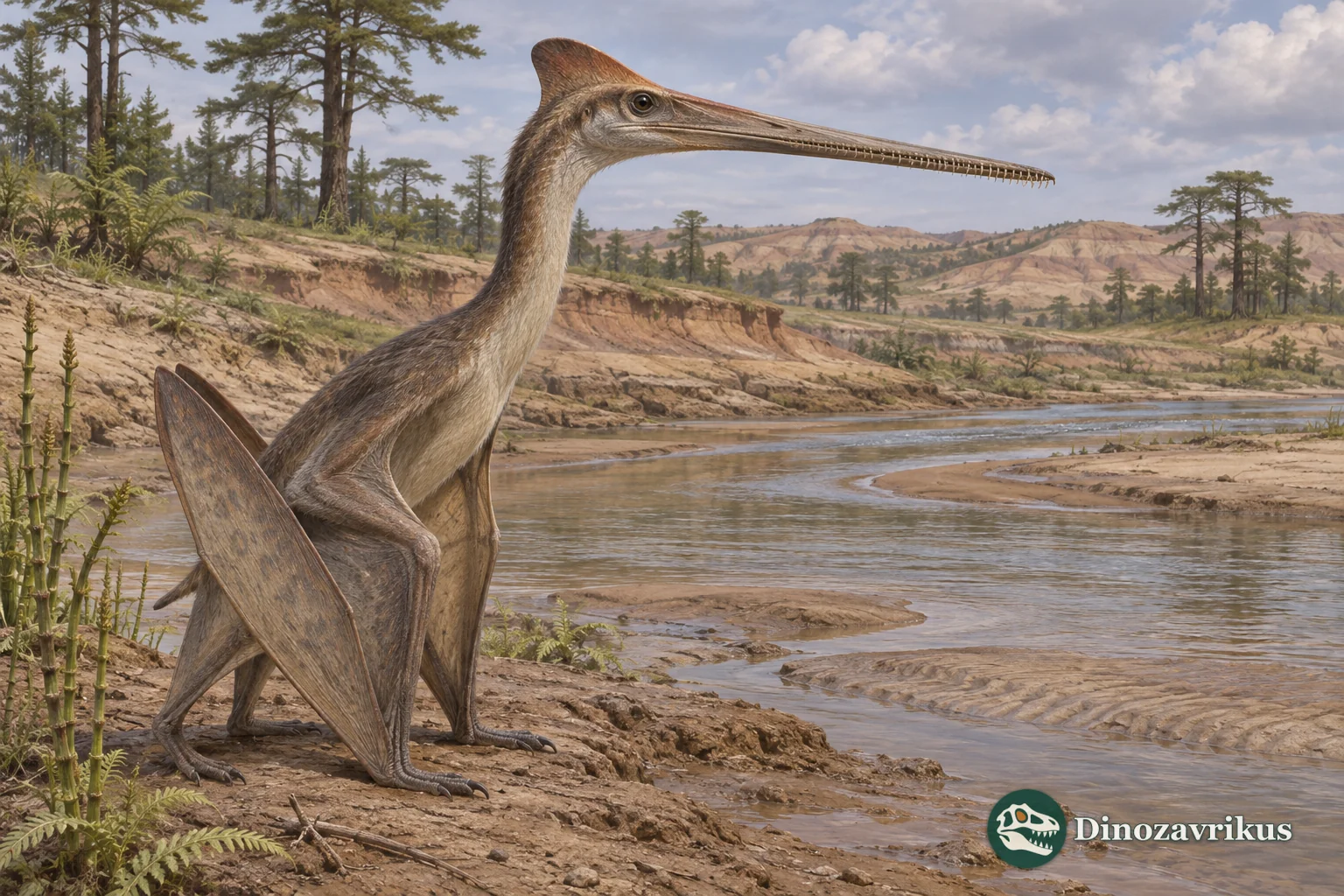
The cover and river scene interpret a whole pterosaur, while the fossil preserves only parts of its skull and skeleton. Wingspan, colour and behaviour cannot be read directly from the type specimen.
Frequently asked questions
Where was Huanhepterus found?
At Sanshilipu quarry beside the Huanhe River in Gansu Province, China, in May 1978.
Which bones are preserved?
Part of the toothed skull, neck vertebrae and fragments of the wings, shoulder and limbs. The complete skeleton is unknown.
How many teeth did it have?
A later study estimated about 25–27 teeth on each side of a jaw from the incomplete specimen.
Was it Jurassic or Cretaceous?
The 1982 description called the strata Late Jurassic; subsequent work has considered an Early Cretaceous age more likely. A precise date remains unsettled.