

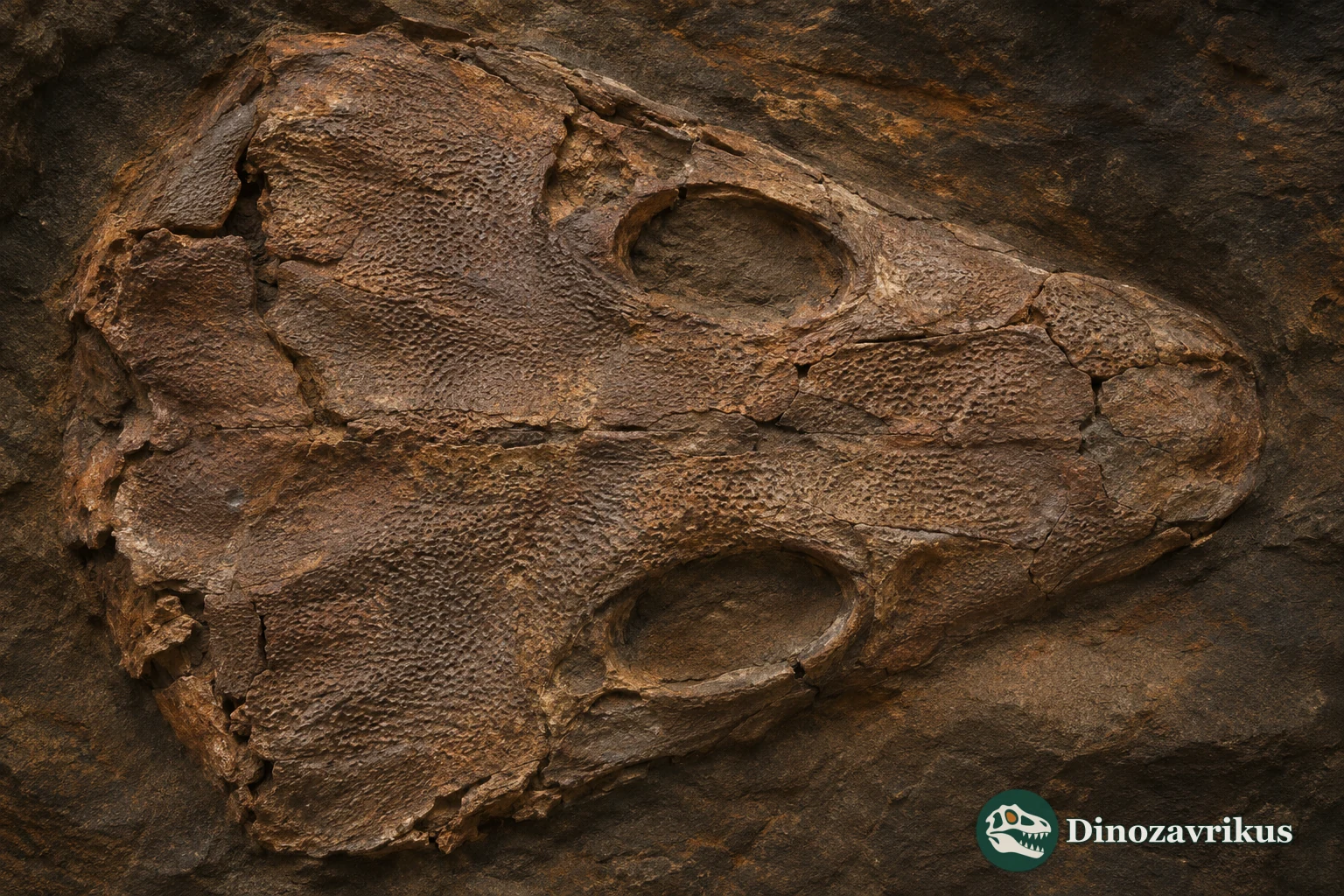
Indobrachyops panchetensis is known from a nearly complete skull from eastern India. Friedrich von Huene and M. R. Sahni named it in 1958. The outline of the specimen and the contacts between its bones have been interpreted differently over the years, leading to several changes in its classification among temnospondyl amphibians.
Quick facts
| Group | Temnospondyls |
|---|---|
| Age | Early Triassic, Induan |
| Region | Asia, Raniganj Coalfield, eastern India |
| Type species | Indobrachyops panchetensis |
| Scientific name | Indobrachyops |
| Diet | Exact prey is unknown |
What can the fossils tell us?
GSI 17754 is a nearly complete skull from the upper part of the Panchet Formation in the Raniganj Coalfield.
A 2011 comparison of skull characters placed Indobrachyops with rhytidosteids, alongside a group of Australian temnospondyls.
Distortion obscures some sutures near the eye. No associated trunk skeleton provides a reliable estimate of body proportions.
A skull from the Panchet Formation
The holotype, GSI 17754, came from Dhenua in the Raniganj Coalfield. A 2011 study assigned the upper Panchet Formation at the locality to the Induan, the first stage of the Triassic. The name panchetensis refers to the rock unit from which the skull came.
The bone that complicated classification
Von Huene and Sahni first included Indobrachyops in the Brachyopidae. Later studies disagreed about the lacrimal, a bone between the nostril and the eye socket. It was difficult to tell a bone boundary from a break in that part of the specimen. A 2011 analysis recovered Indobrachyops within the Rhytidosteidae, in a subgroup that also included Derwentia and several other Australian genera.
Reading a distorted skull
A fracture can shift two formerly adjoining pieces in different directions, while compression can change the outline of parts of the skull. In a 2022 conference study, researchers attempted to correct the distortion and compared the revised anatomy with that of the Brazilian Sangaia. They proposed placing both species in the same genus. The published conference abstract presents the proposal. The Indian holotype provides no direct record of body length or diet.
Frequently asked questions
Which specimen is the basis for Indobrachyops?
The holotype is GSI 17754, a nearly complete skull from the Panchet Formation.
Does its name refer to Brachyops?
Yes. The name combines a reference to India with Brachyops, reflecting the historical comparison with brachyopids.
Where did the 2011 study place it?
The analysis placed it among rhytidosteids in the same subgroup as Derwentia and several other Australian forms.
Can researchers measure its full body length?
The skull gives an indication of head shape. A reliable body length would require associated material from the trunk and tail or a closely comparable skeleton.