

Infernodrakon hastacollis is known from one long cervical vertebra from Montana's Hell Creek Formation. The bone was found during preparation of a field jacket containing part of a young tyrannosaur skeleton. Initially compared with Quetzalcoatlus, it was given a separate genus after a new study. Its head, wings and full body remain unknown.
Quick facts
| Scientific name | Infernodrakon hastacollis, Thomas and colleagues, published online 2025 |
|---|---|
| Holotype | BMR P2002.2, an almost complete but crushed neck vertebra |
| Locality | Carter County, Montana, United States |
| Rock and age | Hell Creek Formation, latest Maastrichtian |
| Group | Azhdarchidae |
| Known material | One cervical vertebra; no skull or wing bones |
| Bone length | 369 mm as preserved |
What can the fossils tell us?
BMR P2002.2 is almost complete and 369 mm long as preserved, but was flattened during burial. No skull or limb belongs to the specimen.
The vertebra was recovered from a field jacket with a tyrannosaur skeleton. Association in sediment does not establish that the animals interacted in life.
A 2006 study compared the bone cautiously with Quetzalcoatlus. Laser scanning and anatomical comparison in a paper published online in 2025 supported a separate genus.
Its neck bone places it among long-necked azhdarchids. Wingspan, head shape, colour and diet cannot be measured from this single element.
A bone in a tyrannosaur field jacket
In July 2002, preparation of a field jacket from the K-12 locality in Carter County revealed a slender bone alongside part of a young tyrannosaur skeleton. It became specimen BMR P2002.2 at the Burpee Museum of Natural History in Rockford, Illinois. Their shared rock block describes burial, not a predator-prey encounter.
The bone came from sandstone of the Hell Creek Formation, approximately 60–70 m above the formation's base at that locality. The original geological description traces river-channel sand, an overlying clay-clast layer and quieter-water deposits. That sequence informs burial conditions without pinpointing where the pterosaur died.
Why a single vertebra received a new name
Henderson and Peterson described the bone in 2006 as an azhdarchid cervical vertebra and compared it provisionally with Quetzalcoatlus. Its preserved length is 369 mm and its midshaft height about 23 mm. Lateral crushing contributes to its narrow appearance, limiting simple size comparisons.
Thomas and colleagues re-examined the bone with laser scanning and compared its anatomical features with other azhdarchids. In a paper published online in February 2025, they named Infernodrakon hastacollis. Their phylogenetic analysis placed it closer to Arambourgiania than to Quetzalcoatlus. That placement is an analytical result based on currently sampled characters, not a fixed fact about every future classification.
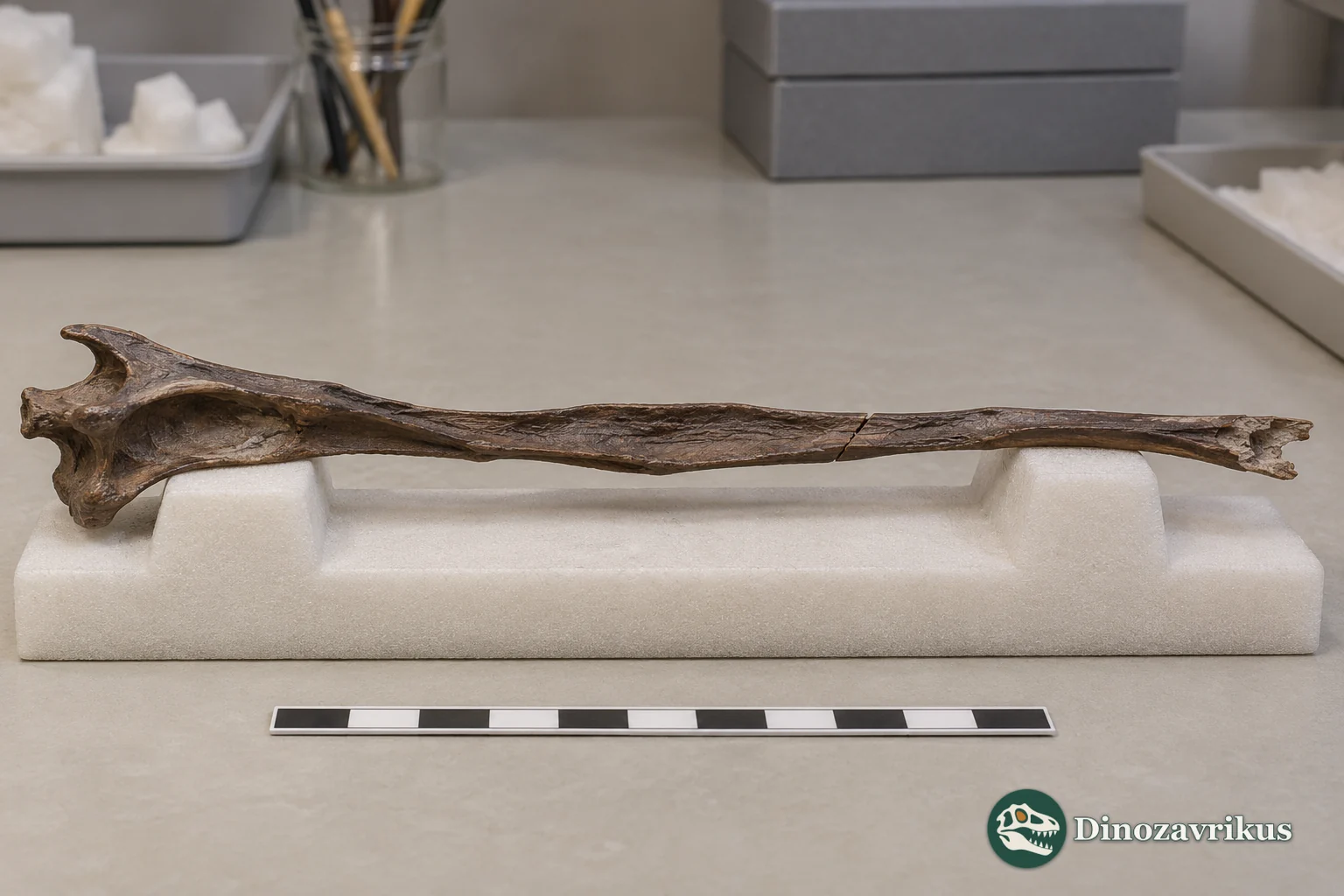
What its size and body cannot tell us
The describing authors called Infernodrakon a medium-sized azhdarchid. Its wingspan cannot be measured directly because no wing bone is known. The beak, legs and body proportions are likewise missing. By comparison, Inabtanin preserves wing elements that allow an estimated span, though that estimate also involves inference.
Long neck and pterosaur identity follow from the bone and comparison. A toothless head, membrane outline, colours and feeding behaviour shown in art depend on relatives and illustration. No gut contents or soft-tissue impressions are reported for the type specimen.
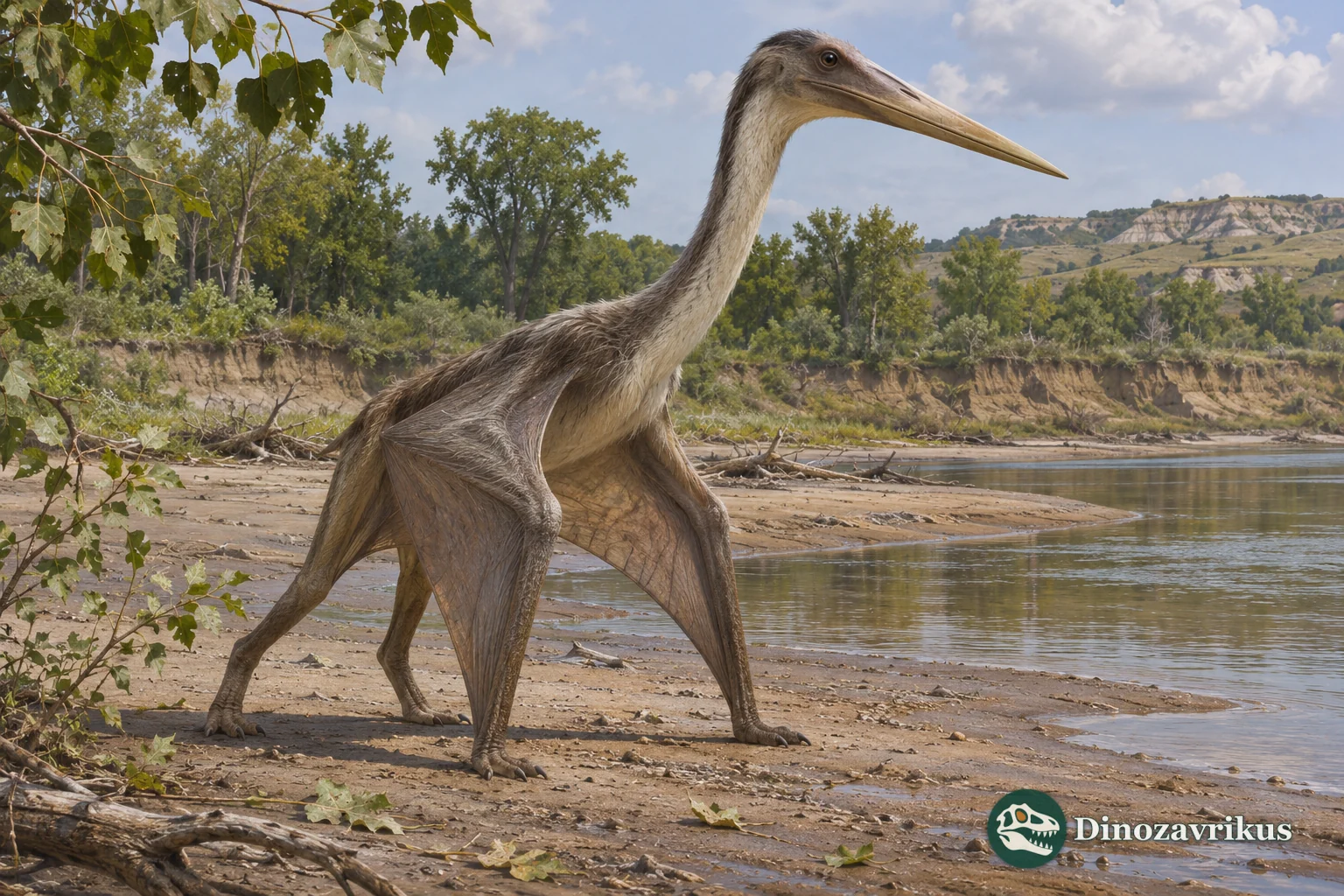
Reconstructing a Hell Creek animal
The second scene places an azhdarchid-like animal in a river environment consistent with the deposit. It does not depict a documented individual or a measured flight pose.
Frequently asked questions
Where was Infernodrakon found?
At the K-12 locality in Carter County, Montana, in rocks of the Hell Creek Formation.
How much of the animal survives?
Only one nearly complete cervical vertebra, catalogued as BMR P2002.2.
Why was it once compared with Quetzalcoatlus?
Its long neck bone indicated an azhdarchid. A later detailed comparison supported a separate genus.
Is its wingspan known?
No. No wing bones are known, so its span cannot be measured directly.