

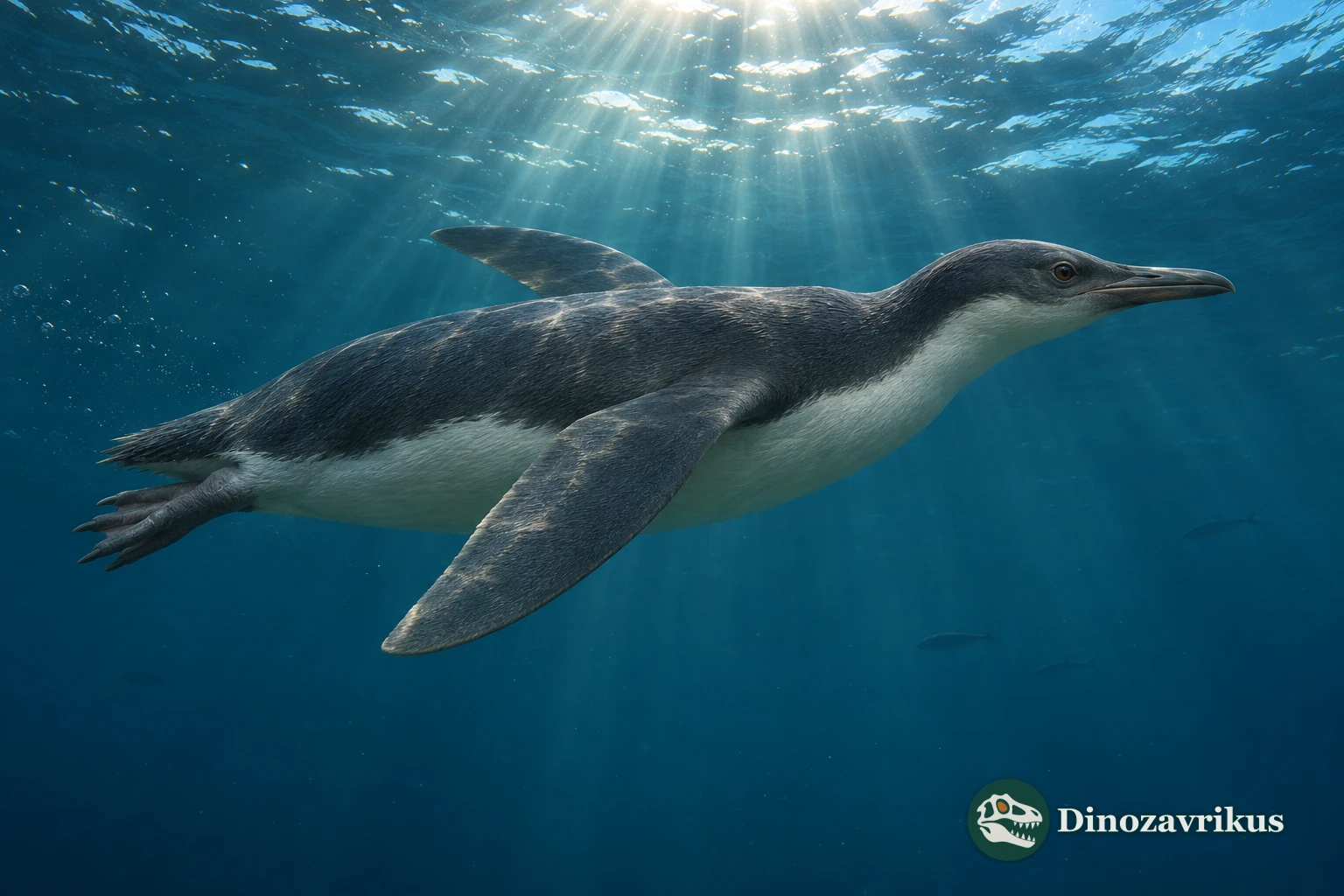
Inguza was a penguin that lived on the coast of southern Africa about five million years ago. Its first fossil was thought to represent a close relative of the living African penguin. Further wing and leg bones gave researchers the chance to test that relationship.
Quick facts
| Group | Penguins |
|---|---|
| Age | Early Pliocene, around 5.15 million years ago |
| Locality | Langebaanweg, South Africa |
| Holotype | Humerus L6510 |
| Additional material | Bones of the wings and hind limbs |
What can the fossils tell us?
Material assigned to the species includes the ulna, radius and carpometacarpus as well as the type humerus.
The distal joint surfaces of the tarsometatarsus are nearly parallel in Inguza. The fourth toe joint is offset dorsally in living banded penguins.
Bones of unfledged chicks occur at Langebaanweg. Their assignment to Inguza is provisional.
The discovery and the change of genus
In 1971 George Gaylord Simpson described humerus L6510 from Langebaanweg as Spheniscus predemersus. It was the first African fossil penguin formally described. It comes from the Varswater Formation, where the fossil-bearing horizon has been estimated at about 5.15 million years old.
After studying additional bones, Simpson erected the genus Inguza in 1979. Specimens assigned to the species include a femur, tibiotarsus and tarsometatarsus, along with bones of the forearm and hand. The published skeletal reconstruction brings together material from several individuals.
What the comparisons show
Daniel Ksepka and Daniel Thomas compared structures on the humerus and the tarsometatarsus. One margin of a depression on the Inguza humerus is concave. The same edge is straight in living Spheniscus, in which a lip bounding the depression also projects more strongly. The distal tarsometatarsus differs in the position of the joint surface that carries the fourth toe.
In the researchers’ analysis this suite of characters placed Inguza outside the group formed by the four living species of Spheniscus. Another fossil penguin from South African deposits, Dege, adds a distinct branch to the story. The analysis concluded that the fossil species represented several separate arrivals of penguins in Africa.
Evidence of breeding
At Langebaanweg, a humerus, femur and other bones document unfledged penguin chicks. Penguins so young could not have travelled far under their own power, so their remains indicate breeding in the region. The authors tentatively assigned these bones to Inguza. Several penguin species occur in the local fossil record, leaving the precise identity of the chicks open.
Frequently asked questions
Where was Inguza discovered?
In Early Pliocene deposits of the Varswater Formation at Langebaanweg, South Africa.
Why did its name change?
Simpson initially placed it in the genus of living banded penguins and later established a separate genus on additional evidence.
Was Inguza the ancestor of the African penguin?
Limb characters place it outside the living banded penguin group and do not support that direct ancestry.
Are chicks of this species known?
Bones of unfledged penguins are known, but their assignment to Inguza remains provisional.