

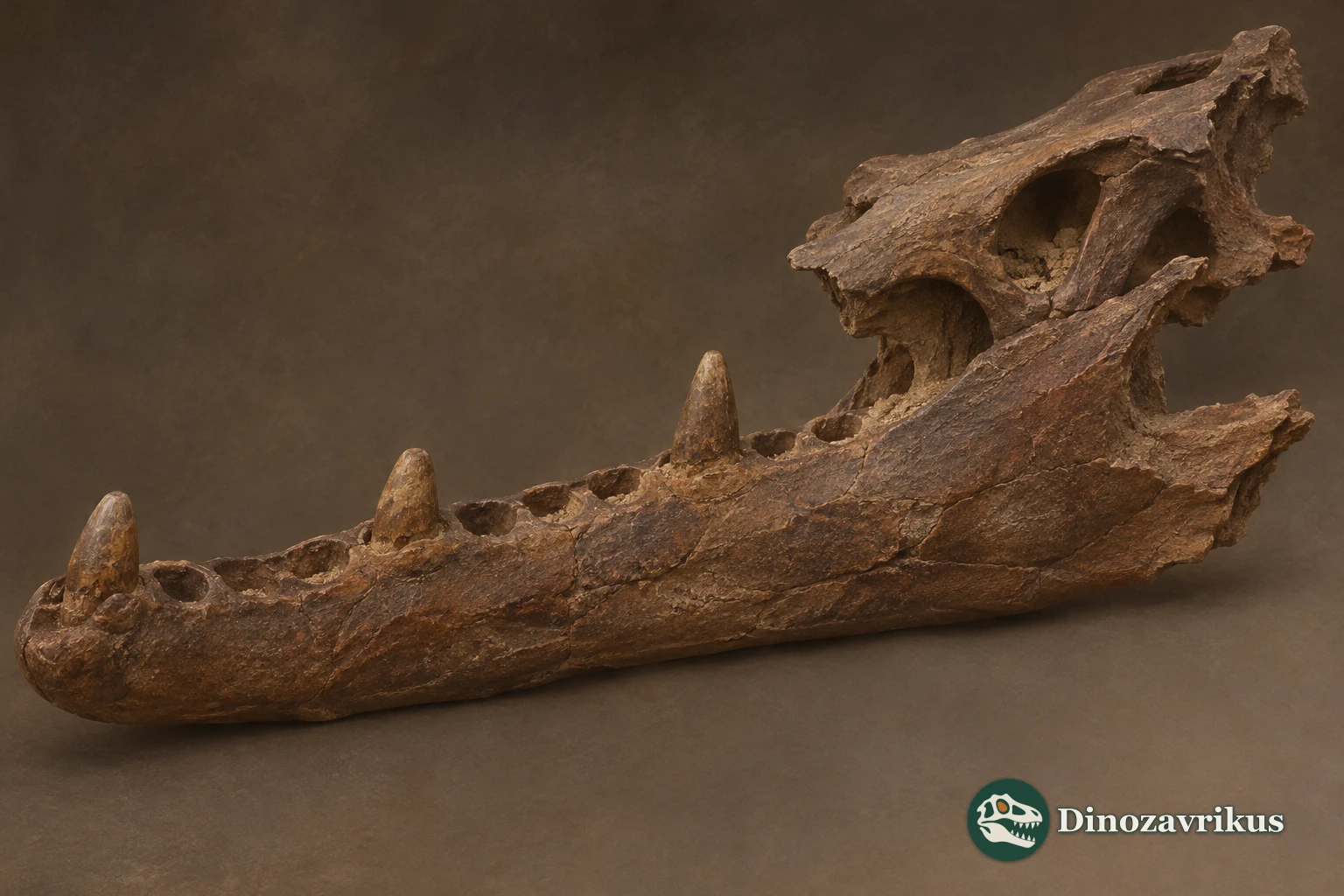
Itasuchus jesuinoi was a crocodyliform from Late Cretaceous river deposits in southeastern Brazil. Its type material combines skull fragments, jaws and disarticulated parts of the skeleton. A femur provides an estimate of body length, while a thin section from a separate osteoderm gives evidence about the structure of its skin.
Quick facts
| Species | Itasuchus jesuinoi |
|---|---|
| Group | Notosuchia, family Itasuchidae |
| Age of holotype | Maastrichtian, Late Cretaceous |
| Locality | Peirópolis, Minas Gerais, Brazil |
| Holotype | DGM 434-R, jaws, skull fragments and skeletal bones |
| Estimated length | About 2.3 m from the femur |
What can the fossils tell us?
DGM 434-R includes pieces of the jaws, vertebrae, limb bones and osteoderms. These bones were recovered out of articulation.
A model based on related animals produced an estimate of 2.26 m, with a reported range of roughly 1.75–2.90 m.
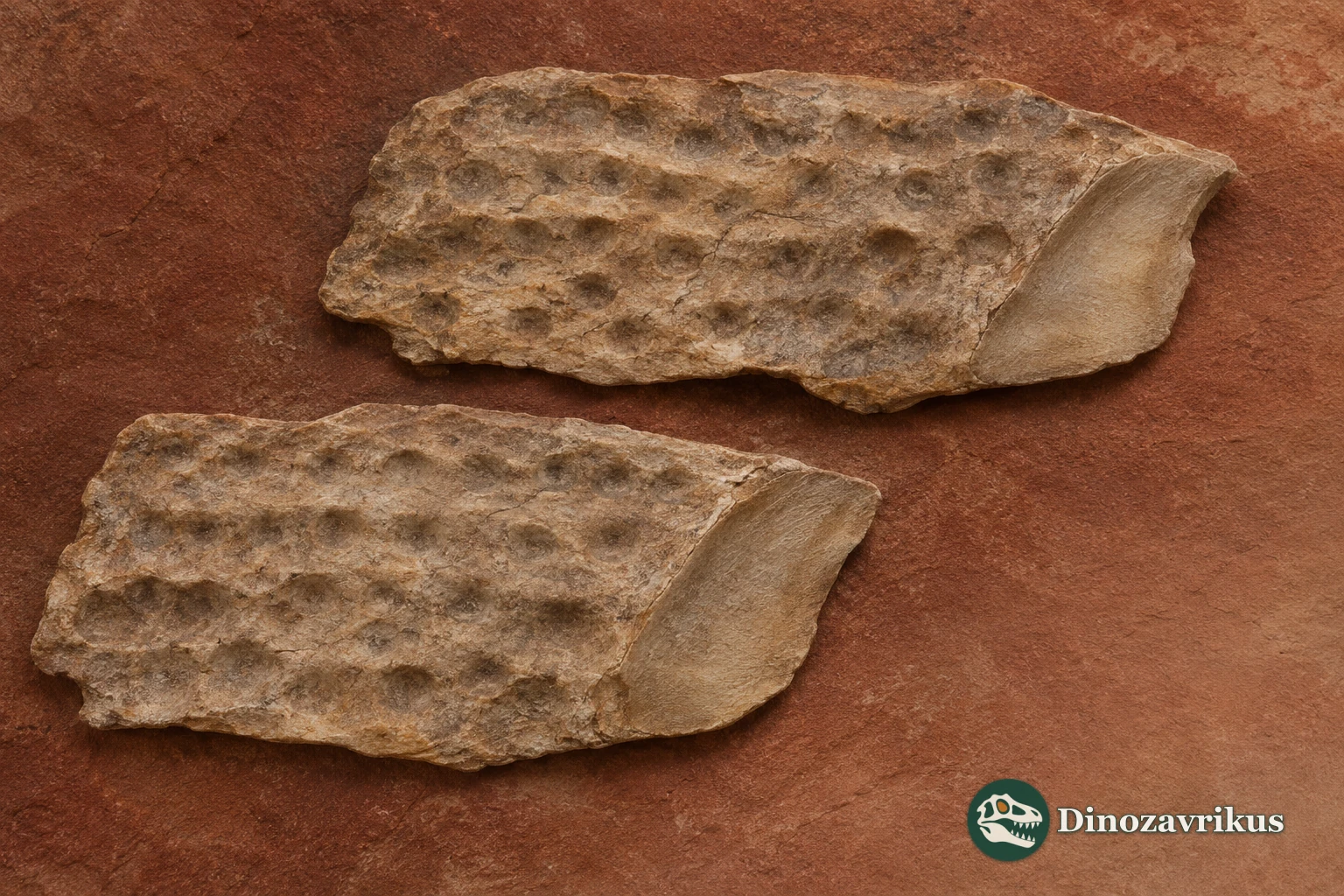
CPPLIP 332 preserves fibre bundles and growth marks. Comparisons with other crocodylomorphs suggest a relatively thick layer of skin around it.
Disarticulated bones from Peirópolis
Llewellyn Ivor Price named Itasuchus in 1955. The holotype DGM 434-R includes parts of the jaws and left side of the skull, vertebrae, pelvic and limb bones and osteoderms. Their similar proportions and lack of duplicated elements supported assignment to one individual.
The material came from Maastrichtian deposits near Peirópolis and the city of Uberaba. Older accounts placed the beds within the Marília Formation. Sedimentological work later recognised Serra da Galga as a separate formation, deposited in a system of branching river channels.
Measuring the femur and looking inside a scute
The femur used in the 2026 length study measures 225.9 mm. A phylogenetic model used relationships and proportions in comparable animals to estimate a total length of about 2.3 m. The reported 75% interval is wider, at about 1.75–2.90 m.
Osteoderms are pieces of bone within the skin. In a thin section of CPPLIP 332, an osteoderm attributed to Itasuchus, fibre bundles approach its outer surface and growth marks pass through the bone. The fibres are consistent with firm attachment to a relatively thick layer of skin. This osteoderm was studied separately from the holotype.
A branch of notosuchian crocodyliforms
Price originally assigned Itasuchus to Goniopholididae. Recent analyses place it among notosuchians and use the genus to define Itasuchidae. In several analyses the jaw and skull evidence places Hamadasuchus within the neighbouring peirosaurid lineage.
Itasuchids are known beyond Brazil. The genus Sissokosuchus was described from Mali in 2025, extending the geographical record for the family. The fossils named Itasuchus itself come from South America.
Frequently asked questions
Where was Itasuchus found?
Near Peirópolis, Minas Gerais, in Late Cretaceous deposits of the Serra da Galga Formation.
Is the entire skeleton preserved?
The type includes jaws, skull pieces, vertebrae, limb bones and osteoderms that were found disarticulated.
How was its length estimated?
A phylogenetic model used a measured femur of 225.9 mm to estimate a total length of about 2.3 m.
What did the osteoderm section show?
Fibre bundles associated with attachment to the surrounding skin and marks left by cycles of growth.