

Jacquhermania is an Eocene ray known from small teeth with smooth, pointed crowns. Four Belgian teeth formed the original basis for its type species and were initially interpreted as shark teeth. A later account added teeth of another ray to the same species. Comparing crown and root anatomy under magnification eventually separated the two forms.
Quick facts
| Group | Myliobatiform rays |
|---|---|
| Type species | Jacquhermania duponti |
| Genus authority | Henri Cappetta, 1982 |
| Type locality | Woluwe-Saint-Lambert, Belgium |
| Type beds | Middle Eocene, Bruxellian deposits |
| Tooth width | Up to 1.5 mm in the Alabama sample |
What can the fossils tell us?
Comparison with new teeth from the Belgian type locality separated Jacquhermania from Coupatezia.
Anterior teeth are narrower, and far lateral teeth have broader, lower crowns.
The resemblance is dental. Root shape and cusp inclination differ from those of living Gymnura.
How four teeth changed classification
In 1874, Tiberius Cornelis Winkler named Cestracion duponti from four teeth at Woluwe-Saint-Lambert. He figured one specimen and interpreted the teeth as anterior elements of a heterodont shark. Maurice Leriche later transferred the species to rays, adding broader, lower teeth with a rough surface. In his 1905 account he attributed the contrast to sex, assigning the smooth pointed teeth to males and flatter ones to females.
Henri Cappetta revisited the figured teeth and abundant new material from the type locality in 1982. Scanning electron photographs helped him compare the historic specimens. He erected Jacquhermania for the smooth-crowned material originally studied by Winkler, and parts of Leriche's wider concept went into Coupatezia woutersi. An old record under Raja duponti therefore needs to be checked against a specimen or illustration.
The genus commemorates Belgian researcher Jacques Herman. Cappetta had initially considered the name Hermania, but it was already in use for a gastropod subgenus.
Crown and root anatomy
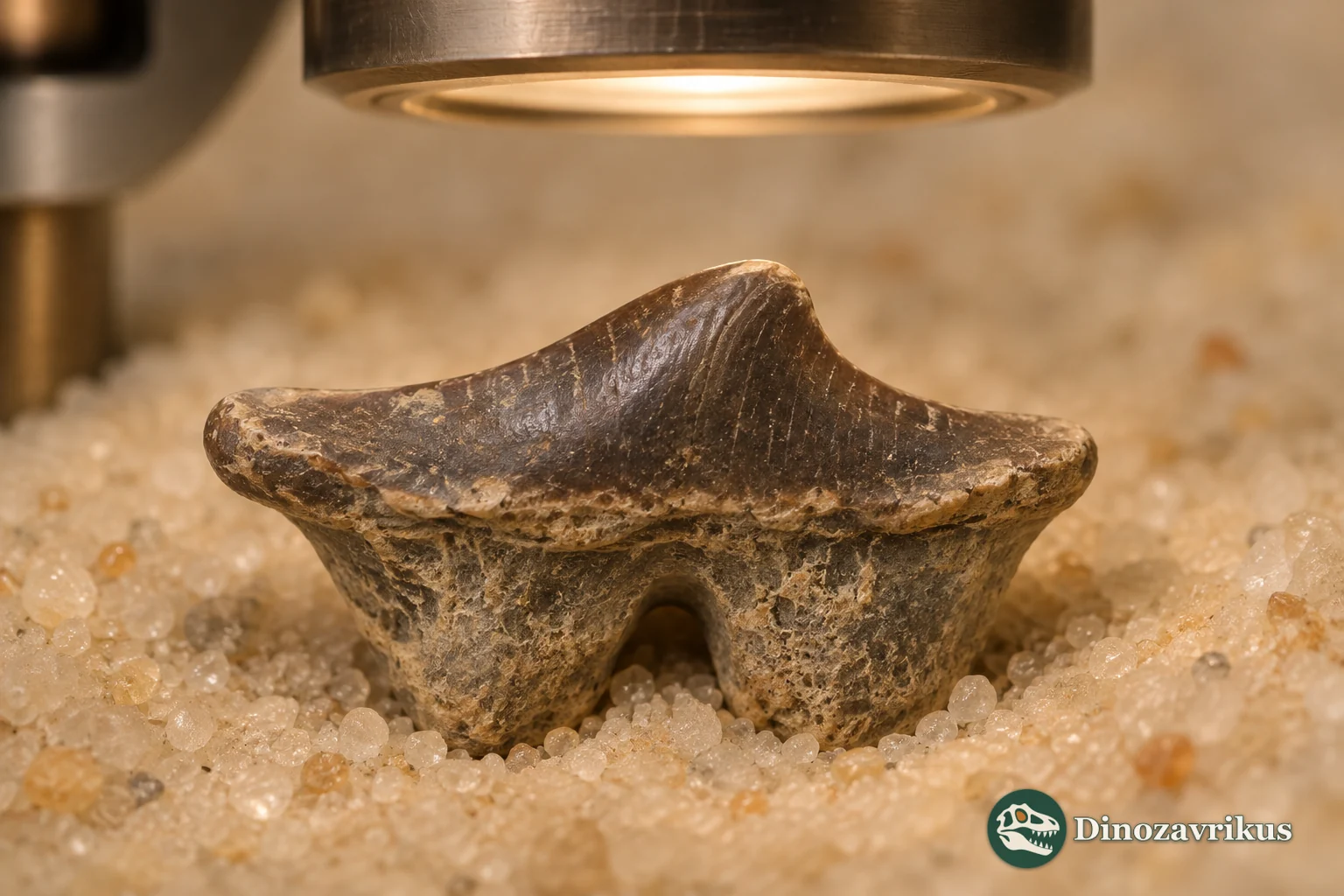
The anterior teeth have tall crowns with nearly upright cusps flattened from side to side. The outer face has a central indentation between two projecting shoulders. Distinct cutting edges run down towards the shoulders. The low root has two lobes separated by a wide groove that contains openings of several sizes.
Towards the corner of the mouth, the cusp changes inclination. Very lateral teeth have a shorter cusp, a broader crown with a more triangular outer face, and heavier root lobes. Cappetta recognised the specimen figured by Winkler as lateral, so the famous original illustration represents only one part of the dentition.
What the Alabama sample added
Ebersole, Cicimurri and Stringer examined 28 isolated teeth from Alabama's Claiborne Group. The widest teeth in that sample measure no more than 1.5 mm. The finds come from the base of the Lisbon Formation and the Gosport Sand. They span the early Lutetian to middle Bartonian, corresponding to calcareous nannoplankton zones NP15–NP17.
Two Lisbon teeth are unusually tall. The authors considered whether they came from the front of the mouth or represented a male variant. Without associated tooth rows, the two explanations cannot be separated. A combination of smooth enameloid, a markedly convex inner crown face and a two-lobed root helps distinguish the teeth from those of other local rays.
The tentative butterfly ray connection
Cappetta linked the genus to living butterfly rays on the basis of the smooth cuspidate crown and its prominent shoulders. In living Gymnura, the anterior cusp is more slender and less upright, and the root is higher and shorter from lip to tongue. The family placement was therefore proposed provisionally. Similar features could have evolved independently.
Body length, exact disc outline and diet cannot be established from these teeth. The cover imagines a general butterfly ray-like outline. The profile of Eoplinthicus illustrates another case where dental characters inform classification but reveal little about the tail.
Frequently asked questions
Why was it first identified as a shark?
Winkler interpreted the pointed crowns as anterior teeth of a heterodont shark. Later comparison placed them among rays.
Whom does the genus honour?
It honours Jacques Herman. Cappetta established the genus in his 1982 revision.
How wide are the teeth?
They are no wider than 1.5 mm in the Alabama sample. That figure measures teeth and gives no body length.
Is a relationship to living butterfly rays established?
The dental similarities justify a tentative placement. Differences in the root and cusp leave that placement open.