

Janusaurus lundi was an ophthalmosaurid ichthyosaur from the Upper Jurassic of Svalbard. Its holotype preserves part of the skull and several regions of the postcranial skeleton, but it is not complete. The original genus name remains in use, although a 2019 revision proposed combining Janusaurus with Arthropterygius.
Quick facts
| Type species | Janusaurus lundi Roberts et al., 2014 |
|---|---|
| Age | Early Middle Volgian, Late Jurassic |
| Locality | Janusfjellet, Spitsbergen, Svalbard |
| Holotype | PMO 222.654, incomplete skeleton |
| Repository | Natural History Museum, University of Oslo |
| Estimated length | About 3–4 m, inferred by comparison |
Evidence guide
PMO 222.654 includes part of the skull, vertebrae, much of the pectoral girdle and left forefin, a right humerus, part of the pelvis and both femora. It is a substantial but incomplete specimen, not a complete skeleton.
The description highlights a very slender stapes, a groove and foramen on the interclavicle, a short scapula relative to the coracoid and an anterodorsal process on the ilium. These features aid comparisons but depend on preservation and taxon sampling.
The holotype is from the Slottsmøya Member of the Agardhfjellet Formation, assigned to the early Middle Volgian of the Late Jurassic. This dates the rock layer, not the animal’s individual age.
Zverkov and Prilepskaya proposed Arthropterygius lundi in 2019. Delsett and colleagues did not accept the synonymy. Janusaurus lundi is the original combination; the alternative reflects a revisionary opinion rather than settled consensus.
The holotype from Janusfjellet
The only known specimen, PMO 222.654, was excavated in 2010 from the north side of Janusfjellet in central Spitsbergen, about 13 km northeast of Longyearbyen. It is held at the Natural History Museum, University of Oslo. The genus name refers to Janusfjellet; the species honours Bjørn Lund, a technician who took part in the 2006–2012 fieldwork.
The fossil preserves part of the skull, representative cervical, dorsal and caudal vertebrae, a nearly complete pectoral girdle and left forefin, the right humerus, part of the pelvis and both femora. Missing regions mean that some proportions and the complete tail cannot be measured directly.
A Late Jurassic polar sea
The specimen came from the Slottsmøya Member of the Agardhfjellet Formation. Roberts and colleagues placed the horizon in the early Middle Volgian, 31 m below the Dorsoplanites Bed. The geological age comes from stratigraphic correlation rather than a direct measurement of the fossil.
The Slottsmøya deposits preserve a diverse marine vertebrate fauna from the high-latitude Boreal realm. Co-occurrence with other ichthyosaurs and plesiosaurs helps describe the ecosystem, but it does not identify what Janusaurus ate.
Anatomy and diagnosis
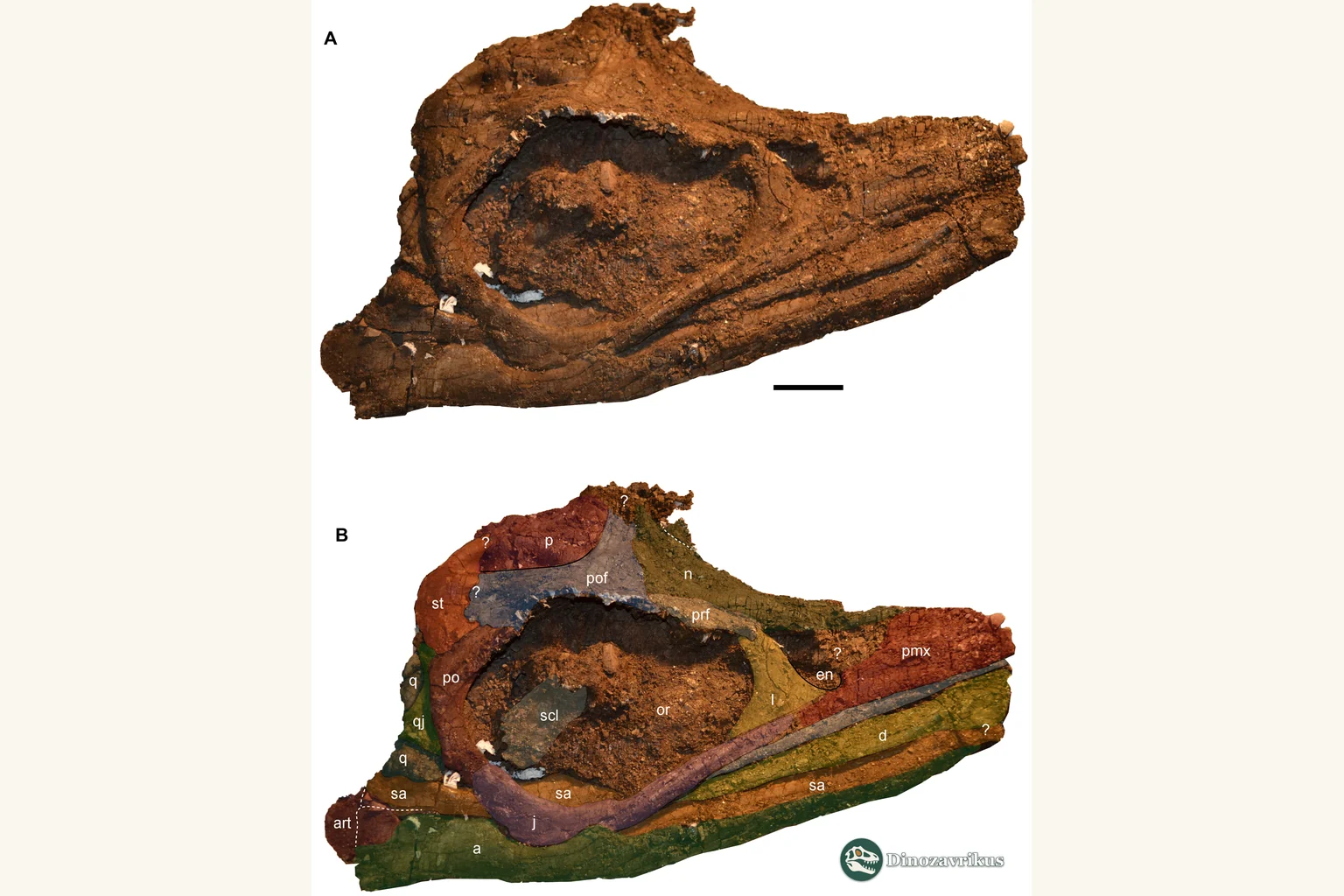
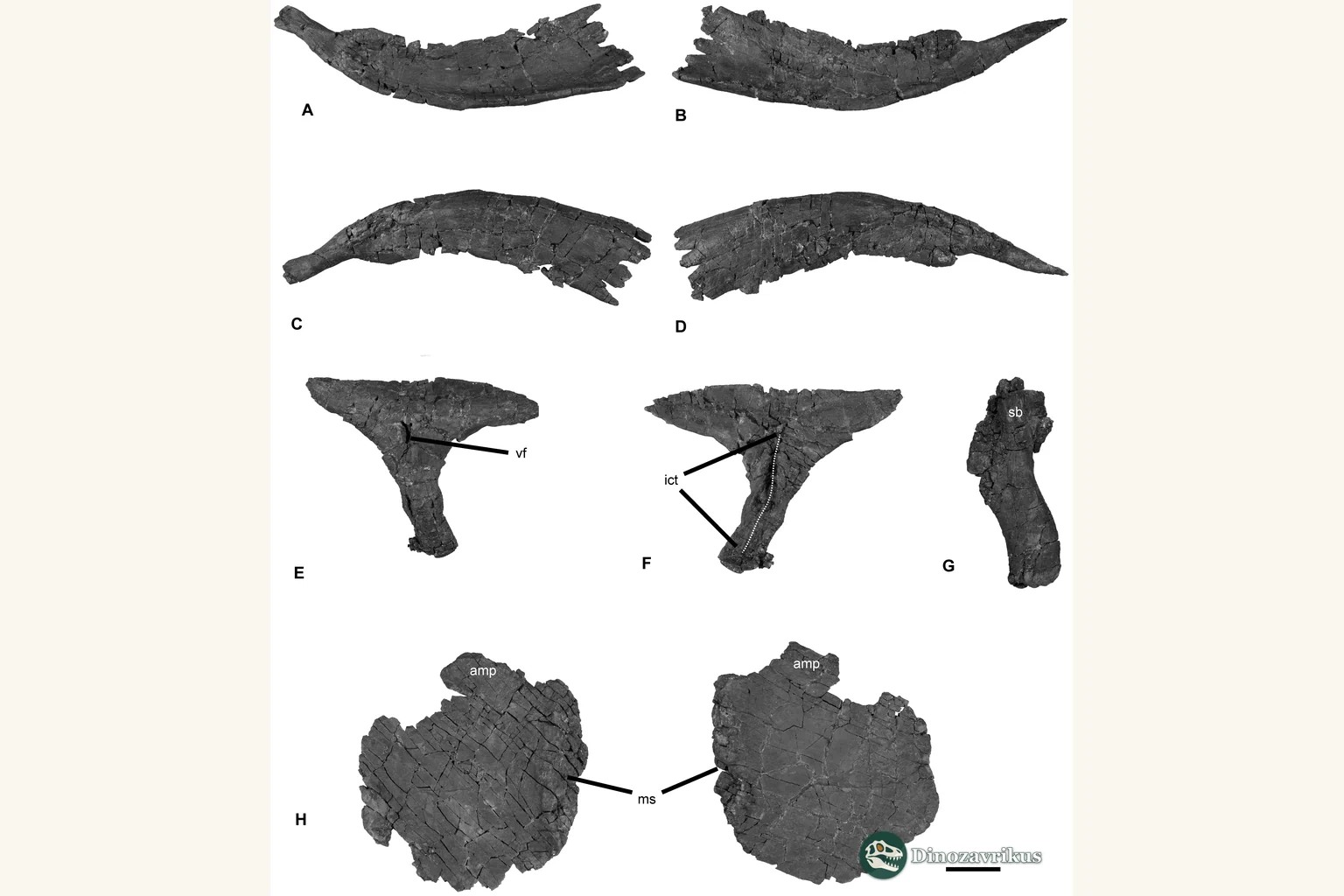
The skull combines a gracile stapes with features of the prearticular and other bones. In the shoulder region, the interclavicle has a trough and a conspicuous ventral foramen; the scapula is short compared with the coracoid. The ilium bears an anterodorsal process, and the humerus has three distal facets. No single trait alone explains the classification: the diagnosis relies on the combination across the preserved skeleton.
The images below show actual bones and the published anatomical interpretation. Labels and coloured overlays belong to the scientific figure, not to an artistic reconstruction.
Size and locomotion
A body length of about 3–4 m was estimated by comparing the skull and ribs with more complete ophthalmosaurids. Because the tail and parts of the axial skeleton are missing, this is a comparative estimate rather than a measurement of a complete Janusaurus skeleton.
The forelimbs were flippers, as in other ichthyosaurs, but the fossil does not record swimming speed or a particular manoeuvre. Limb proportions allow anatomical comparison; detailed behaviour remains unknown. The related Svalbard form Arthropterygius is useful context, as is the Jurassic ichthyosaur Hauffiopteryx, though neither is demonstrated to be a direct ancestor.
Janusaurus or Arthropterygius?
The 2014 description named Janusaurus lundi as a distinct genus and species. Its phylogenetic analysis placed it among ophthalmosaurines but did not resolve all relationships among the Svalbard taxa.
In 2019, Zverkov and Prilepskaya treated Janusaurus as part of Arthropterygius, using the combination Arthropterygius lundi. Delsett and colleagues disputed that synonymy later the same year, arguing that the evidence did not justify merging the genera. The fossil record is limited, so the safest account distinguishes the original name from the proposed alternative rather than presenting either as a universal consensus.
Frequently asked questions
Where was Janusaurus found?
Its holotype was excavated on the north side of Janusfjellet, Spitsbergen, in the Slottsmøya Member of the Agardhfjellet Formation.
Is a complete skeleton known?
No. PMO 222.654 preserves parts of the skull, vertebrae, much of the shoulder girdle, limb bones and pelvic elements, but many regions are missing.
How large was Janusaurus?
The authors estimated a length of about 3–4 m by comparison with more complete ophthalmosaurids. It is not a direct measurement of a complete Janusaurus skeleton.
Why do some sources call it Arthropterygius lundi?
A 2019 revision proposed that Janusaurus belongs within Arthropterygius. Delsett and colleagues disputed the synonymy, so the alternative combination reflects an unresolved taxonomic debate.