

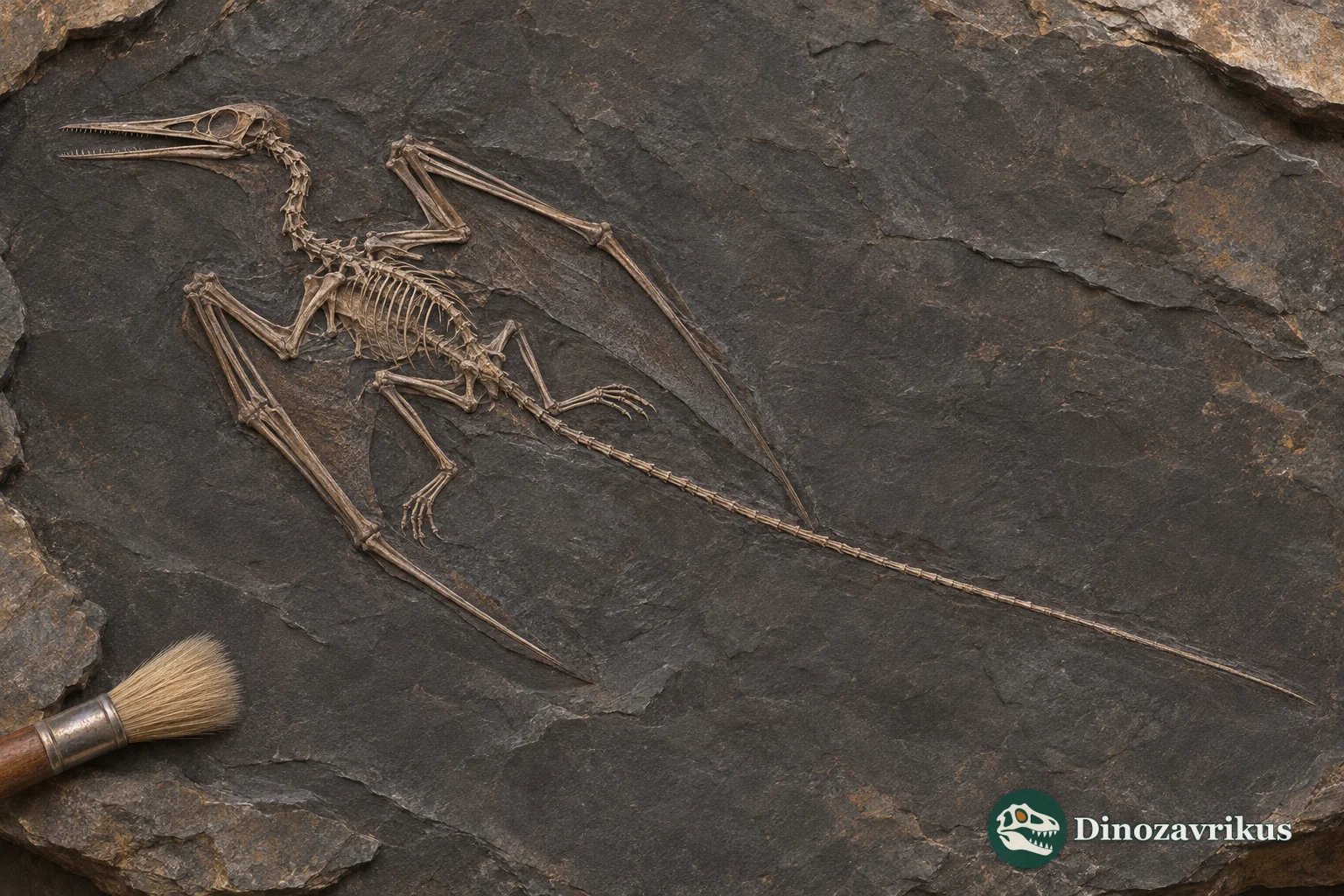
Jianchangopterus zhaoianus was named from a nearly complete pterosaur skeleton with a skull from northeastern China. The original authors placed it among rhamphorhynchids. Later comparisons suggested that the specimen might instead be an immature wukongopterid. That interpretation remains difficult to test directly because researchers could not locate the holotype for re-examination.
Quick facts
| Scientific name | Jianchangopterus zhaoianus, Lü and Bo, 2011 |
|---|---|
| Holotype | YHK-0931, a nearly complete skeleton with skull |
| Locality | Linglongta, Jianchang County, Liaoning, China |
| Rock and age | Tiaojishan Formation; Linglongta layers later dated to around 161–160 million years ago |
| Teeth | Seven upper and six lower pairs reported in the original description |
| Wing detail | A strongly curved fourth wing-finger phalanx |
| Relationships | Originally a rhamphorhynchid; an immature wukongopterid has been proposed |
What can the fossils tell us?
The description records a skeleton with skull. Neither gut contents nor an informative body covering is reported, so diet and original colour cannot be read directly.
The authors counted seven upper and six lower tooth pairs and described a recess in the maxilla. Jaw shape alone does not identify particular prey.
The fourth wing-finger phalanx curves markedly and measures roughly 96% of the first. This is a bone measurement, not a direct record of the full membrane.
It was described as a rhamphorhynchid in 2011. Later authors proposed an immature wukongopterid, but the type specimen was unavailable for their direct check.
A skeleton from Linglongta
Lü and Bo named Jianchangopterus zhaoianus in 2011. The genus refers to Jianchang County; the species name honours Zhao Limin, who supplied the specimen for study. Holotype YHK-0931 includes a skull and most of the skeleton, although flattening and damaged areas complicate some anatomical observations.
The original paper called the Tiaojishan rocks Middle Jurassic. Later dates for Linglongta layers point to approximately 161–160 million years ago, near the beginning of the Late Jurassic. These are dates for the geological sequence, not direct measurements of the bone. Kunpengopterus from the region became important in later comparisons.
Teeth and an unusual wing bone
The first description reported seven pairs of upper teeth and six pairs of lower teeth. It also identified a maxillary recess and a pronounced ridge on the joined front of the lower jaw. These details help compare pterosaur specimens, but no preserved food identifies its prey.
The fourth phalanx of the wing finger is conspicuously curved and nearly as long as the first, at about 96% of its length. Neither an isolated phalanx measurement nor a drawing of the wing establishes the wingspan of an adult animal.
Why its relationships were reconsidered
The describing authors compared the skeleton with Sordes and placed it among rhamphorhynchids. A 2021 study of a juvenile Kunpengopterus proposed that Jianchangopterus could be an immature member of Wukongopteridae. Its authors reported that staff could not locate YHK-0931 at the museum where it was expected, preventing direct confirmation.
A later comparative dataset treated the specimen as an immature wukongopterid and removed it from its main phylogenetic matrix because immaturity could distort the analysis. This does not by itself establish synonymy with another genus. Jeholopterus also lived in Jurassic China but belongs to a different pterosaur group.
An animal in a Jurassic landscape
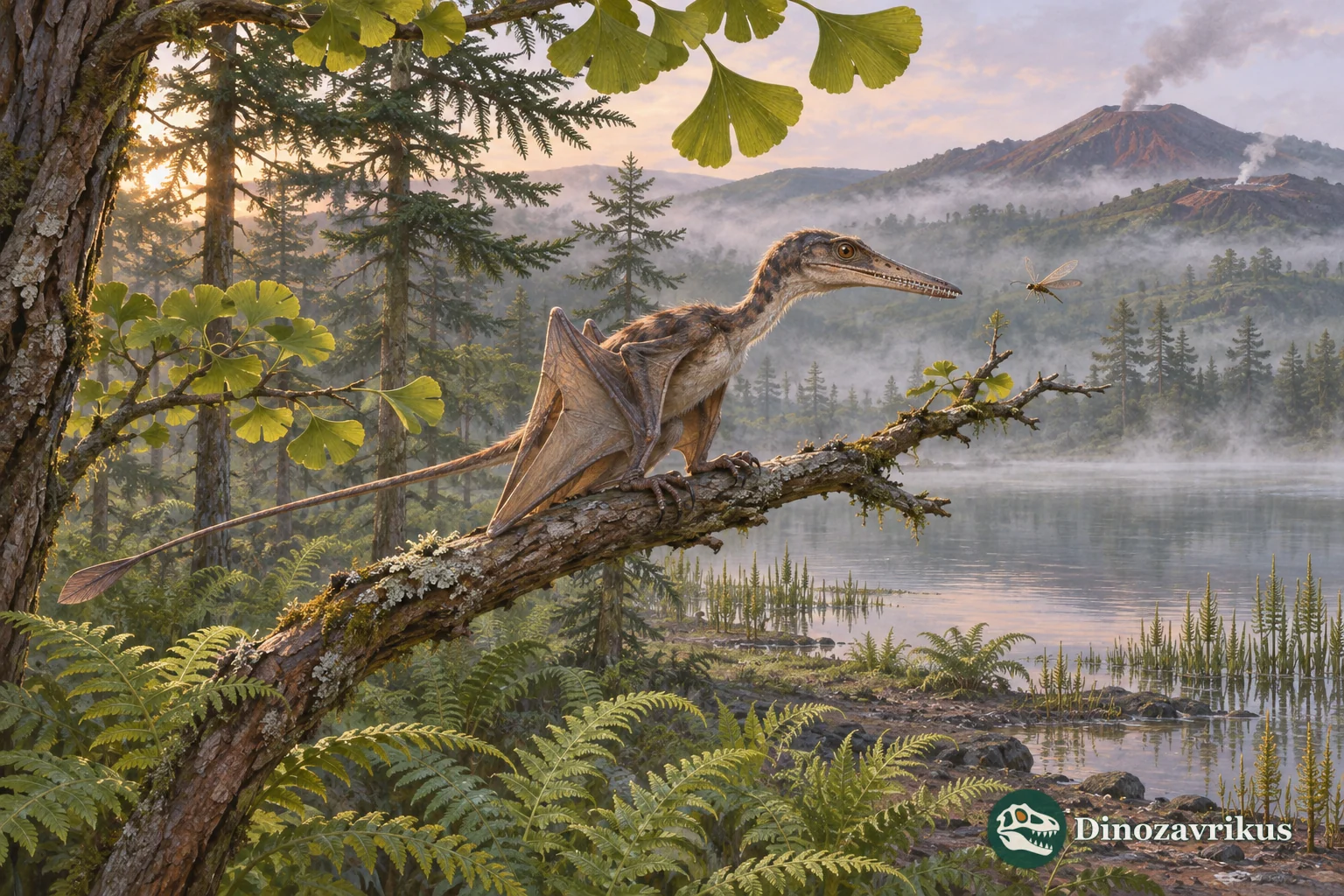
The lakeside scene conveys a plausible environment. Its posture, colour and interest in insects are artistic possibilities; the fossil does not provide direct evidence of its diet.
Frequently asked questions
Where was Jianchangopterus found?
At Linglongta in Jianchang County, Liaoning Province, China. The holotype is numbered YHK-0931.
Which bones are known?
The original paper describes a nearly complete skeleton, including skull, jaws, teeth and wing bones.
Was it a rhamphorhynchid or a wukongopterid?
The first authors favoured a rhamphorhynchid. Later researchers proposed an immature wukongopterid, but direct re-examination of the type was unavailable.
Why is its geological age given differently?
The 2011 description used a Middle Jurassic assignment. Later dating of Linglongta beds indicated around 161–160 million years ago, early Late Jurassic.