

Jeholopterus ningchengensis is a small pterosaur from Daohugou in northern China. Its nearly complete articulated skeleton preserves impressions of the flight membrane and hairlike body fibres. The fossil makes it possible to examine more than bones, although feeding behaviour and original colour remain uncertain. The age of the Daohugou beds has also been revised since the species was named in 2002.
Quick facts
| Scientific name | Jeholopterus ningchengensis, Wang and colleagues, 2002 |
|---|---|
| Holotype | IVPP V12705, a nearly complete articulated skeleton |
| Locality | Daohugou, Ningcheng County, Inner Mongolia, China |
| Age | Late Jurassic, around 160 million years ago for the fossil-bearing beds |
| Group | Anurognathidae, small pterosaurs with broad short skulls |
| Estimated wingspan | Approximately 90 cm in the original description |
| Soft tissues | Impressions of flight membrane and hairlike pycnofibres |
What can the fossils tell us?
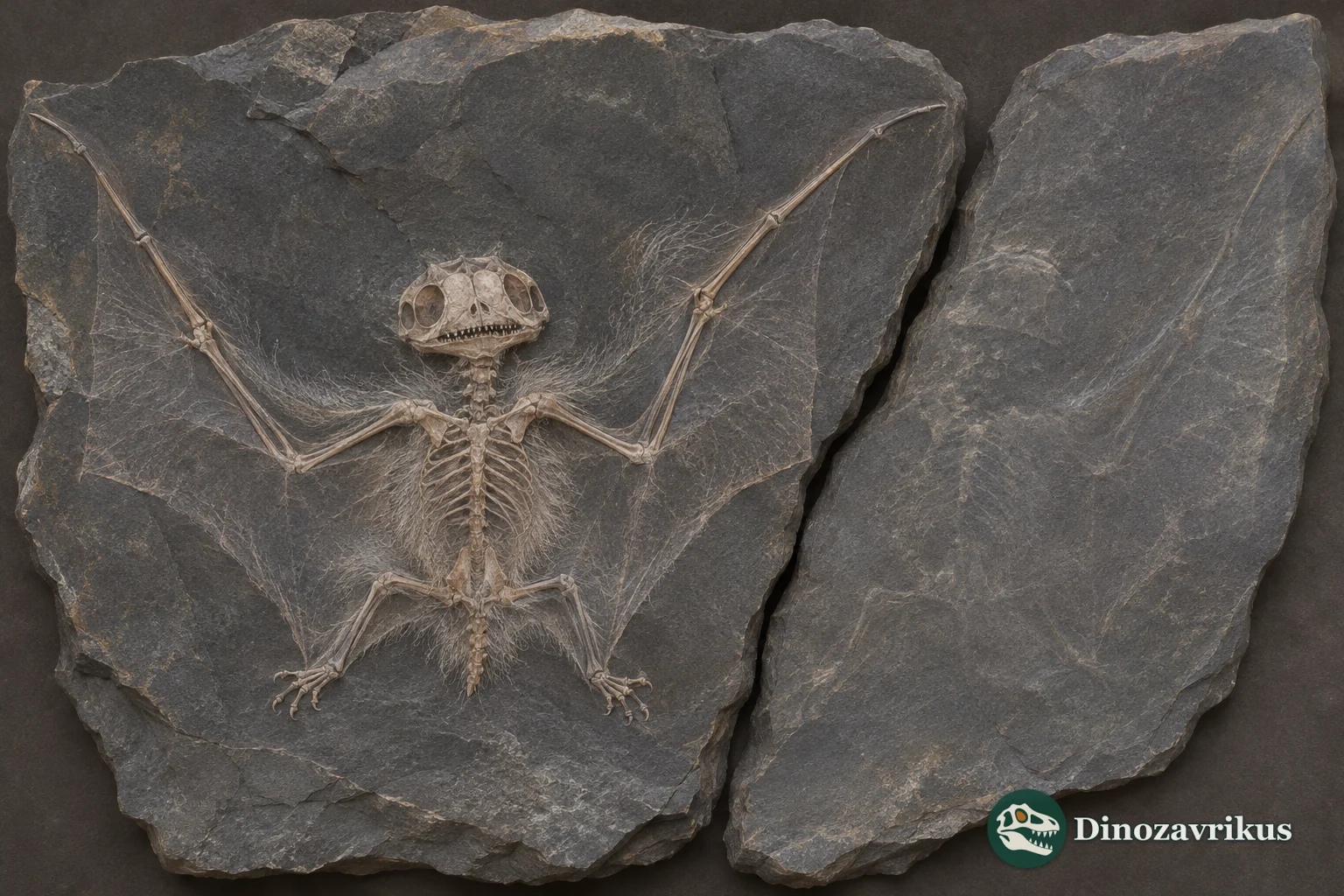
IVPP V12705 preserves a nearly complete skeleton across two sides of a split slab. Its short broad skull and limb bones are direct evidence; body mass is not directly measured.
The slab records membrane extending towards the ankle and fibrous structures in its outer zone. These features do not reveal exact flight speed.
Impressions around the torso and parts of the wing are interpreted as pycnofibres. Their presence is supported; their original colour is unknown.
The 2002 description treated the fossil as Early Cretaceous. Later dating of Daohugou beds indicates Late Jurassic, roughly 161–160 million years ago.
A fossil split between two slab surfaces
Holotype IVPP V12705 came from finely layered Daohugou rocks. Its skeleton remained articulated, while splitting the slab left impressions across two surfaces. The skull, vertebral column, limbs and much of the wings can be studied together with traces of soft tissue. Such preservation tests reconstructions usually based on bones alone.
The original 2002 paper assigned the beds to the Early Cretaceous. Later stratigraphic work dated the Daohugou assemblage to the Late Jurassic, approximately 161–160 million years ago. This is a date for the surrounding geological sequence, not a measurement on the individual skeleton. Daohugoupterus comes from the same fossil-bearing region but is a different genus.
A short skull and an estimated wingspan
The skull is short and broad, a feature of anurognathids. Its length was estimated at about 28 mm in the original description. The authors also noted short metacarpals and an elongated fifth toe. They estimated a wingspan of approximately 90 cm from the skeleton; an intact, fully spread membrane was not available for direct measurement.
The skull and small teeth have been used to infer insect feeding. No confirmed stomach contents with identifiable prey are known from the holotype, however. As with Eosipterus, anatomical clues and direct dietary evidence must be kept separate.
A membrane with internal fibres
A later soft-tissue study found that the flight membrane reached towards the ankle. Fibrous structures in the outer wing zone appear in several layers. The researchers distinguished a firmer outer part and more flexible inner part of the membrane. These features constrain wing anatomy but do not determine an exact flight speed or hunting method.
Hairlike pycnofibres are preserved around the body and parts of the wing. They show that the animal was not uniformly bare-skinned. The fossil's present brown tones cannot be read as its original colour pattern.
What a living scene adds
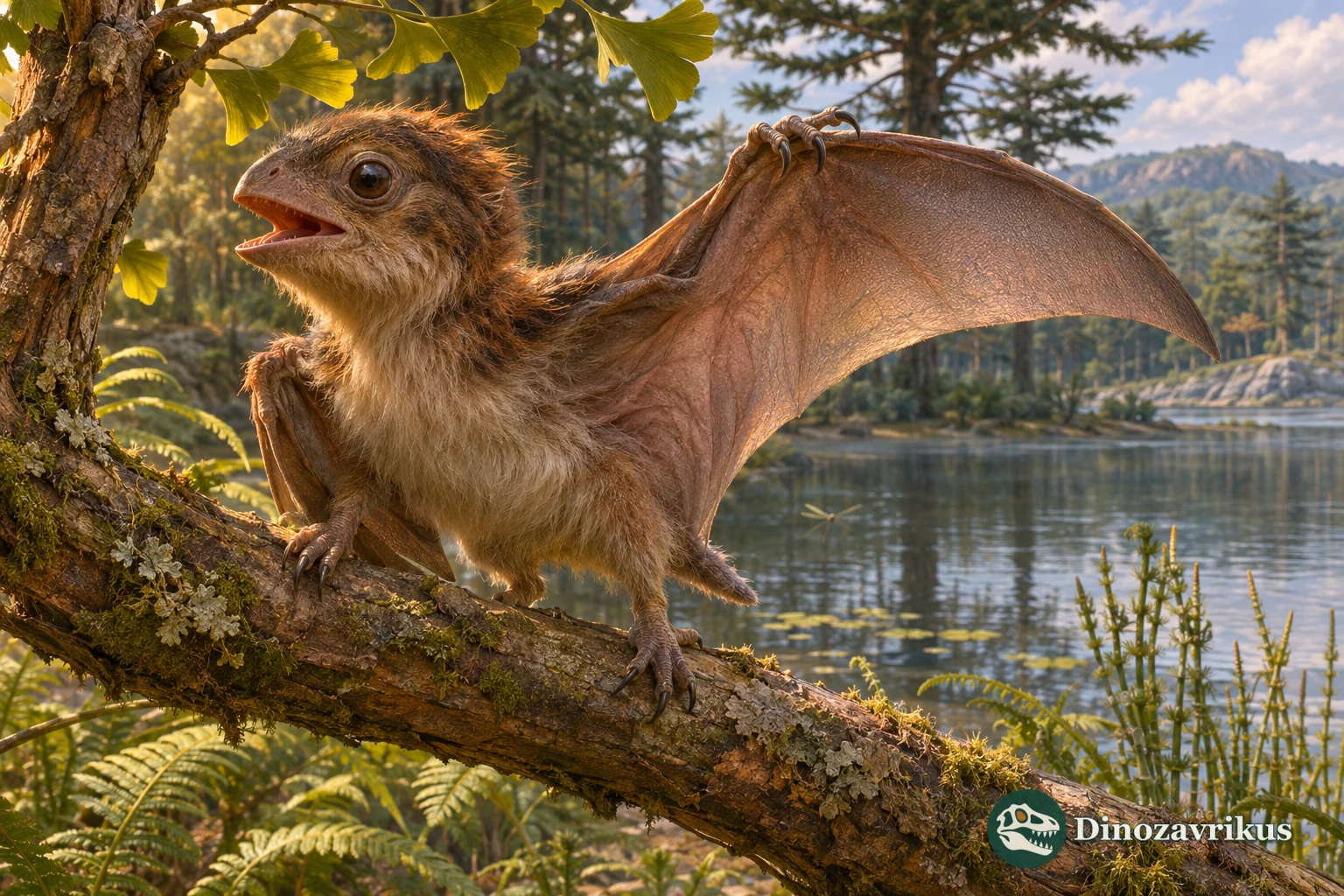
The second image imagines a small pterosaur in a forested lake environment. Perching, colour and prey choice are interpretive details, while the bones, membrane traces and body fibres are preserved evidence.
Frequently asked questions
Where was Jeholopterus found?
At Daohugou in Ningcheng County, Inner Mongolia, China. Its holotype is IVPP V12705.
Why do some older sources call it Cretaceous?
The original paper used an Early Cretaceous age, while later studies dated Daohugou beds to the Late Jurassic.
Is its wing membrane preserved?
Impressions of parts of the flight membrane and its fibrous structure are preserved, although not as a complete intact skin.
Is an insect diet proven?
No. Skull shape and teeth support an insect-feeding hypothesis, but identifiable prey remains are not reported from the holotype.