

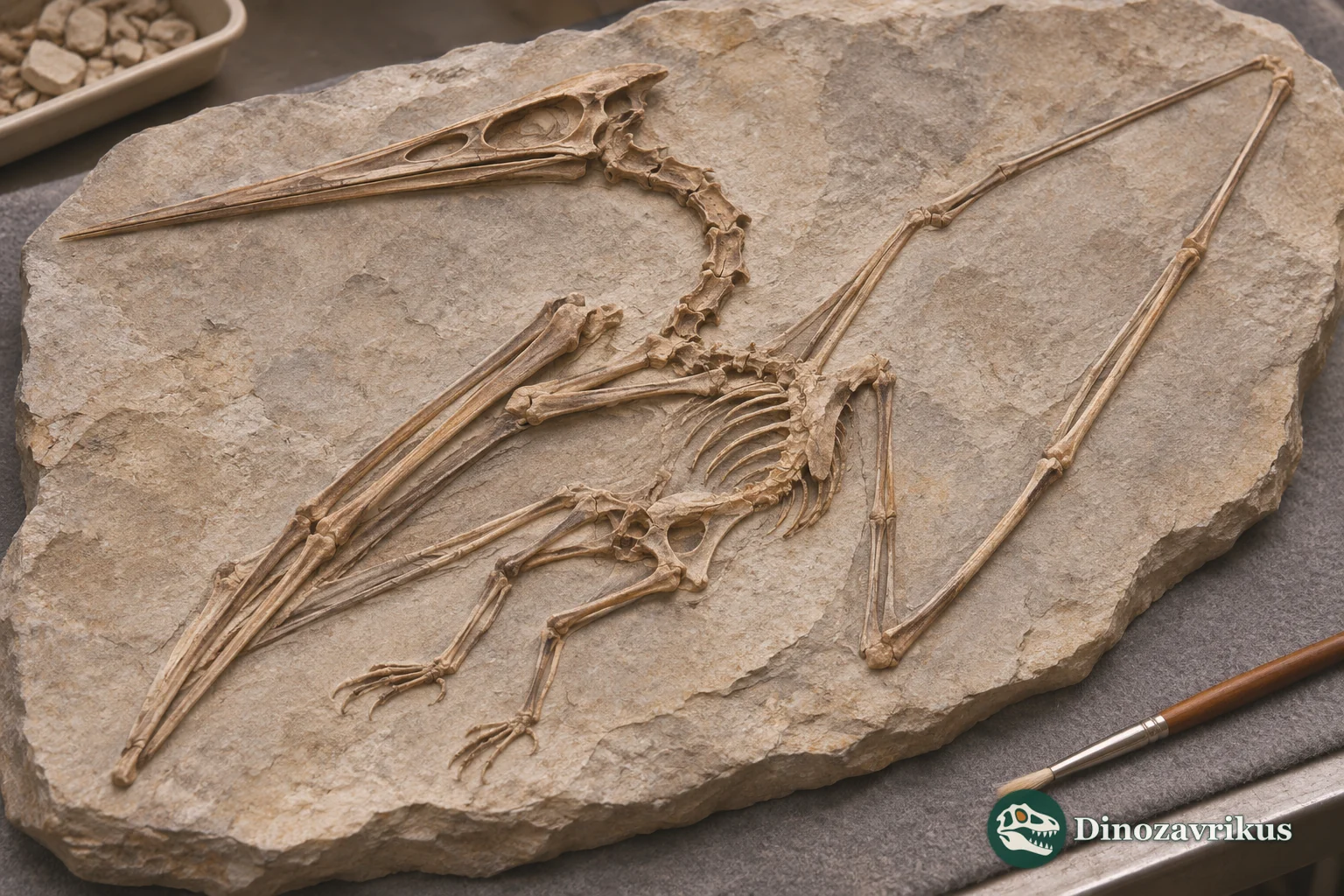
Jidapterus edentus is an Early Cretaceous pterosaur from Liaoning, China. Its nearly complete skeleton preserves a long toothless skull, cervical vertebrae, wings and legs. The specimen reveals much more anatomy than an isolated bone could, although it was still immature. Its measured wingspan therefore cannot simply be treated as the adult limit for the species.
Quick facts
| Scientific name | Jidapterus edentus, Dong and colleagues, 2003 |
|---|---|
| Holotype | RCPS-030366CY (CAD-01), a nearly complete skeleton with skull |
| Locality | Chaoyang region, western Liaoning, China |
| Rock and age | Jiufotang Formation, Aptian Early Cretaceous, around 122 million years ago |
| Beak | Long, narrow and toothless, with a longitudinal trough on top |
| Estimated wingspan | Approximately 1.53 m for the preserved specimen |
| Growth stage | Incomplete fusion of a wing-finger process indicates immaturity |
What can the fossils tell us?
RCPS-030366CY preserves the skull, lower jaw and most of the skeleton. It permits comparisons of the jaws, neck, wings and feet within one individual.
The holotype lacks teeth. A longitudinal trough and ridge are visible on its bony snout, but they do not directly reveal its food.
The estimate sums preserved bones of both wings. No complete membrane provides an independent measurement of its outline or flight performance.
The extensor tendon process on the first wing-finger phalanx had not fused. An adult wingspan cannot be established from this single immature individual.
A skeleton from the Jiufotang Formation
The genus and species were named in 2003. The species name edentus refers to the lack of teeth. Holotype RCPS-030366CY, also called CAD-01, preserves a partly articulated skull and much of the remaining skeleton. It comes from the Jiufotang Formation in western Liaoning. Geological studies place those rocks in the Aptian Early Cretaceous, around 122 million years ago; that is the age of the deposit, not the age of the individual at death.
A detailed redescription in 2017 measured the skull and limbs again and tested its relationships among azhdarchoid pterosaurs. The snout is about 115.7 mm long. Its narrow, toothless bony beak has a shallow lengthwise trough and ridge. The shape of any living keratin covering is not directly preserved.
Wingspan and growth
The 2017 authors estimated a wingspan of approximately 1.53 m by summing the preserved humerus, ulna, metacarpal and wing-finger phalanges on both sides. This is a calculation from bones, not a direct measurement of an intact flight membrane.
The extensor tendon process on the first wing-finger phalanx had not fused, indicating the holotype was not fully mature. The adult span remains unknown. Small, gently curved foot claws and limb proportions led the authors to infer terrestrial ability, but there are no footprints attributable to this individual.
Relationships and feeding remain questions
Jidapterus is classified among chaoyangopterid azhdarchoids. The 2017 study compared it with Chaoyangopterus and retained it as a distinct genus based on a combination of skull and skeletal features. This is a comparative anatomical result that new fossils can refine.
The fossil has no teeth, but no identifiable stomach contents or direct prey traces are reported. Proposed diets are therefore hypotheses. Eoazhdarcho shows that other toothless azhdarchoids lived in the region, although its inferred habits cannot simply be transferred to Jidapterus.

A reconstructed Early Cretaceous setting
The final scene evokes the broader environment of Early Cretaceous Liaoning. The precise appearance of the original locality and the animal's colour and behaviour are artistic reconstructions.
Frequently asked questions
Where was Jidapterus found?
In the Chaoyang region of western Liaoning, China, in rocks of the Jiufotang Formation.
Did it have teeth?
No. Its holotype preserves an elongated toothless skull, although the absence of teeth does not establish a specific diet.
How wide was its wingspan?
The preserved individual was estimated at about 1.53 m using wing-bone measurements. Its adult wingspan is unknown because the specimen was immature.
Why is it kept separate from Chaoyangopterus?
A 2017 redescription identified a distinct combination of skull and skeletal features. Future discoveries could further refine that classification.