

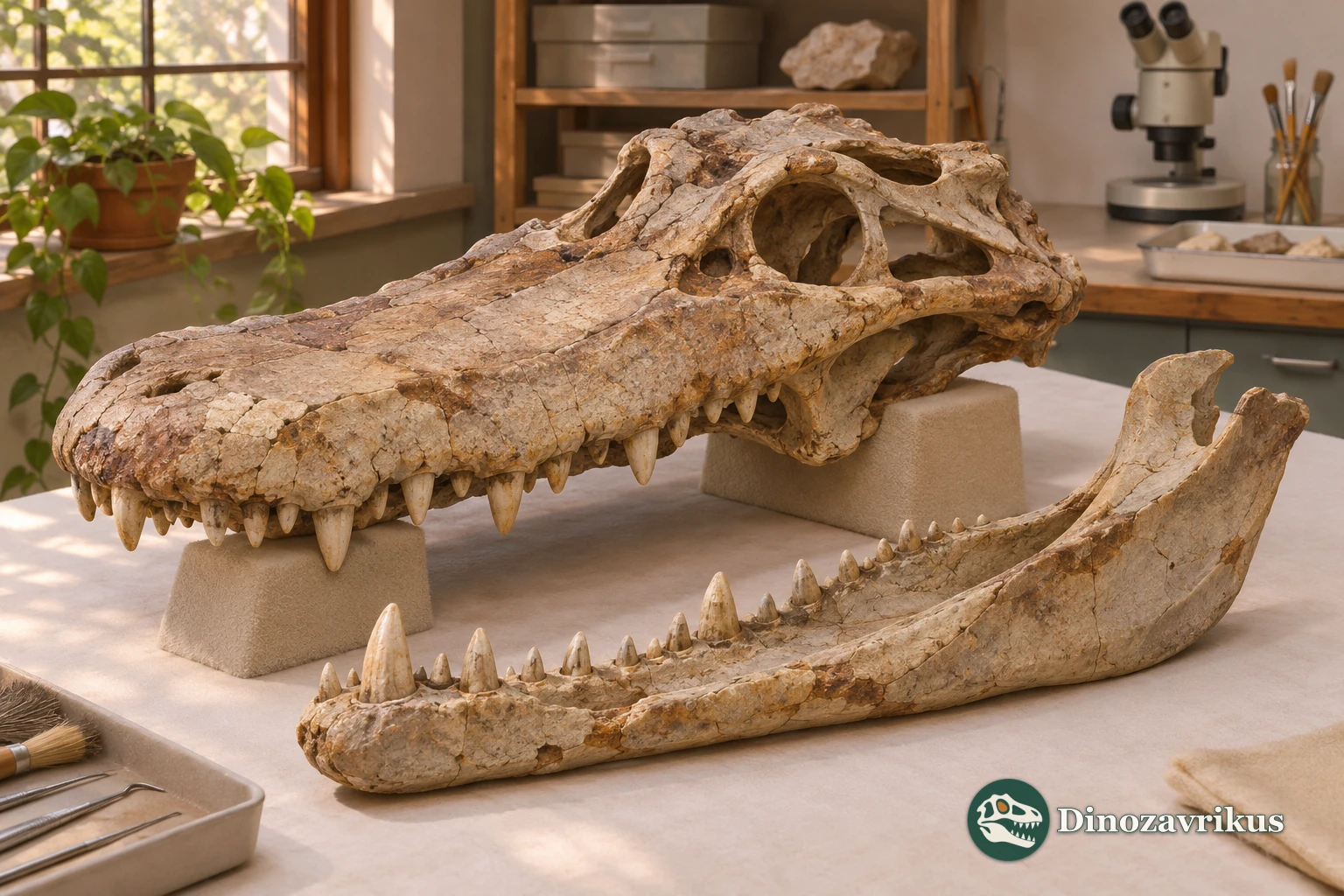
Kambara is the oldest named crocodilian genus from the Australian Cenozoic. Its Queensland skulls have moderately broad, flattened snouts and teeth without serrations. Two species from Murgon closed their jaws in different ways. Fossil upper arm bones from the same site also preserve an unusual combination of straight shafts and aligned joint ends.
Quick facts
| Type species | Kambara murgonensis |
|---|---|
| Group | Mekosuchinae |
| Age | Eocene |
| Localities | Murgon and Rundle Formation, Queensland |
| Type specimen | QM F21115, skull |
| Named species | Four |
What can the fossils tell us?
The upper tooth row in Kambara murgonensis overlapped the lower row. The teeth in Kambara implexidens fitted between one another.
Two arm bones were compared with those of living crocodilians to model weight bearing. They can be assigned to the genus, but their species is unknown.
Crocodilian eggshell and hatchling-sized bones occur at Murgon. The material cannot identify which species laid the eggs.
The two Murgon species
Paul Willis, Ralph Molnar and John Scanlon named Kambara in 1993 from the Tingamarra deposits near Murgon. The type skull of Kambara murgonensis is QM F21115 in the Queensland Museum. The Murgon deposits are estimated to be around 54–55 million years old.
Steven Salisbury and Paul Willis named K. implexidens from the same locality in 1996. Its type, QM F29662, is a nearly complete skull. In the type species the upper tooth row lay outside the lower row at closure. In K. implexidens the teeth interlocked. The pattern is legible in the positions of the sockets and the recesses that received opposing teeth.
Younger fossils from the Rundle Formation
Two more species come from the younger Eocene Rundle Formation. The K. molnari holotype, QM F12364, is a partial left lower jaw. Its bite is intermediate between an overlapping and an interlocking arrangement.
K. taraina has an interlocking bite and is represented by more abundant cranial and body material. The specimens of K. molnari and K. taraina come from different levels of the formation. The finds do not establish that the two species shared the habitat at the same time.
Walking on the shore
Two humeri from Murgon, QM F56058 and QM F56060, have almost straight shafts and joint ends that align with one another. The living crocodiles used for comparison had more curved shafts. In 2020, researchers used geometric measurements and computer models to examine how stresses were distributed when those bones were loaded in different positions.
The results are consistent with an ability to walk with the torso raised. The frequency of this posture cannot be read from two bones. Later mekosuchines such as Australosuchus help place Kambara in the broader history of Australian crocodilians, which occupied a variety of freshwater settings.
The Murgon setting and possible nesting
The Tingamarra fossils preserve a freshwater assemblage. Kambara could have preyed on small vertebrates at the water’s edge. Its jaw morphology gives no list of those prey. Crocodilian eggshell fragments and bones from hatchling-sized animals led to the proposal that the two Murgon species used the area for nesting. The eggshell cannot be assigned to either species with confidence.
Frequently asked questions
How did the species differ in their bites?
The type species had overlapping tooth rows. K. implexidens and K. taraina had interlocking teeth. K. molnari had an intermediate arrangement.
Is Kambara known outside Australia?
All four named species come from Queensland.
Which species do the upper arm bones represent?
The two Murgon humeri can be referred to Kambara. The bones do not preserve a basis for identifying their species.
Did the two Rundle species live side by side?
The fossils come from separate levels. They do not demonstrate that the species occupied the same water body at the same time.