

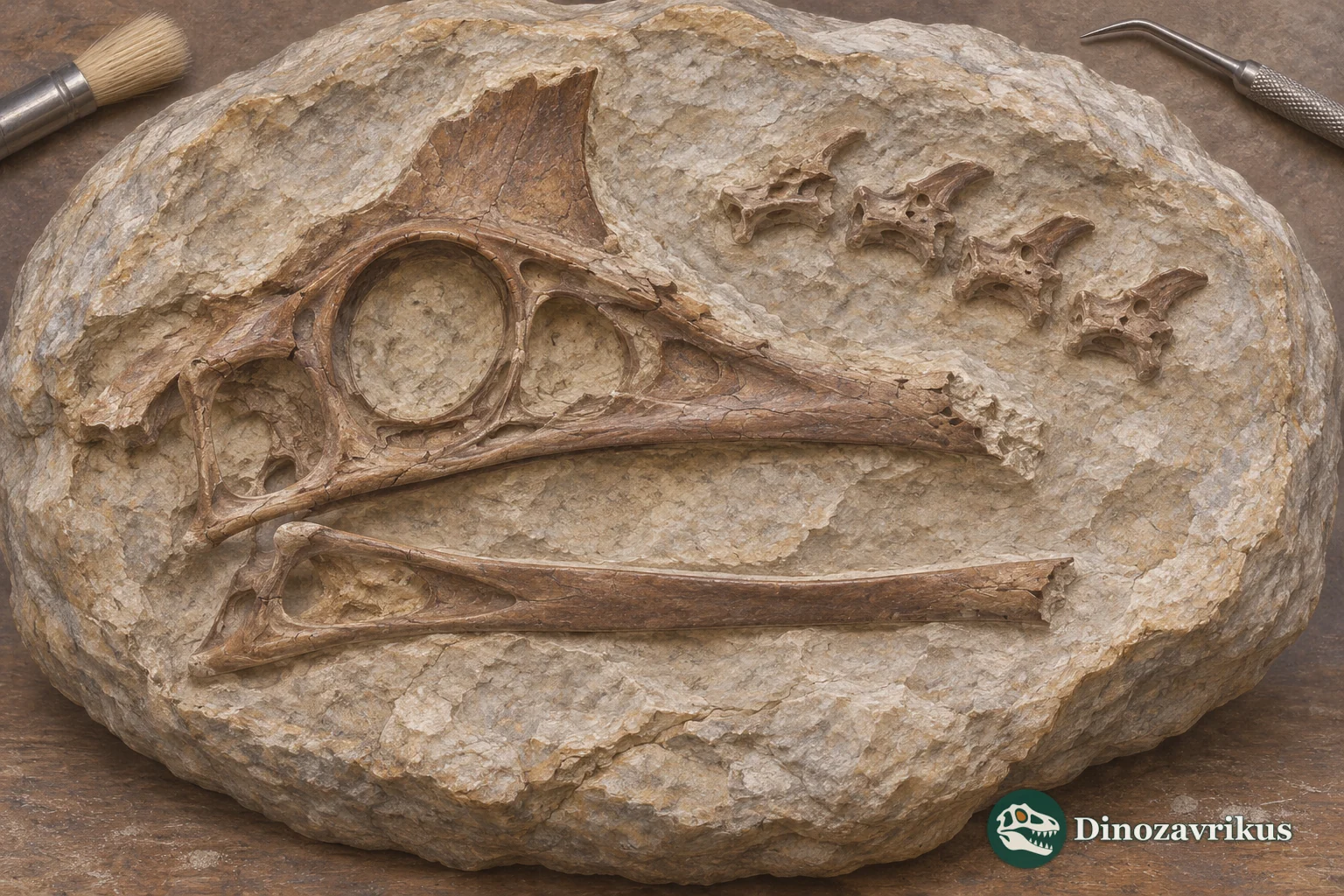
Kariridraco dianae was named from an incomplete crested skull, a lower jaw and neck vertebrae from northeastern Brazil. Preparation revealed that the fossil concretion was composite: pieces of another pterosaur's front jaws had been attached to it. The authors excluded those pieces before diagnosing the species. The genuine crest survives only in part, and no wing bones are known.
Quick facts
| Scientific name | Kariridraco dianae, Cerqueira and colleagues, 2021 |
|---|---|
| Holotype | MPSC R 1056, incomplete skull, lower jaw and four cervical vertebrae |
| Provenance | Araripe Plateau, northeastern Brazil; exact collection site unknown |
| Rock and age | Romualdo Formation, Aptian Early Cretaceous |
| Jaw | Toothless, with 205 mm of lower jaw preserved |
| Crest | Steep surviving premaxillary crest base |
| Placement | Thalassodromine tapejarid, near Tupuxuara in the 2021 analysis |
What can the fossils tell us?
Most of the lower jaw and portions of the skull and crest survive. The front of the genuine snout and part of the crest are missing.
Preparation exposed front jaw fragments from another pterosaur glued to the original concretion. Those pieces were excluded from the diagnosis.
The cervical material helps comparison with thalassodromines. No wing bones allow a direct wingspan measurement for this species.
Local workers donated the concretion without precise field coordinates. The matrix supports a Romualdo Formation origin, not an exact position within it.
A skull with an incomplete field history
Holotype MPSC R 1056 is housed at the Plácido Cidade Nuvens Palaeontology Museum. Local workers donated it without an exact collection locality. Its limestone concretion matches the Romualdo Formation of the Araripe Plateau, but the particular quarry and bed cannot be identified. The genus name refers to the Kariri people and the word dragon; the species honours Diana Prince, the fictional Wonder Woman.
During preparation, the team found that the front parts of an upper and lower jaw from a second pterosaur had been glued to the original rock. They removed those parts from the anatomical interpretation. The genuine specimen includes skull regions around the orbit and temple, a short tall nasoantorbital opening and the base of a steep crest. The surviving lower jaw measures 205 mm, with no teeth or empty tooth sockets.
Testing the crest and identifying relatives
The preserved crest rises at roughly 45 degrees to the jaw axis. Because the front jaws had been altered, the researchers also tested whether this crest was an added piece. Matching broken edges and continuous surrounding matrix supported its authenticity. Its complete height and any soft-tissue ornament remain unknown.
A 2021 phylogenetic analysis placed Kariridraco among thalassodromines, close to Tupuxuara. This is a result of comparing available skull and neck characters, not direct evidence of a particular ancestor. Caupedactylus is another Brazilian pterosaur known from cranial remains, but its anatomical combination differs.
Limits on size and feeding
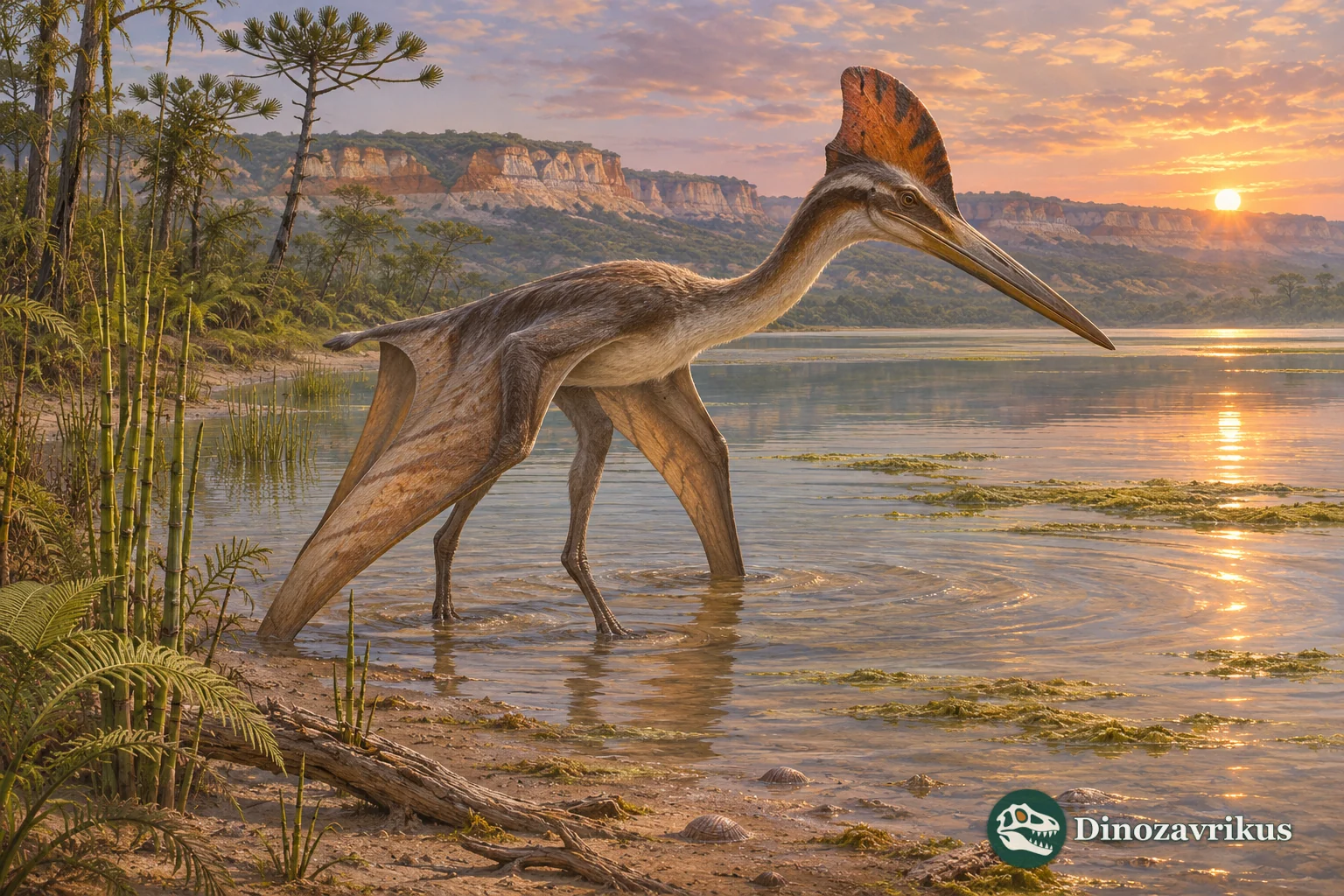
The holotype preserves no wings, legs or trunk. Its wingspan and body mass cannot be measured from this specimen. The toothless jaws do not identify a particular diet, and no gut contents are reported. A living scene therefore uses relatives for general proportions and artistic choices for colour, wing outline and behaviour.
Pterodaustro shows how diverse Early Cretaceous South American pterosaurs could be, but its feeding adaptations do not establish Kariridraco's habits.
An imagined Araripe shoreline
The final scene evokes a possible setting for the Romualdo Formation. Because the precise collection site is unknown, it is not a reconstruction of the actual spot where MPSC R 1056 was found.
Frequently asked questions
Where was Kariridraco found?
It came from the Romualdo Formation of the Araripe Plateau, Brazil, but its precise collection point was not recorded.
Did all the bones in its concretion belong together?
No. Preparation identified front jaw pieces from another pterosaur that had been glued to the original fossil.
Was the crest also added?
The authors checked its broken margins and matrix and considered the surviving crest base genuine; the complete crest is unknown.
Is its wingspan known?
No wing bones are part of the holotype, so its wingspan is not directly measured.