

Caupedactylus ybaka is a toothless, crested pterosaur from the Romualdo Formation of Brazil. Its type specimen MN 4726-V includes a nearly complete skull and jaw, with some shoulder and wing bones. The precise collection locality is unknown. Changes on the left side of the skull may record disease, but their cause is uncertain.
Quick facts
| Scientific name | Caupedactylus ybaka, Kellner, 2013 |
|---|---|
| Holotype | MN 4726-V |
| Material | Nearly complete skull, jaw, shoulder and wing fragments |
| Rock unit | Romualdo Formation, Araripe Basin, Brazil |
| Age | Early Cretaceous |
| Collection locality | Exact site unknown |
| Group | Tapejarid pterosaur |
What can the fossils tell us?
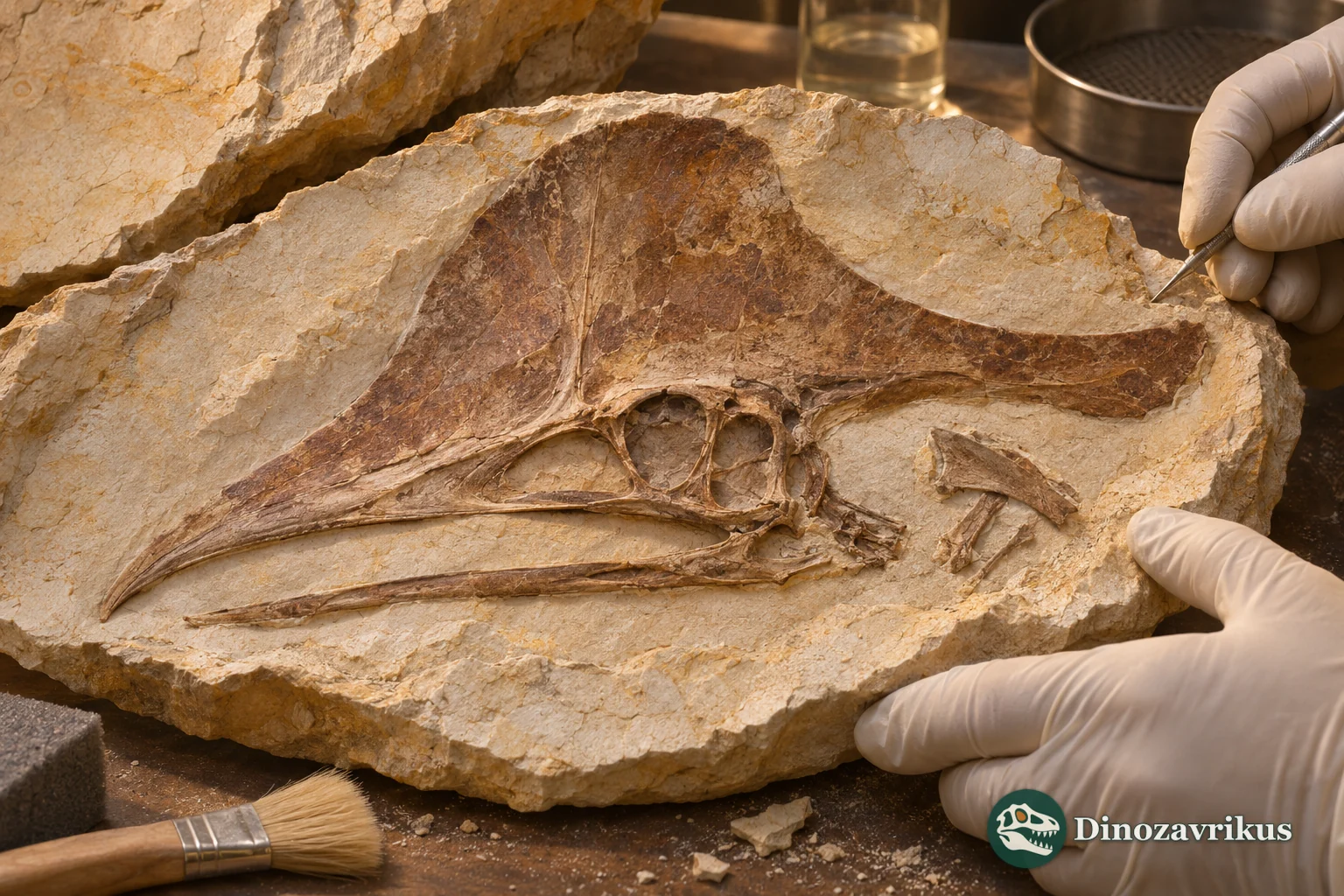
MN 4726-V includes a nearly complete skull and mandible, shoulder girdle elements, a humerus, part of a wing phalanx and ribs. It is not a complete skeleton.
The premaxillary crest expands fore and aft. Grooves interpreted as vascular traces prompted a thermoregulation hypothesis, not proof of that function.
The original description reported unusual changes around the left cheek and quadrate bones, possibly related to infection. The exact cause is unresolved.
The specimen is assigned to the Romualdo Formation, but its precise collection site is unknown. Colour and behaviour are unpreserved.
A skull from the Romualdo Formation
Alexander Kellner named Caupedactylus ybaka in 2013 from specimen MN 4726-V. It preserves a nearly complete skull and mandible together with pieces of the shoulder girdle, a humerus, a wing phalanx and ribs. A later review confirmed its Romualdo Formation origin but recorded no precise collection site, so a named quarry would be an unsupported claim.
The Romualdo rocks belong to the Early Cretaceous Araripe Basin of northeastern Brazil. The deposit identifies the burial setting. It does not prove that every pterosaur lived permanently at the shoreline. Caiuajara is another Brazilian tapejarid from a different locality and fossil assemblage.
A toothless beak and large crest
The front of the toothless snout curves downward, while a prominent premaxillary crest rises from the skull and extends forward and backward. Palatal details and skull openings distinguish this species from other tapejarids. Grooves on the crest were interpreted as traces of blood vessels, leading Kellner to suggest a thermoregulatory role. That proposed function cannot be directly measured from the fossil.
Later phylogenetic analyses refined relationships within Tapejaridae. One analysis placed Caupedactylus near Aymberedactylus; this is a hypothesis of relatedness based on character comparisons, not a direct ancestor-descendant sequence.
An unusual left side of the skull
The type description recorded pathological changes near the left jugal, quadratojugal and quadrate. An infection was proposed as a possible cause, although the altered bones do not establish a certain medical diagnosis. The condition of one individual should not be treated as a feature of the entire species.
The preserved wing and shoulder elements allow more comparison than an isolated skull, but the complete wing and animal remain unknown. Diet has not been demonstrated by preserved stomach contents.
Limits of a life reconstruction
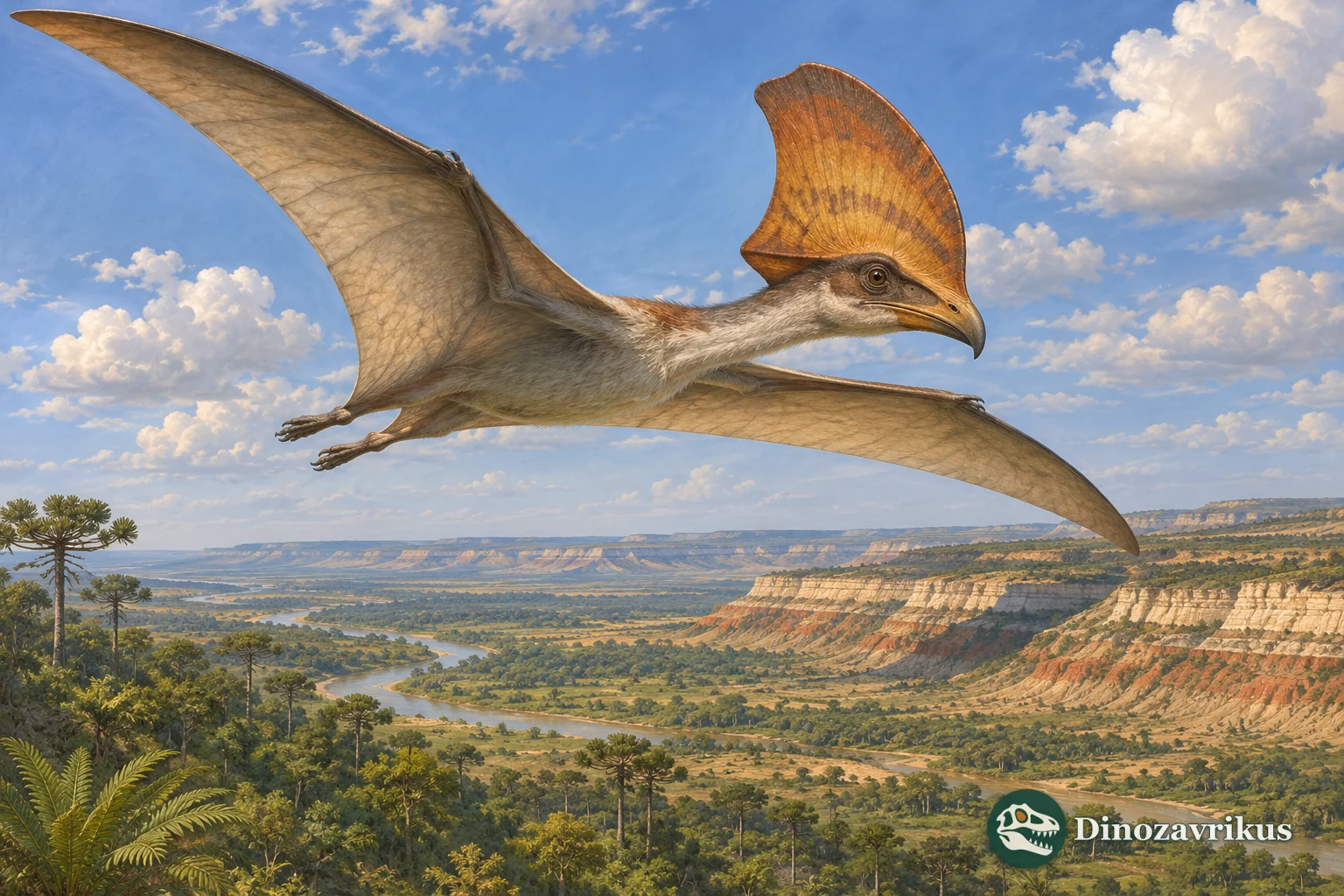
A flying pterosaur with a high crest is a reasonable visual interpretation of the known anatomy. Its exact colour, crest covering, individual movements and landscape position are artistic decisions. Additional associated fossils would help constrain body proportions and test the functional ideas about the crest.
Frequently asked questions
Where was Caupedactylus found?
Its holotype is assigned to the Romualdo Formation of Brazil's Araripe Basin, but the exact collection site is unknown.
Did it have a bony crest?
Yes. A large crest is preserved on the skull. Its suggested thermoregulatory function has not been proven.
What happened to the left side of its skull?
The original description noted pathological changes and proposed infection as one possible explanation. The precise cause is uncertain.
Is a complete skeleton known?
No. MN 4726-V includes a nearly complete skull and selected shoulder, wing and rib elements, not the whole skeleton.