

Kepodactylus insperatus is a Late Jurassic pterosaur known from a small set of disarticulated bones in Colorado's Morrison Formation. The fossils were recovered during a 1992 Stegosaurus excavation and named in 1996. The authors estimated a wingspan around 2.5 m, but the skull and a complete wing are missing. A living reconstruction therefore shows one possibility, not a measured outline of the animal.
Quick facts
| Scientific name | Kepodactylus insperatus, Harris and Carpenter, 1996 |
|---|---|
| Holotype | DMNH 21684, separate neck, wing and foot bones |
| Locality | Small Stegosaurus Quarry, Garden Park, Colorado, USA |
| Rock and age | Lower part of the Morrison Formation, Late Jurassic |
| Estimated wingspan | Approximately 2.5 m in the original comparative estimate |
| Diagnostic evidence | Elongated cervical vertebra and ungrooved wing-finger phalanx |
| Skull and diet | Unknown; no direct food evidence |
What can the fossils tell us?
The type includes one cervical vertebra, a left humerus, parts of the wing finger and a metatarsal. There is no skull or complete wing.
An elongated centrum and pneumatic opening are visible. Burial compression distorted some of its shape.
The first wing-finger phalanx lacks a longitudinal groove seen in some earlier forms. The 2.5 m span is comparative, not a direct measurement.
The bones were recovered during a Stegosaurus excavation, but the small vertebrate material was scattered in lake mudstone and sandstone.
A find from a Stegosaurus quarry
The Denver Museum of Natural History excavated in Garden Park in 1992. Alongside a Stegosaurus skeleton, the Small Stegosaurus Quarry yielded scattered smaller vertebrate fossils. Many lay in grey lake mudstone below sands deposited by a spreading flood. Shared burial does not demonstrate an encounter between the pterosaur and Stegosaurus.
Holotype DMNH 21684 includes a cervical vertebra, left humerus, first left wing-finger phalanx, other phalanx fragments and one metatarsal. The genus name refers to Garden Park; insperatus means unexpected. Harpactognathus also comes from the Morrison Formation, but its different incomplete material cannot simply be combined with Kepodactylus.
Why it was assigned to Pterodactyloidea
The cervical vertebra was flattened during burial and lost most of its neural spine. Its elongated centrum and a posteriorly located pneumatic opening still offer comparative characters. The humerus bears a large, rectangular deltopectoral crest and another pneumatic opening. The first wing-finger phalanx lacks a longitudinal furrow present in some longer-tailed pterosaurs.
Harris and Carpenter used the cervical and wing characters to identify a pterodactyloid. They could not place it confidently in a narrower family, in part because there is no skull. Rhamphocephalus illustrates how difficult some Jurassic pterosaur assignments become when fossils are sparse, but it supplies no missing Kepodactylus bones.
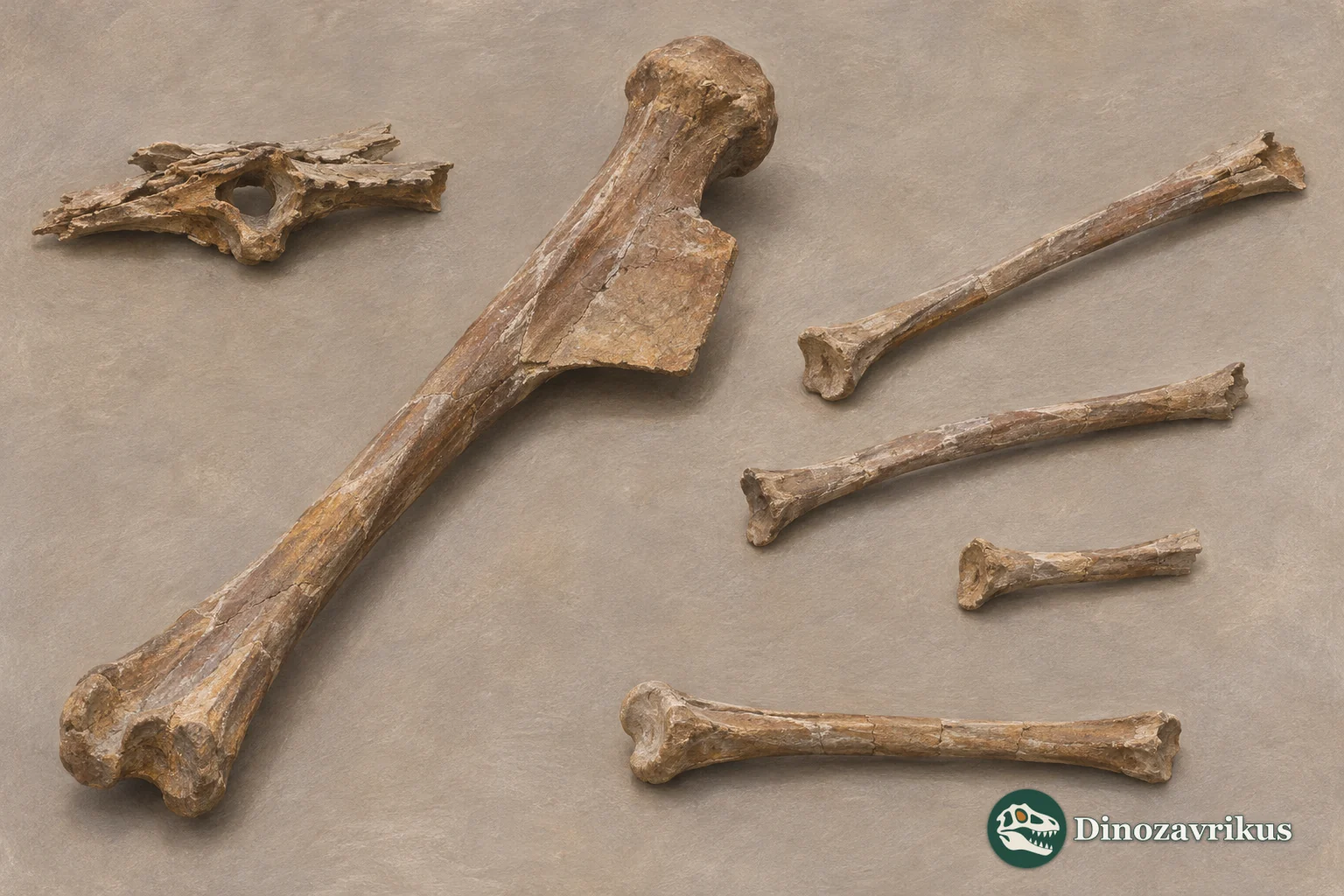
A large estimate with a missing head
The original authors estimated a wingspan of about 2.5 m through comparison with other pterosaurs. No complete wing or extended membrane was available for direct measurement, and one individual cannot establish the full adult size range.
Jaws, teeth, body covering and gut contents have not been found. Its feeding habits and head shape are unknown. Art can convey the broad pterodactyloid build, but a specialised beak or colourful crest would be an unsupported addition.
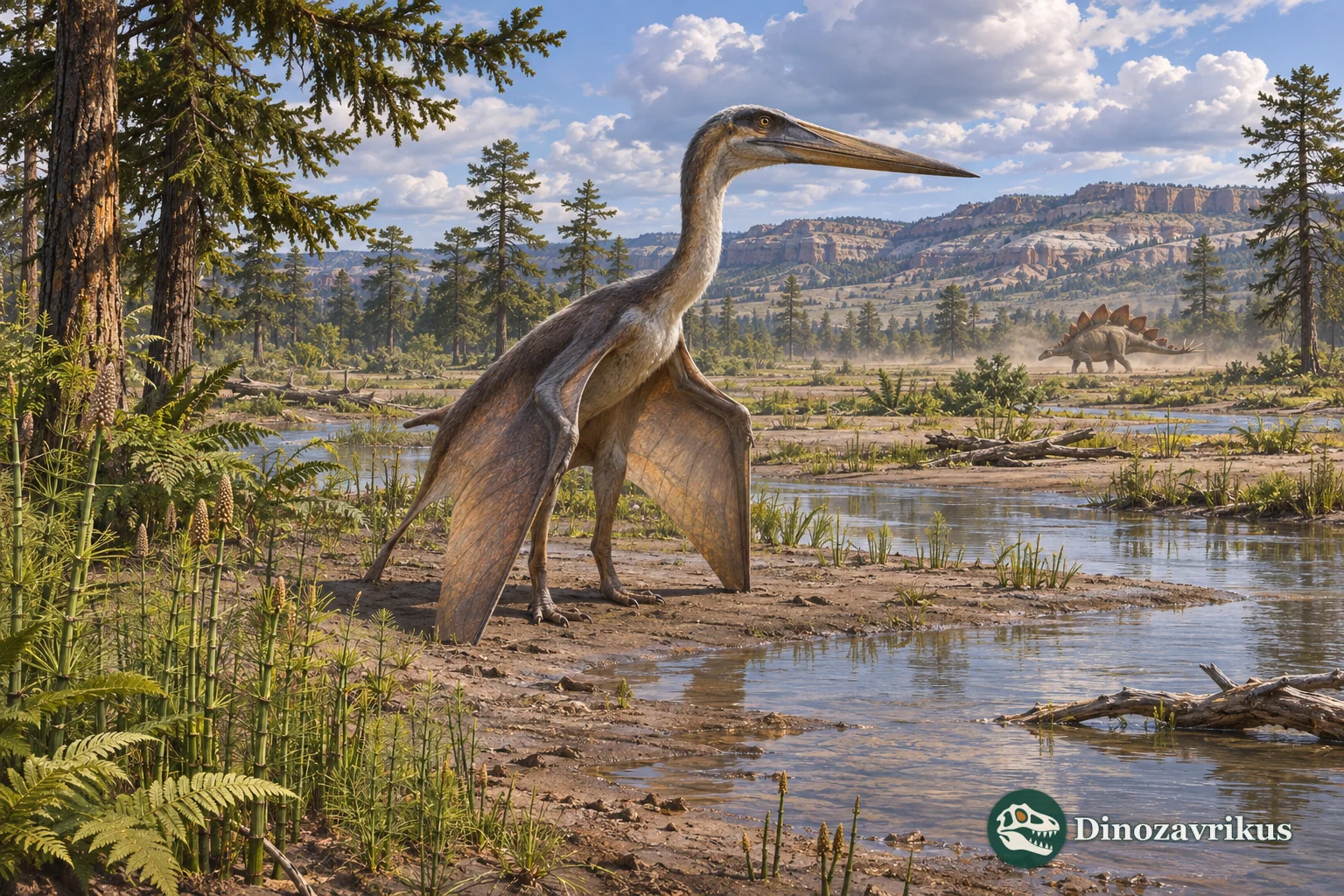
A reconstructed Morrison setting
The second scene draws on the Morrison Formation floodplain and includes Stegosaurus at a distance. It does not record a living interaction between the two animals.
Frequently asked questions
Where was Kepodactylus found?
At the Small Stegosaurus Quarry in Garden Park, Colorado, in the lower Morrison Formation.
What bones are known?
A cervical vertebra, humerus, several wing-finger fragments and one metatarsal; no skull is known.
Is its 2.5 m wingspan a direct measurement?
No. It is an estimate based on comparison of incomplete bones with other pterosaurs.
Do we know what it ate?
No jaws or direct food remains survive, so its diet has not been established.