

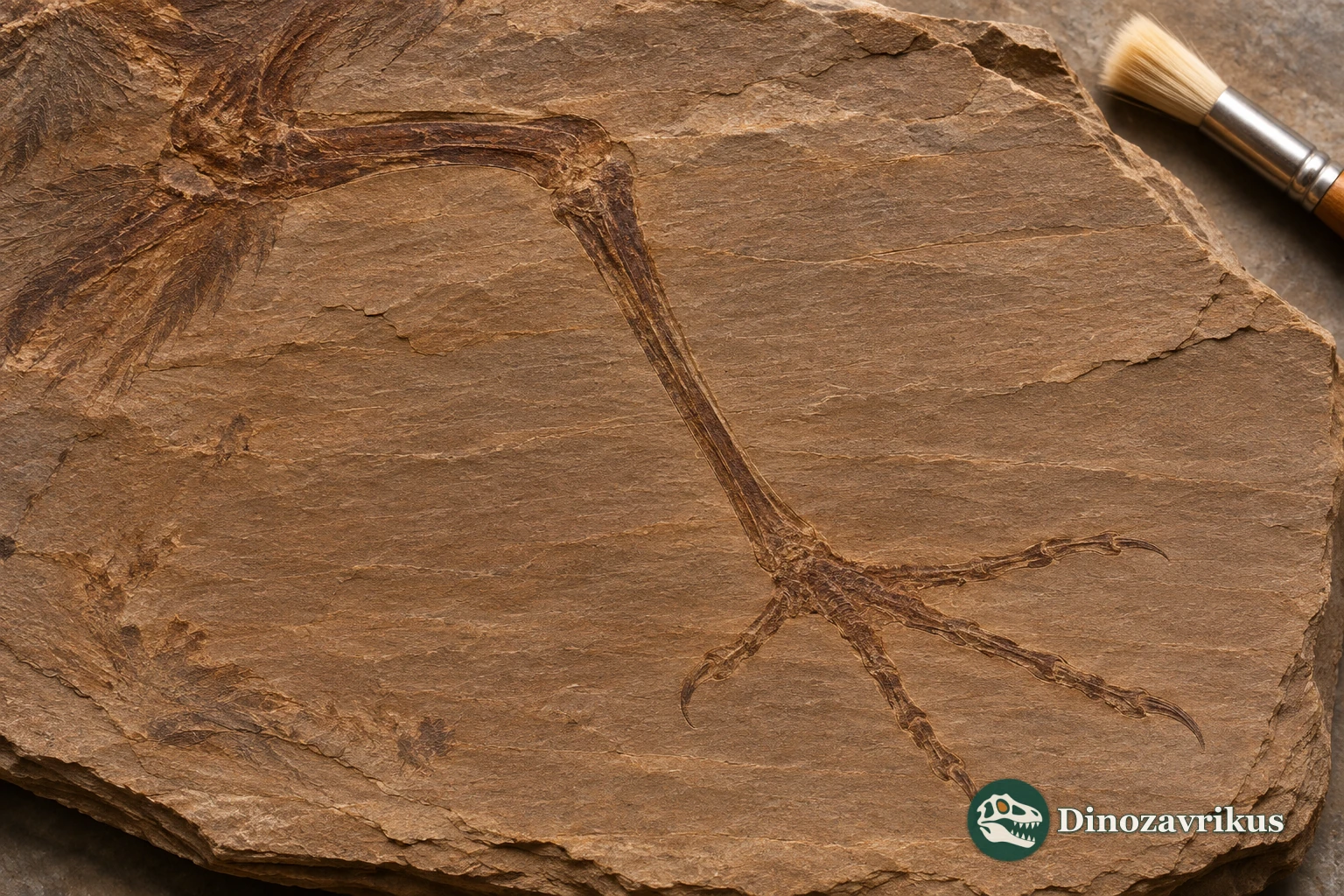
A Khinganornis skeleton is preserved on two slabs from Inner Mongolia. It retains small teeth, elongated legs and toes that could have helped the bird wade. The texture of its bone and the fusion of some skeletal elements suggest the individual had reached maturity.
Quick facts
| Group | Ornithuromorpha |
|---|---|
| Age | Early Cretaceous, Aptian |
| Locality | Morin Dawa, Inner Mongolia, China |
| Holotype | SGM-AVE-2017001 |
| Material | Near-complete skeleton on matching slabs |
| Formation | Longjiang Formation |
What can the fossils tell us?
Small teeth occur at the front and farther back in the upper jaw, and at least seven are visible in the lower jaw. The crowns do not resolve its diet.
These limb proportions suit wading. The third toe was the longest in the foot.
The outer cortex of the humerus and femur has fewer vascular canals. Together with fusion in the skeleton, this suggests the bird had reached maturity.
A skeleton from the Greater Khingan
The fossil came from Pigeon Hill near Baoshan in Morin Dawa, eastern Inner Mongolia. Matching slabs from the Longjiang Formation preserve most of a single skeleton. The specimen, SGM-AVE-2017001, is held at Hebei GEO University. Xuri Wang and colleagues published its description online in 2020. It appeared in the journal's 2021 issue.
Khinganornis takes its name from the Greater Khingan range, while hulunbuirensis refers to Hulunbuir. The locality extended the known range of the Jehol-type bird fauna beyond the classic sites farther south in northeastern China.
Teeth and toes
Small low-crowned teeth remain at the front and farther back in the upper jaw. At least seven can be seen in the lower jaw. They show that teeth persisted at the tip of the bill. The description records no food remains that establish the diet.
The long lower legs and toes led the describers to suggest that the bird could forage while wading. The middle toe was the longest. In Gansus, the fourth toe was longer than the rest. Differences like this matter when comparing how birds with similar overall leg proportions might have moved.
Maturity and the age of the lake beds
Thin sections from the right humerus and femur reveal fewer vascular canals toward the bone surface. Growth arrest lines could not be distinguished in the readable portions. The outer bone tissue and fusion of skeletal elements point to an adult individual. They give no precise age in years.
The original description cited a tuff age of 121.23 ± 0.74 million years. Later measurements dated tuffs in two local sections to 119.20 ± 0.38 and 118.67 ± 0.13 million years. These dates help correlate the Early Cretaceous lake deposits and measure the age of the ash layers themselves.

Relationships within early birds
Khinganornis belongs to Ornithuromorpha, the group that includes living birds. The original analysis recovered it beside Iteravis and Changzuiornis. A later analysis including the newly described Shuilingornis placed Khinganornis, Gansus and Iteravis in an expanded Gansuidae. Both arrangements are hypotheses drawn from comparisons of skeletal traits.
Frequently asked questions
How much of Khinganornis is known?
A single nearly complete skeleton is known from matching slabs. It preserves bones of the head and limbs.
Were there teeth at the tip of the bill?
Yes. Teeth are preserved on the premaxillae at the front of the upper jaw as well as farther back.
Why is the bird shown wading?
Its long lower legs and toes suit wading. The skeleton does not establish exactly how it caught or gathered food.
How can paleontologists tell that it was mature?
Fused skeletal elements and the low density of vascular canals near the surface of the sampled bones indicate that growth had slowed substantially.