

Khunnuchelys was a Late Cretaceous softshell turtle recorded from China, Uzbekistan and Kazakhstan. Its skull had a deep snout and a broad, strongly curved surface in the upper jaw. These features help identify even incomplete skulls.
Quick facts
| Group | Turtles, softshells (Trionychidae) |
|---|---|
| Age | Late Cretaceous |
| Region | Asia (China, Uzbekistan and Kazakhstan) |
| Type species | Khunnuchelys erinhotensis |
| Holotype | IVPP V9535, partial skull from China |
| Known fossils | Partial skulls |
| Shell | No shell securely associated with a skull |
| Scientific name | Khunnuchelys |
| Diet | Exact diet unknown |
What can the fossils tell us?
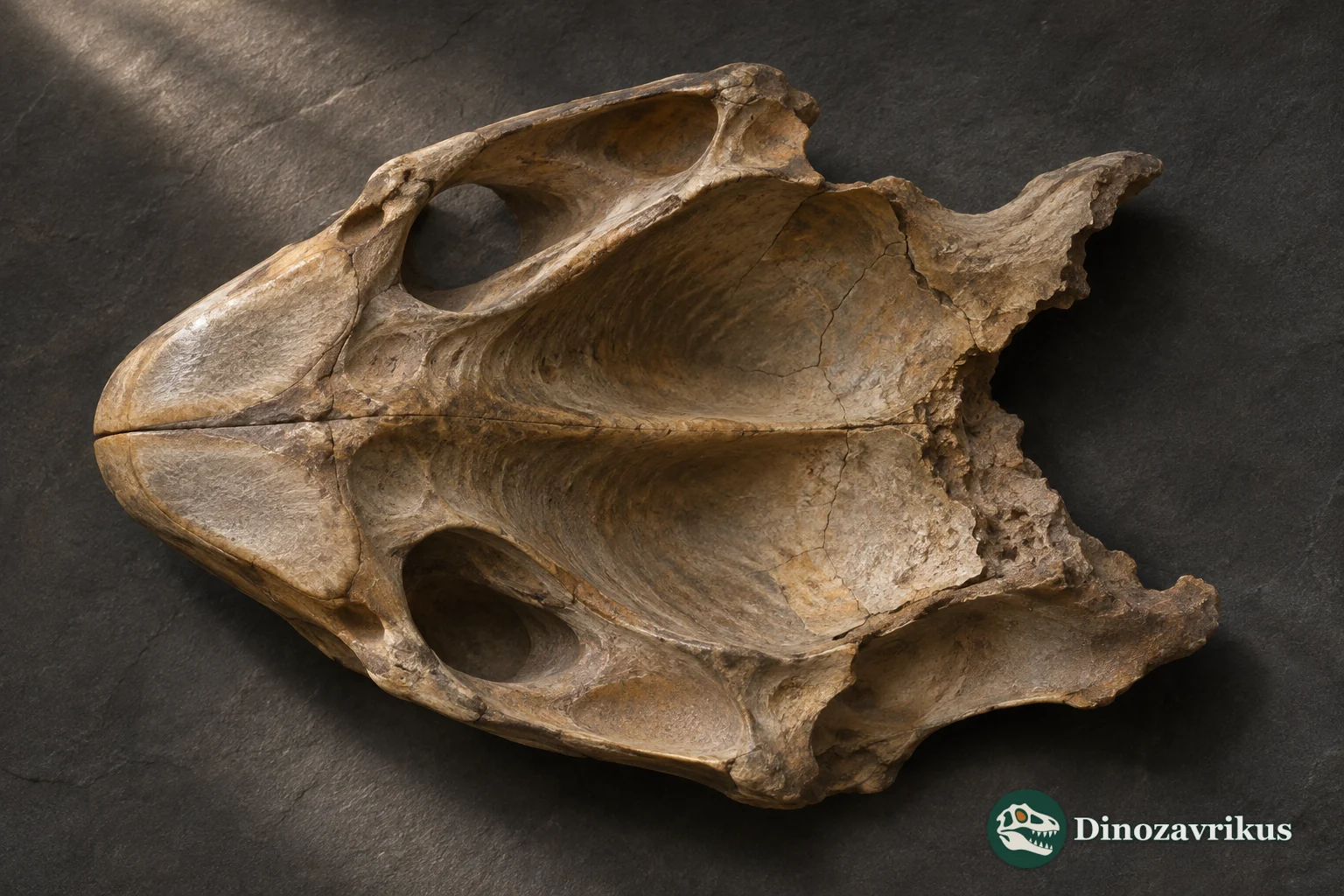
The type comes from the Iren Dabasu Formation near Erenhot. Much of the skull remains, although several edges and the crest at the back are missing.
The type of Khunnuchelys kizylkumensis from the Bissekty Formation preserves the braincase and roof of the skull.
ZIN PH 5/55 from the Bostobe Formation is the type of Khunnuchelys lophorhothon. A second partial skull came from Baykhozha.
Three species identified from skulls
Brinkman, Nessov and Peng named two species in 1993. The type species, Khunnuchelys erinhotensis, comes from Inner Mongolia, an autonomous region of China. The second, Khunnuchelys kizylkumensis, is from late Turonian rocks at Dzharakuduk in Uzbekistan.
Two partial skulls from Santonian to early Campanian beds of the Bostobe Formation in Kazakhstan were described in 2015 as Khunnuchelys lophorhothon. The species name recalls an earlier identification by Nessov, who tentatively compared one fossil to the duck-billed dinosaur Lophorhothon.
What the underside of the skull shows
The bones of the upper jaw formed a deep, beaklike rim and a wide crushing surface. The palate curved strongly upward and bore a ridge along the middle. In the Kazakh species the palate bones extended farther beneath the paired grooves behind the internal nostrils than they did in the other species.
The shape of the palate and broad jaw surfaces inspired the idea that Khunnuchelys crushed hard food. The skulls do not identify particular prey. A comparable feeding hypothesis has been proposed for another Cretaceous softshell, Gilmoremys, on the basis of jaw anatomy.
The missing shell
Large shells assigned to ‘Trionyx’ kansaiensis occur in the Bostobe Formation as well. Their size is compatible with estimates derived from the skull of Khunnuchelys lophorhothon. The estimated shell length varies with the comparison used to extrapolate from the skull.
An associated skull and shell would test whether the two names represent the same turtle. Until such a fossil turns up, shell shape and total body length remain uncertain.
Frequently asked questions
Where was the type species found?
In the Iren Dabasu Formation near Erenhot in Inner Mongolia, China.
How did the species from Kazakhstan get its name?
Its holotype was initially compared with the duck-billed dinosaur Lophorhothon. The species name preserves that part of its history.
What does the palate tell us about its diet?
The upper jaw could have been suited to crushing hard items. The particular foods remain unknown.
Has a shell been found with a skull?
There is no confirmed association. Large shell fossils from the same Kazakhstan formation are possible matches.