

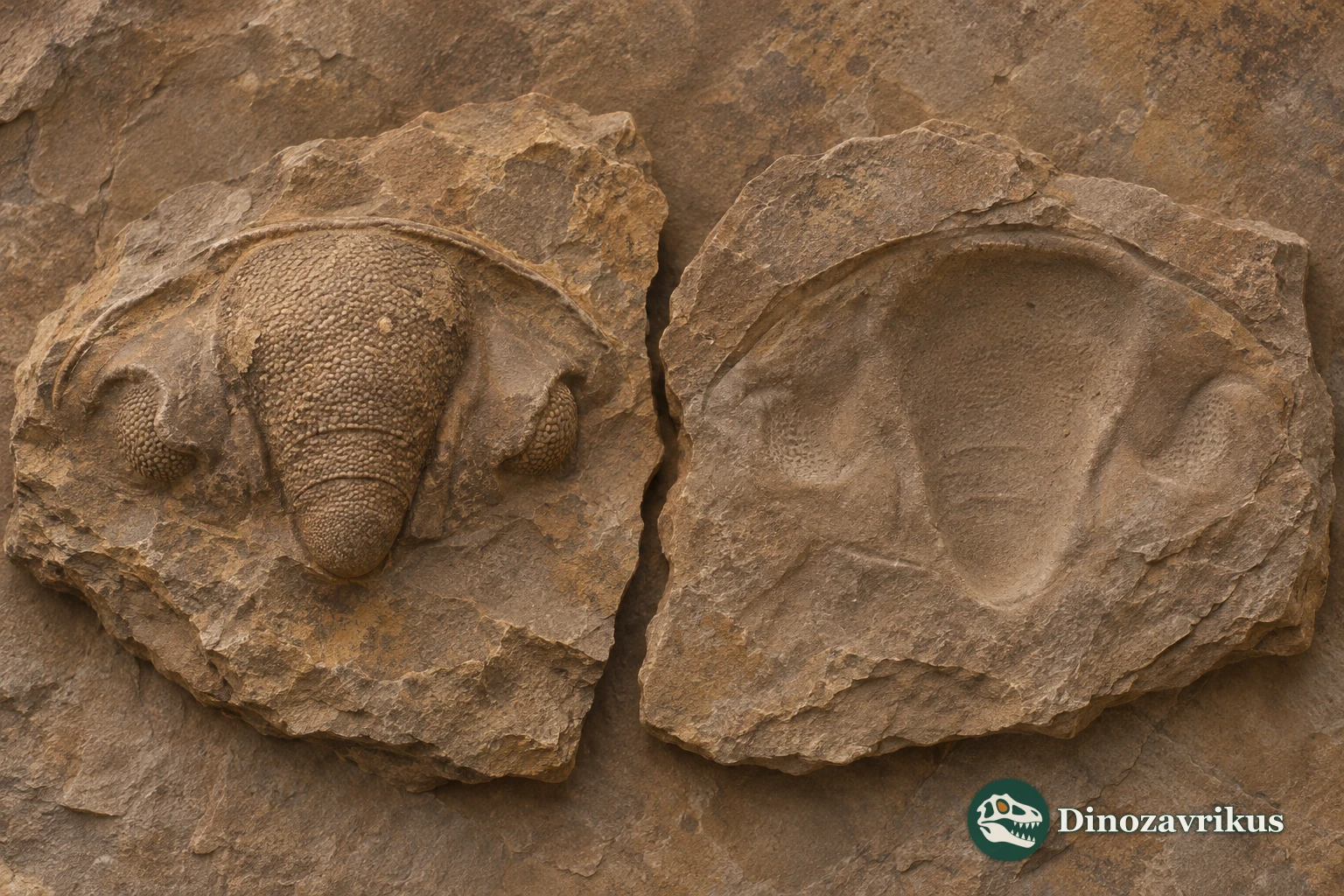
Kindbladia was a late Cambrian trilobite identified chiefly from parts of the head shield. Well-preserved surfaces show fine granules. If the outer layer stays attached to the surrounding rock when it splits, the remaining mould preserves less of the texture needed to tell species apart.
Quick facts
| Group | Trilobites |
|---|---|
| Age | Late Cambrian |
| Genus named | Edward Frederickson, 1948 |
| Type species | Kindbladia wichitaensis |
| Type beds | Honey Creek Formation, Oklahoma |
| Nevada material | Cranidia and free cheeks |
What can the fossils tell us?
Nevada cranidia also show two pairs of deep furrows to the sides of the raised central lobe.
The layer can stay attached to the matrix. An internal mould may therefore look different from the original outer surface.
A similar outline is not sufficient to assign a tail shield when it was found apart from the head.
From Oklahoma to Nevada
Edward Frederickson established Kindbladia in 1948 on material from Oklahoma's Honey Creek Formation. Its type species had been described by Charles Resser in 1942 as Berkeia wichitaensis. The Nevada species K. affinis also changed genus. Charles Walcott first described that species in 1884, and Resser subsequently assigned it to Iddingsia and then to Berkeia.
Nevada cranidia show a high central lobe that tapers forward to a rounded front, with narrow fixed cheeks sloping steeply upward. Two pairs of deep furrows cut into the sides of the glabella. Three shallower depressions occur in the furrow near the front border.
What is lost when the rock splits
Allison Palmer illustrated the Kindbladia affinis cranidium USNM 141538 from Shingle Pass. It preserves a dense covering of fine granules. Palmer described a central node on the occipital ring of this species, compared with a spine in the type species.
The shell is relatively thick, and its granular surface tends to adhere to the matrix. The outer surface and the occipital edge both matter for identification. A mould that lacks one of them may preserve the shape of the head but lose a diagnostic detail.
Detached tail shields and disputed assignments
Palmer doubted that a tail shield figured by Frederickson belonged to Kindbladia. Its outline and the thickened band on the side resembled the pygidium of Cheilocephalus. A separate Nevada tail shield that Palmer attributed to K. affinis was later compared with Iddingsia. Associations inferred from isolated pieces remain open to revision.
Frequently asked questions
What was the original name of the Kindbladia type species?
Berkeia wichitaensis. Resser named it in 1942, and Frederickson designated it the type when he established Kindbladia in 1948.
Where did the granular cranidium USNM 141538 come from?
Shingle Pass, Nevada. Palmer figured it as Kindbladia affinis.
How did Palmer distinguish the occipital ring of K. affinis?
He described a central node on that ring, whereas the type species has a spine.
Why are some pygidia hard to identify?
Closely related trilobites can have similar isolated tail shields. An articulated shell can establish which head and tail characters belong together.