

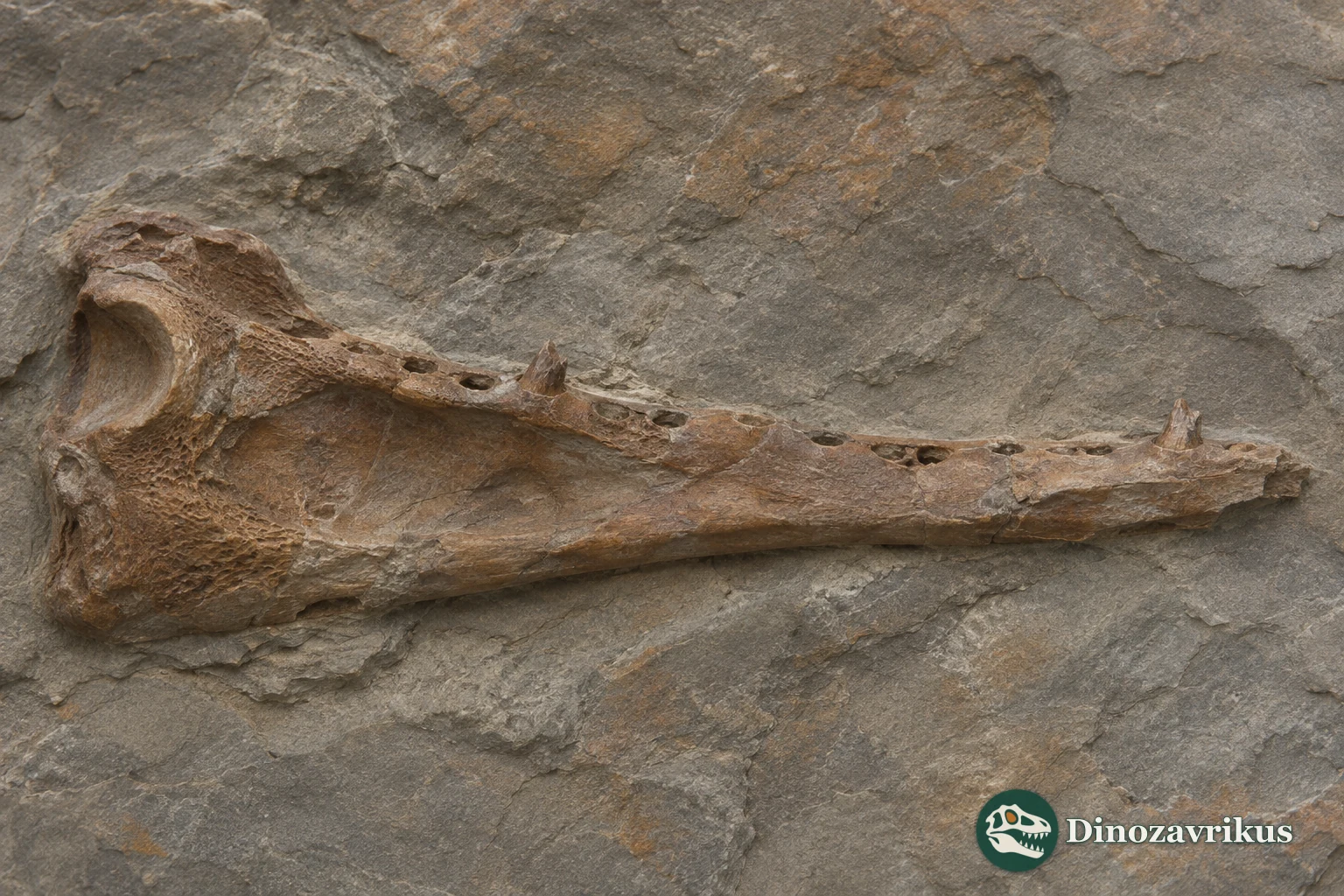
Koinia silantjevi was a temnospondyl from Permian rocks exposed along the Vym River in European Russia. A fragment of the lower jaw is the type specimen. Separate bones from the same locality have also been referred to the species, but there is no complete skull or articulated skeleton.
Quick facts
| Group | Temnospondyls, melosaurines |
|---|---|
| Age | Permian, lower Kazanian regional interval |
| Region | Europe, Komi Republic, Russia |
| Type species | Koinia silantjevi |
| Scientific name | Koinia |
| Diet | Exact prey is unknown |
What can the fossils tell us?
PIN 4416/15 is part of a lower jaw from Ust-Koin. Other isolated bones from the locality have been assigned to the species.
Koinia is classified among the melosaurines. It occurs in the Golyusherma vertebrate assemblage, assigned to the Roadian in one modern geological correlation.
The material gives no reliable body length. Separate bones and the setting of burial leave the diet and exact habitat unresolved.
The jaw from the Vym River
Yuri Gubin named Koinia in 1993. The type specimen, PIN 4416/15, comes from Ust-Koin in the Knyazhpogost District of the Komi Republic. The rocks are exposed along the Vym downstream from the mouth of the Koin. The referred finds include separate skull and shoulder-girdle bones, so the outline of the complete animal cannot be determined.
Relationships and geological age
Koinia belongs to the melosaurines, a group of Permian archegosauroid temnospondyls. Another archegosauroid, Konzhukovia, is known from skull remains at other Russian localities. The beds at Ust-Koin are lower Kazanian in the regional scale. Older Russian publications used an Upper Permian designation for the Kazanian, while a later comparison assigned the Golyusherma assemblage to the Roadian, part of the Middle Permian in the international scale.
Bones in a buried channel
At Ust-Koin, cross-bedded sandstones mark an ancient channel. The deposits include fish scales, fin spines and the bones of several tetrapods. This is evidence for the setting in which the remains accumulated. It leaves open where in the waterways Koinia lived and what prey it took.
Frequently asked questions
Which fossil is the basis for Koinia?
The type, PIN 4416/15, is part of a lower jaw.
Why do different publications give Middle or Upper Permian?
The regional Kazanian interval was historically listed as Upper Permian. A modern correlation uses a Roadian, or Middle Permian, age for the Golyusherma assemblage.
What kind of amphibian was it?
It was a melosaurine, one branch of the Permian archegosauroid temnospondyls.
What else is found in the channel deposits?
They contain fish scales, fin spines and the bones of other tetrapods, including Permian therapsids.