

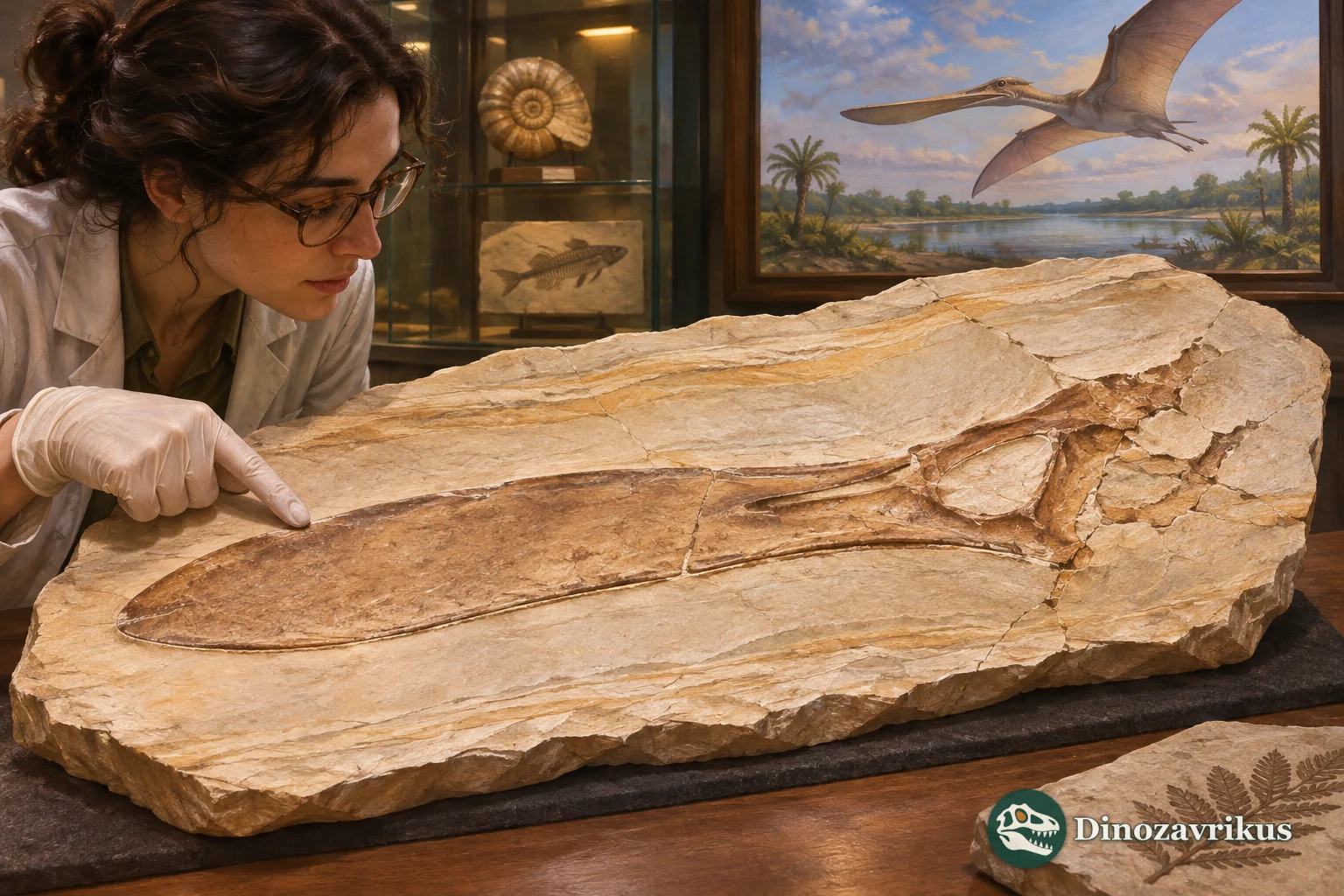
Lacusovagus magnificens is known from a single incomplete upper skull associated with the Crato Formation of northeastern Brazil. Its broad, low, toothless front contrasts with many pterosaurs in those rocks. No wings, trunk or limbs have been assigned to the species. The often-cited wingspan of roughly 4.1 m therefore comes from comparison with relatives, not from an actual Lacusovagus wing.
Quick facts
| Scientific name | Lacusovagus magnificens, Witton, 2008 |
|---|---|
| Holotype | SMNK PAL 4325, incomplete upper skull |
| Locality | Araripe Basin, Brazil; exact collecting site unknown |
| Rock unit | Nova Olinda Member of the Crato Formation, inferred from the slab |
| Age | Early Cretaceous, probably Aptian |
| Skull | 618 mm preserved along the midline; at least 655 mm estimated |
| Wingspan | About 4.1 m by comparison; no wing bones known |
What can the fossils tell us?
SMNK PAL 4325 includes parts of the premaxillae and maxillae, perhaps also the jugal. No additional specimen is securely assigned to this species.
The skull came through a fossil dealer. Lithology and preservation point to the Nova Olinda Member, but the exact collection site is unrecorded.
The preserved midline length is 618 mm. A 655 mm minimum incorporates a restored gap, while 4.1 m wingspan comes from proportional comparison.
Both the original description and a recent reassessment favour chaoyangopterid affinity. Missing skull characters can alter some phylogenetic results.
A skull without a field locality
Mark Witton named the species in 2008 from SMNK PAL 4325, housed at the State Museum of Natural History Karlsruhe. It had been obtained from a fossil dealer, leaving no documented quarry coordinates. The rock and preservation support assignment to the Nova Olinda Member of the Crato Formation, but cannot locate the actual excavation point.
Parts of the premaxillary and maxillary bones survive, perhaps with a piece of jugal. The specimen has damage from before burial as well as post-discovery preparation and repair. A later review found no reason to assign other isolated Crato bones to Lacusovagus. The genus name refers to a lake wanderer; the species name reflects its impressive size.
What the broad rostrum actually shows
The preserved midline extends 618 mm. Allowing for a gap reconstructed during preparation gives a minimum complete skull length around 655 mm. Its front is low, broad and toothless, with outward-flaring maxillary margins and a large opening farther back. Compression prevents a secure measurement of original skull height.
The original 4.1 m wingspan estimate compared skull proportions with Jidapterus. No humerus, wing finger or flight membrane of Lacusovagus checks that number directly. Damage and missing areas also prevent a definitive conclusion about whether it carried a cranial crest.
Relationships and a lagoon setting
The original analysis placed Lacusovagus near Asian chaoyangopterids. A newer reassessment supports that interpretation but explains how coding characters that are not preserved can shift its position in some trees. Chaoyangopterus offers a comparative anatomy reference, not an identified direct ancestor.
The laminated Crato rocks record a water-rich setting that can inform an illustration. They do not reveal where this particular pterosaur fed. Toothlessness alone does not prove fish eating or mud probing. Its food, soft beak tissue, colour and behaviour remain unknown.

The limits of a complete-animal picture
A living pterosaur can be pictured using the preserved skull and general features of relatives. The result is an interpretation. Neither the full outline nor the exact wingspan was recovered from the single holotype.
Frequently asked questions
Where was Lacusovagus found?
Its skull is associated with the Crato Formation in Brazil's Araripe Basin, but its exact collecting site was not recorded.
How many specimens are known?
Only the incomplete holotype skull SMNK PAL 4325 is confidently assigned to the species.
Was its wingspan measured at 4.1 metres?
No. That figure is a proportional estimate from comparison with other pterosaurs; no Lacusovagus wing is known.
What did it eat?
There is no direct food evidence. The shape of a toothless rostrum cannot by itself identify particular prey.