

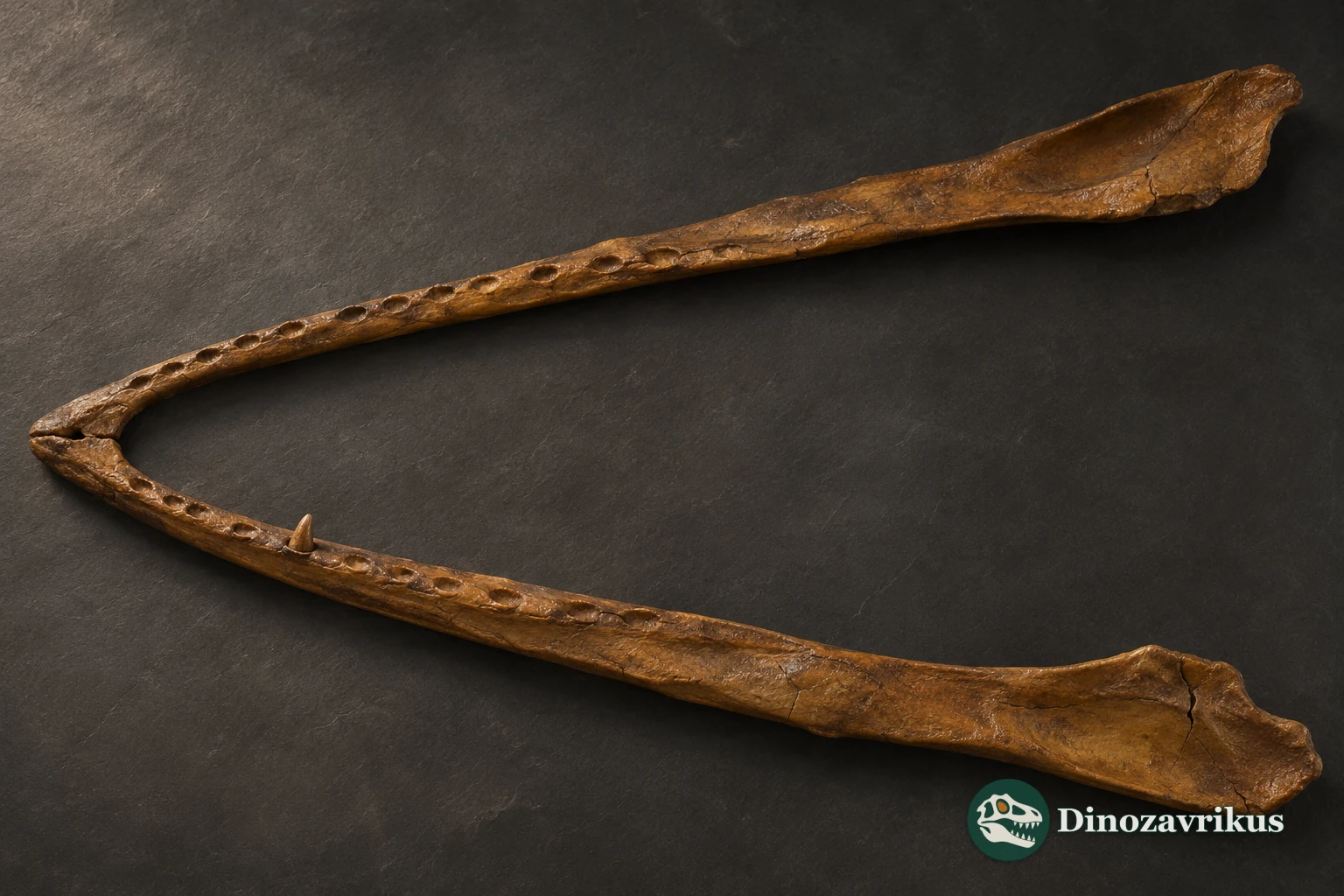
Laganosuchus was a Cenomanian crocodyliform from northern Africa. Its best specimen preserves both branches of the lower jaw. They are remarkably long and shallow, diverge behind a short anterior union and carry twenty-four tooth sockets on each side. No upper skull has been described.
Quick facts
| Type species | Laganosuchus thaumastos |
|---|---|
| Group | Stomatosuchidae |
| Age | Late Cretaceous, Cenomanian |
| Localities | Echkar Formation, Niger, and Kem Kem beds, Morocco |
| Type of the type species | MNN IGU13, nearly complete lower jaw |
| Maximum type jaw length | 83.8 cm |
What can the fossils tell us?
Both branches are nearly complete. The 83.8 cm measurement comes from the jaw itself and does not give the full body length.
The largest sockets lie near the front. A replacement tooth survives in one of the sockets farther back.
Four sockets and a replacement crown are preserved in the Moroccan type. That short section is the area available for direct comparison.
Two fossils from Cretaceous Africa
Paul Sereno and Hans Larsson named the genus in 2009. The type of Laganosuchus thaumastos, MNN IGU13, came from the Echkar Formation at Iguidi in Niger. The lower jaw is nearly complete. The rear projection behind its left joint is missing.
The Moroccan species L. maghrebensis is based on UCRC PV2, the front of a left dentary from the Kem Kem beds. A study published in 2020 also referred NMC 41786 to this species. A comparison with the jaw from Niger highlighted the enlarged first, second and fourth sockets.
Measurements from the lower jaw
The jaw is 83.8 cm long at its maximum extent. The distance from its tip to the middle of the jaw joint is about 75 cm. The branches are shallow and joined only along a short stretch at the front. These proportions indicate a broad mouth. An upper jaw would test the reconstruction of its precise outline.
A replacement crown in the right dentary is about 14 mm high. Tooth form and socket spacing distinguish this material from other regional crocodyliforms. The back teeth of Hamadasuchus, for example, were flattened from side to side and serrated. The right joint of the Niger jaw preserves irregular bone described as pathological. Its cause remains unknown.
Possible habits at the water’s edge
Sereno and Larsson proposed that Laganosuchus could have waited for prey in the water. The shallow jaws and modest crowns are among the clues behind this interpretation. They do not record a particular prey animal or exactly how the jaws moved during feeding.
Both the Niger and Moroccan finds come from rocks associated with river systems. This is consistent with a connection to water. It does not show how much time the animal spent in the channel or on its banks.
Frequently asked questions
Which parts of Laganosuchus have been found?
The type of L. thaumastos preserves nearly complete lower jaws. An upper skull and the rest of the skeleton have yet to be described.
How long is the type jaw?
Its maximum measured length is 83.8 cm. The measurement does not give an exact body length.
Where did the second species come from?
L. maghrebensis is based on a jaw fragment from the Kem Kem beds of south-eastern Morocco.
Do the fossils show what it ate?
The authors proposed feeding in water. No direct evidence identifies particular prey.