

Leidybatis was an Eocene ray with broad teeth that formed a working surface in the jaw. Isolated Alabama teeth show variation even within the median row. Associated dental plates from Moravia provide complementary evidence of how neighbouring crowns fitted together.
Quick facts
| Group | Myliobatiform rays |
|---|---|
| Type species | Leidybatis jugosus |
| Genus authority | Henri Cappetta, 1986 |
| Type area | Burlington County, New Jersey, USA |
| Material | Teeth and associated dental plates |
| Alabama sample | 71 isolated teeth |
What can the fossils tell us?
A flat facet on the swelling is consistent with use during life. Other enamel loss may reflect taphonomy.
Median roots have many fine lamellae. Lateral roots in the studied sample have two or three.
Associated plates from Moravia complement the isolated Alabama teeth. These finds do not preserve a complete skeleton.
From a New Jersey tooth to a separate genus
Joseph Leidy named Myliobates jugosus in 1876 from Eocene material in Burlington County, New Jersey. He illustrated a tooth in two views in 1877. Henri Cappetta established Leidybatis in 1986 for that form and a new species, L. granulosus. The original species epithet was retained in a new genus combination.
Dirk Hovestadt and Maria Hovestadt-Euler questioned the diagnostic value of the type species in 2013. An isolated convex tooth can resemble teeth in living eagle rays. Ebersole and colleagues retained the name in 2019, emphasising a combination of crown ornament and root structure. Strong convexity alone cannot resolve the issue: it may depend on position in the upper or lower dentition.
Swollen crowns and thin margins
Median teeth extend across the jaw. Each crown bears a swelling that contrasts with the thin areas to either side. The swelling can be centred or offset. It is high and centred in the large specimen MSC 35005, but lower and displaced to one side in MSC 37082. The Alabama study interpreted this as variation within a species, while leaving the precise upper or lower origin of individual teeth unresolved.
Tuberculate enameloid remains on unworn parts of the biting surface. Both crown faces carry coarse vertical folds that sometimes join. Regular nutritive grooves divide the median root into numerous thin lamellae. The lateral teeth have roughly six-sided crowns with similar ornamentation and only two or three root lamellae.
Separating similar fossil rays
In the Alabama material the root lamellae do not project past the inner edge of the crown. In Myliobatis and Aetomylaeus the corresponding projection is conspicuous. Crown ornament adds a second distinction: the upright folds of Leidybatis contrast with the pits and granulation described on the faces of Aetomylaeus teeth. A broad tooth outline occurs in several rays, so it is useful to compare several surfaces together.
The same revision described the crowns of L. granulosus, L. rusticus and L. zemensis as apparently more evenly convex than those of L. jugosus. In the latter, the swelling stands out from the thin margins. That feature is more informative when wear or breakage has left enough of the crown intact.
Beds, dental plates and feeding
The Alabama Claiborne sample consists of 71 isolated teeth. Two fragments came from the lower Tallahatta Formation. The rest came from the Tallahatta–Lisbon contact or the base of the Lisbon Formation. The occurrences span the late Ypresian to middle Lutetian, in zones NP14–NP15. They provide several dated records without establishing a continuous local population.
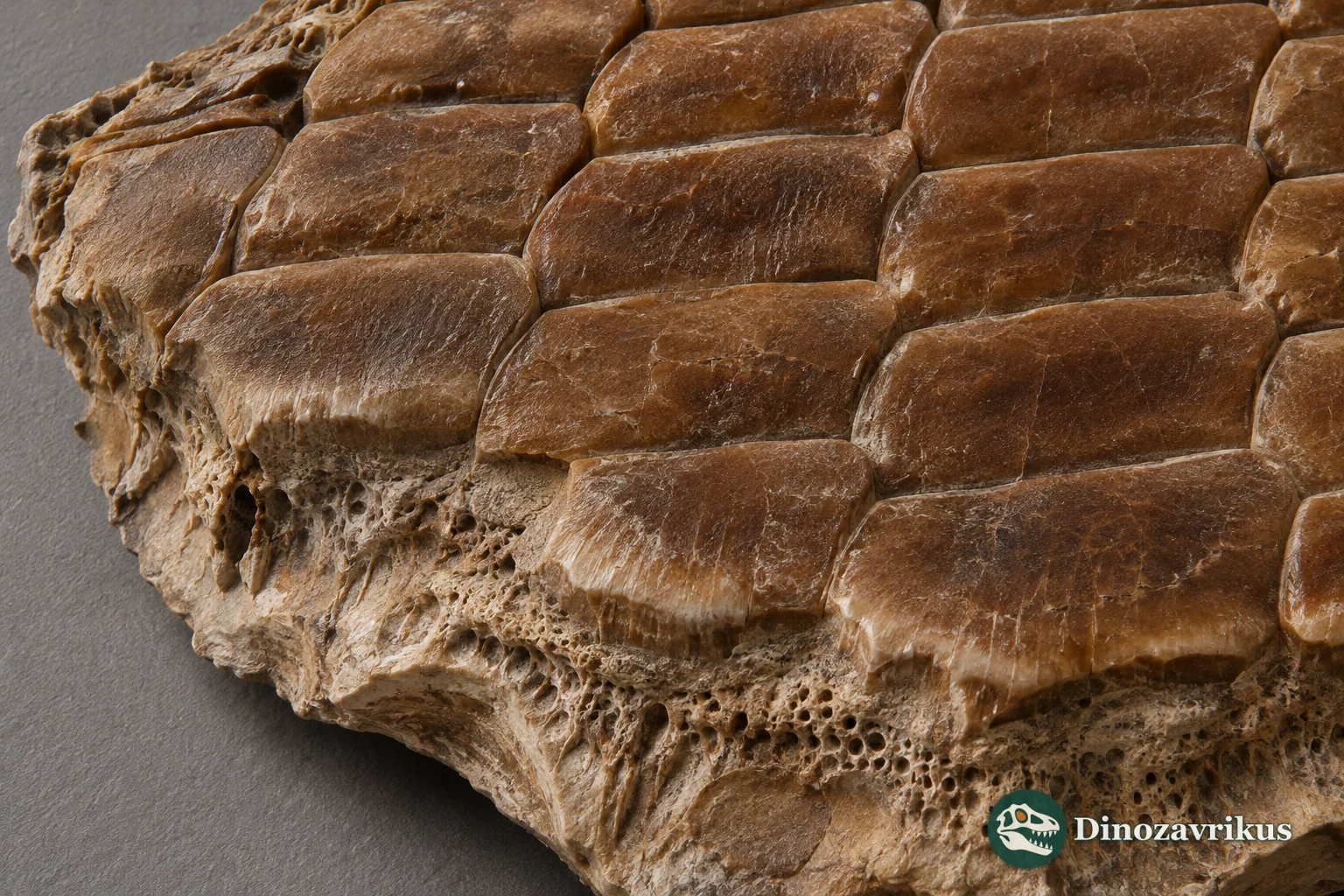
Near Staré Město in Moravia, Eocene deposits of the Frýdlant Formation yielded associated dental plates and isolated teeth referred to L. jugosus. Plates preserve neighbouring teeth and help interpret their arrangement. They do not show the complete animal. Broad working surfaces and flat wear facets on some crowns are consistent with processing hard food, but no particular prey is identified. See Eoplinthicus for a different case of interpreting Eocene ray teeth.
Frequently asked questions
Who named the type species?
Joseph Leidy named it in 1876 from New Jersey material. Henri Cappetta erected the genus in 1986.
How do lateral teeth differ from median teeth?
Lateral teeth are closer to hexagonal and have two or three root lamellae. Median teeth are much broader and have many more lamellae.
Where are associated plates known from?
Associated plates were reported from the Eocene Frýdlant Formation near Staré Město in Moravia.
Can wear identify the ray's prey?
Wear facets and tooth form are consistent with crushing hard food, but do not identify particular prey.