

Limicorallus was named from a broken left humerus in Kazakhstan. Evgeny Kurochkin described it as a rail. Later comparisons put the Kazakhstan fossil in the cormorant family. A much younger German specimen was assigned to the genus with a question mark.
Quick facts
| Group | Cormorant family in later work |
|---|---|
| Age of type species | Late Oligocene |
| Locality | Myn-Sai ravine, Kazakhstan |
| Holotype | PIN 1442-262 |
| Known type material | Distal left humerus |
What can the fossils tell us?
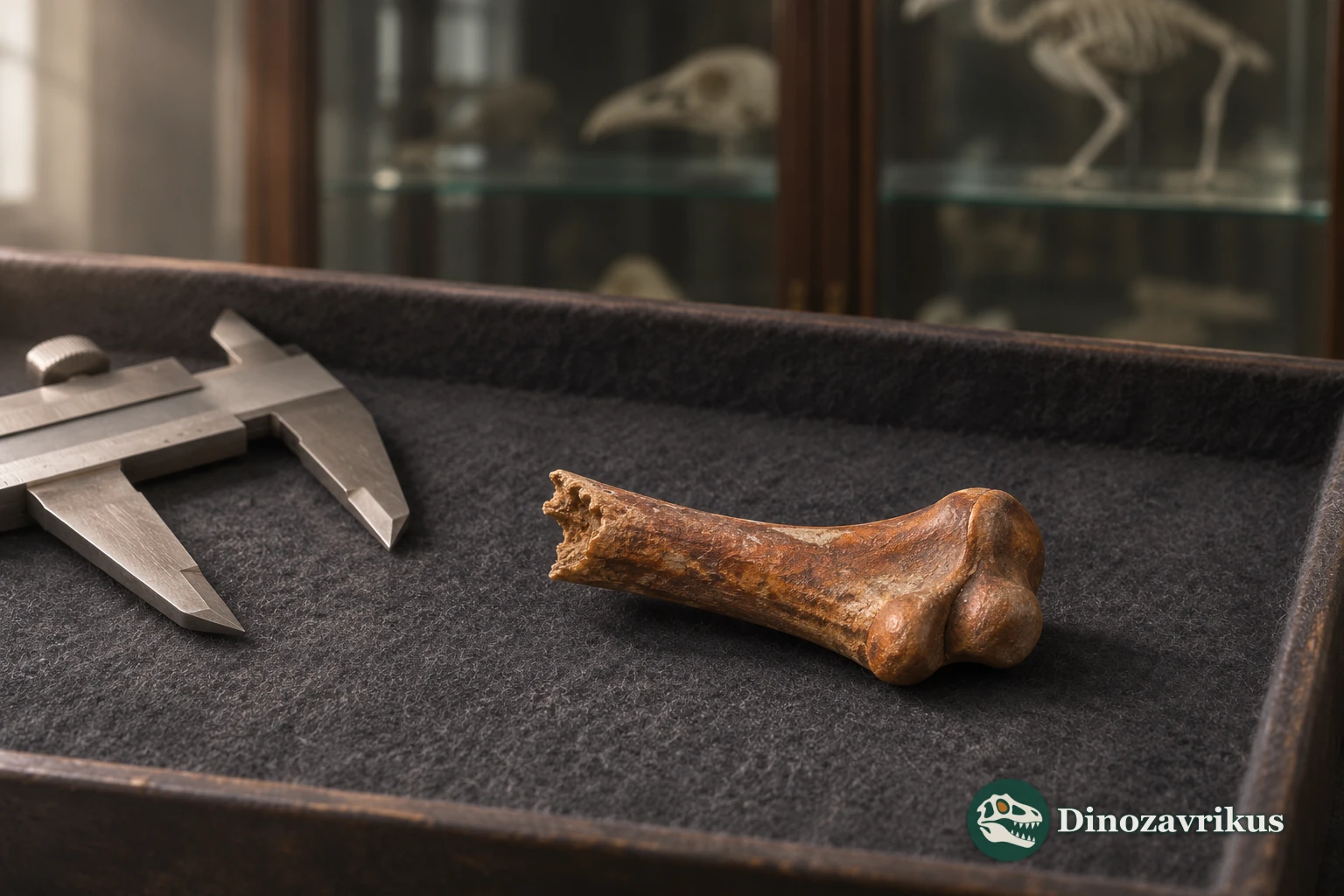
PIN 1442-262 preserves the elbow end of the left humerus. Its features can be compared across birds. It does not preserve the length of the wing.
Gerald Mayr judged the Kazakhstan bird slightly smaller than a living pygmy cormorant. The comparison gives a relative size and does not establish body mass.
The German type is a tarsometatarsus. The Kazakhstan type is a humerus. Without the same bone in both types, the proposed link remains tentative.
The fossil from Myn-Sai
Evgeny Kurochkin described Limicorallus saiensis in 1968. PIN 1442-262 came from the Indricotherium beds of the Myn-Sai ravine near Shalkar-Teniz. Early publications called these beds middle Oligocene. Recent accounts list the Kazakhstan species as late Oligocene.
The holotype is the end of a left humerus that articulates with the forearm at the elbow. In Gerald Mayr’s comparison, the bird was slightly smaller than a living pygmy cormorant. The fossil does not yield a precise body length, mass or wingspan.
From rails to cormorants
Kurochkin originally assigned the fossil to rails. Later anatomists rejected that identification, and one interpretation suggested a duck. Jiří Mlíkovský and Petr Švec assigned the specimen to Phalacrocoracidae in 1986. Gerald Mayr and a subsequent account of Asian Paleogene birds accepted the cormorant placement.
Broadly contemporary European Borvocarbo is represented by different parts of the skeleton. These offer more features for testing its affinities. For the Kazakhstan fossil, the identification rests on one region of the wing.
A possible German species
In 2009 Mayr described the tiny early Miocene Limicorallus (?) carbunculus from a tarsometatarsus, the bone above the toes. It probably came from Mainz-Weisenau, Germany. The question mark refers to the generic assignment. The Kazakhstan type has no corresponding foot bone, so the two types cannot be compared directly.
Frequently asked questions
What fossil was used to name Limicorallus?
A partial left humerus, PIN 1442-262, from the Myn-Sai ravine in Kazakhstan preserves the elbow end.
Was it a rail?
The original description placed it with rails. The comparisons used in later accounts identify it as a member of the cormorant family.
How large was the Kazakhstan bird?
Its humerus suggests a bird slightly smaller than a modern pygmy cormorant. Its body length and mass remain unknown.
Is a second species known?
A small early Miocene bird from Germany was tentatively assigned to the genus. It is known from a foot bone and cannot be compared directly with the original wing fragment.