

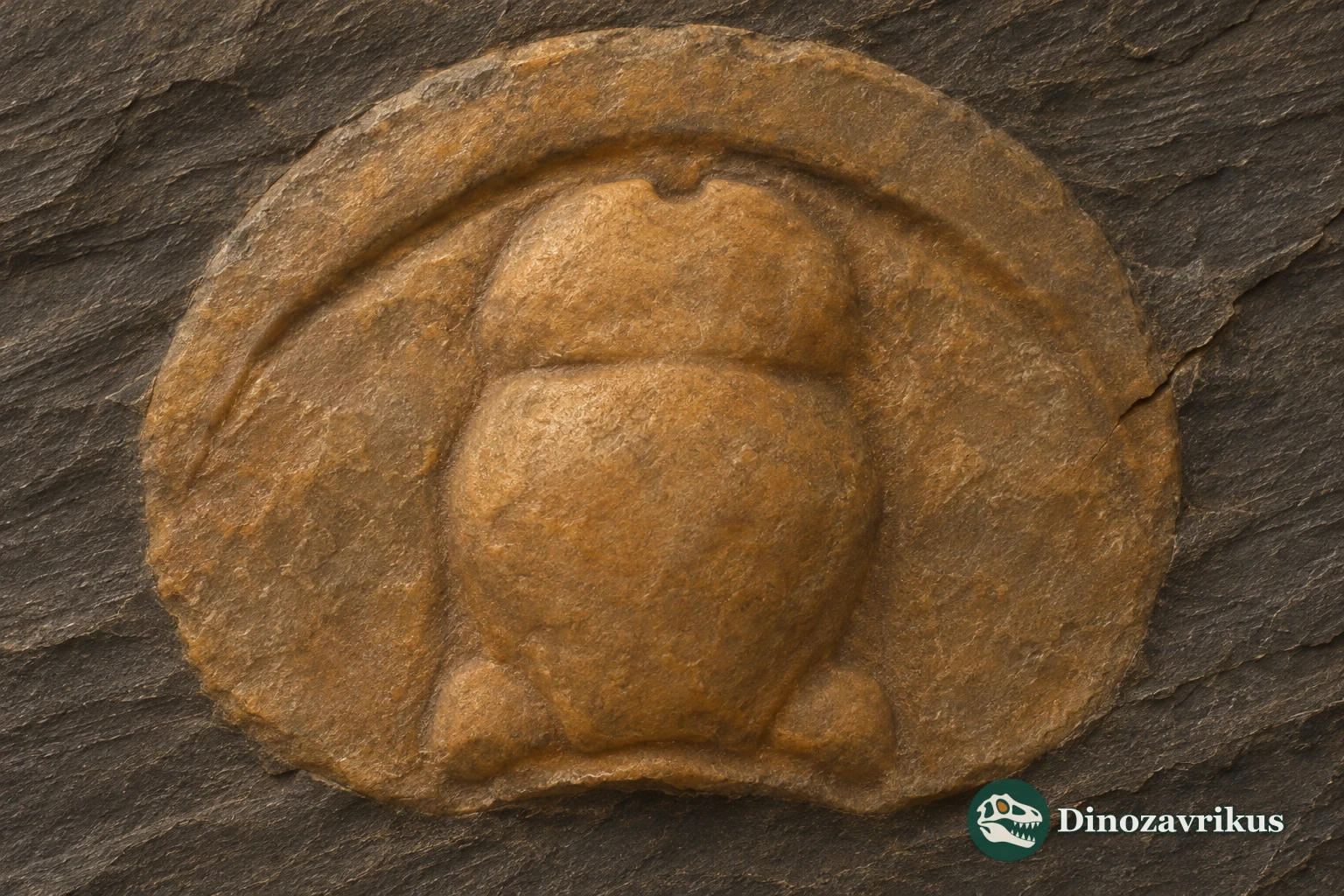
Linguagnostus was a minute Cambrian marine agnostoid. In the type species, the central axis of the tail shield ends in a tongue-shaped lobe and three spines project from the margin. The shape is distinctive even when a tail shield is the only part preserved.
Quick facts
| Group | Agnostida, Diplagnostidae |
|---|---|
| Age | Cambrian |
| Type species | Linguagnostus kjerulfi |
| Genus established | Teiichi Kobayashi, 1939 |
| Type area | Krekling, Oslo Region, Norway |
| Known fossils | Detached head and tail shields |
What can the fossils tell us?
The Krekling pygidium is the lectotype. The presence of a median spine helps distinguish it from a similar species.
The glabella itself bears a short forward notch. Some cephala of another species show the same notch, so it carries limited weight on its own.
Most records fall in the lower Lejopyge laevigata Zone. Chinese sections record a slightly longer range.
The specimens from Norway
Waldemar Brøgger described Agnostus kjerulfi in 1878 from the Alum Shale Formation at Krekling in the Oslo Region. When Teiichi Kobayashi erected Linguagnostus in 1939, he chose Brøgger's species as the type. The tail shield PMO 28684 was later selected as the lectotype. The head shield PMO 28682, a paralectotype, comes from the same bed and locality.
Swedish material widened the sample. A small limestone concretion at Fjällbränna yielded three cephala and six pygidia, mostly fragments. A separate find at Långseleån adds another tail shield. Those samples let palaeontologists compare the relief of several specimens.
Which parts help distinguish the species?
The head of L. kjerulfi has a broad groove along its anterior border and a short notch in the front of the glabella. Some specimens resemble Diplagnostus at a glance. The tail offers the clearer distinction. Its central axis carries a long raised node, and a sinuous ridge runs back to the bases of the lateral spines.
In L. groenwalli the rear margin lacks the central spine. Its axial node is interrupted and continues as a separate knob. Some heads assigned to that species also have the short notch seen in L. kjerulfi. The 2023 Scandinavian revision therefore gave the tail characters more weight when separating them.
Fossils that mark part of the succession
Norwegian, Swedish, Kazakh and Himalayan records of L. kjerulfi generally lie in the lower part of the Lejopyge laevigata Zone. In China it also occurs at the base of the upper part of that zone. This is a modest difference in the observed range, which matters when a record is used to correlate beds.
The Huaqiao Formation in northwestern Hunan yielded more than one species of the genus, including L. stenus and L. reconditus. The study defined a zone by the lowest occurrence of L. reconditus in the sequence, alongside a broader assemblage of agnostoids.
Frequently asked questions
Where was the type species first described from?
The first material came from the Alum Shale Formation at Krekling in the Oslo Region.
Where are the three marginal spines?
Two sit towards the sides of the pygidium, with a third at the middle of the rear margin.
Can a short notch in the head separate the two Scandinavian species?
The notch can occur in both. Tail shields carry more reliable features for distinguishing them.
Which species gives its name to a zone in Hunan?
L. reconditus. Its lowest occurrence in the studied succession defines the base of the zone.