

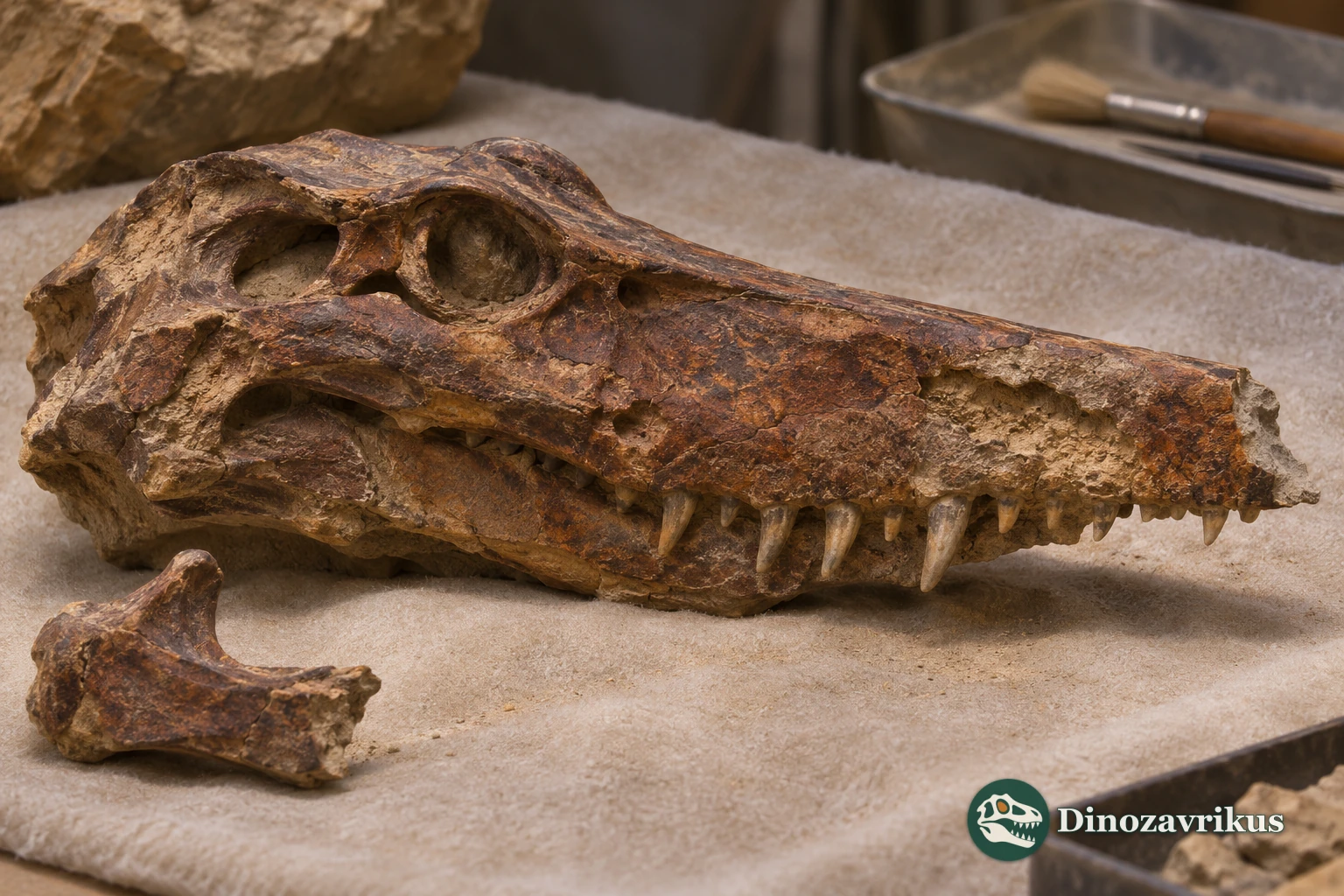
Lomasuchus palpebrosus was a Late Cretaceous peirosaurid from Argentine Patagonia. Its type skull preserves a high muzzle, small bones above the eye sockets and a notch that received an enlarged tooth from the lower jaw.
Quick facts
| Species | Lomasuchus palpebrosus |
|---|---|
| Group | Peirosaurid notosuchian |
| Age | Late Turonian to early Coniacian |
| Locality | Loma de la Lata, Neuquén, Argentina |
| Principal fossil | Skull and jaw fragment, MOZ 4084 PV |
| Rock unit | Portezuelo Formation |
What can the fossils tell us?
Separate palpebral bones lie along the upper edges of the eye sockets. The tip of the snout and parts of the palate are missing.
The notch at the boundary between two upper jaw bones records where a large tooth fitted when the jaws closed.
Specimen MCF-PVPH-160 includes a skull and bones behind it. A later reassessment left its genus unresolved, so it does not establish the limb anatomy of Lomasuchus.
A find near Lake Los Barreales
Zulma Gasparini, Luis Chiappe and Marta Fernández named Lomasuchus in 1991. Specimen MOZ 4084 PV came from Loma de la Lata, on the northern side of Lake Los Barreales in Neuquén Province. Later stratigraphic accounts placed it in the Portezuelo Formation, dated locally to the late Turonian and early Coniacian.
Much of the cranium survived. The tip of the snout, parts of the palate and ends of the quadrate bones are missing. The associated piece of lower jaw came from the back of the left branch.

Brow bones and a high snout
Separate palpebral bones overhang the orbits. Small pits mark the surface of the skull roof. A substantial notch between the premaxilla and maxilla received a large tooth from the lower jaw. Large and small teeth alternate along the jaws, and some preserved crowns have serrated cutting edges. The surviving teeth do not identify its usual prey.
CT scans of the type skull revealed ossified elements in the ethmoid region in front of the braincase. These bones lie inside the skull and add information that cannot be recovered from its external shape alone.
Two peirosaurids at one locality
The types of Lomasuchus and Gasparinisuchus came from Loma de la Lata, but their rock units differ. Gasparinisuchus comes from the younger Bajo de la Carpa Formation. Its muzzle is broader, while that of Lomasuchus is relatively high and narrow.
A more complete specimen, MCF-PVPH-160, was sometimes assigned to Lomasuchus because it included a skull associated with postcranial remains. A later detailed study treated it as an indeterminate peirosaurid. The head of Lomasuchus is consequently much better known than its body.
Frequently asked questions
When did Lomasuchus live?
Its type comes from the Portezuelo Formation, dated to the late Turonian and early Coniacian of the Late Cretaceous.
What parts of the type are preserved?
The type includes a mostly complete skull and the rear of the left lower jaw. The snout tip and some palatal bones are missing.
What was the notch in the upper jaw for?
It received an enlarged lower tooth as the jaws closed. The notch records the position of that tooth relative to the bones above it.
Is a complete skeleton known?
The securely attributed material consists of the skull and a jaw fragment. A more complete specimen once referred to the genus was left at family level in a later study.