

Macelognathus vagans was a Late Jurassic crocodylomorph from what is now the western United States. Its flattened, toothless jaw tip long puzzled researchers. Discoveries in Colorado linked that jaw shape to parts of the skull and hind limbs, changing both its identification and what could be inferred about its stance.
Quick facts
| Species | Macelognathus vagans |
|---|---|
| Group | Early crocodylomorphs |
| Age | Late Jurassic, Kimmeridgian to early Tithonian |
| Sites | Como Bluff, Wyoming, and Fruita, Colorado |
| Holotype | YPM 1415, front of the lower jaw |
| Horizon | Brushy Basin Member, Morrison Formation |
What can the fossils tell us?
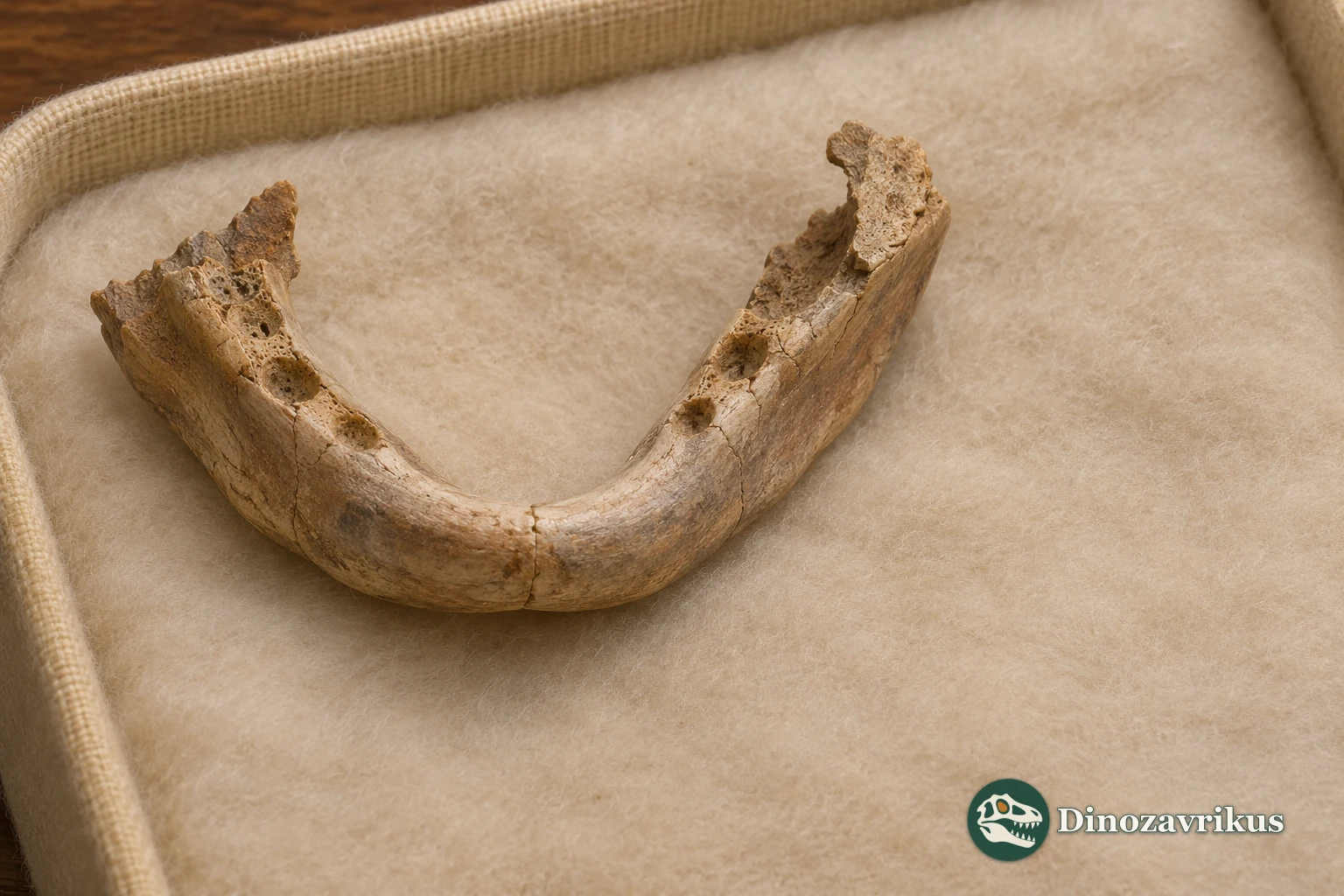
The type preserves the flattened front where the two branches meet. Other material preserves teeth farther back.
The rounded head sits on a distinct neck. Alongside ankle and lower leg anatomy, this supports an upright limb posture without establishing running speed.
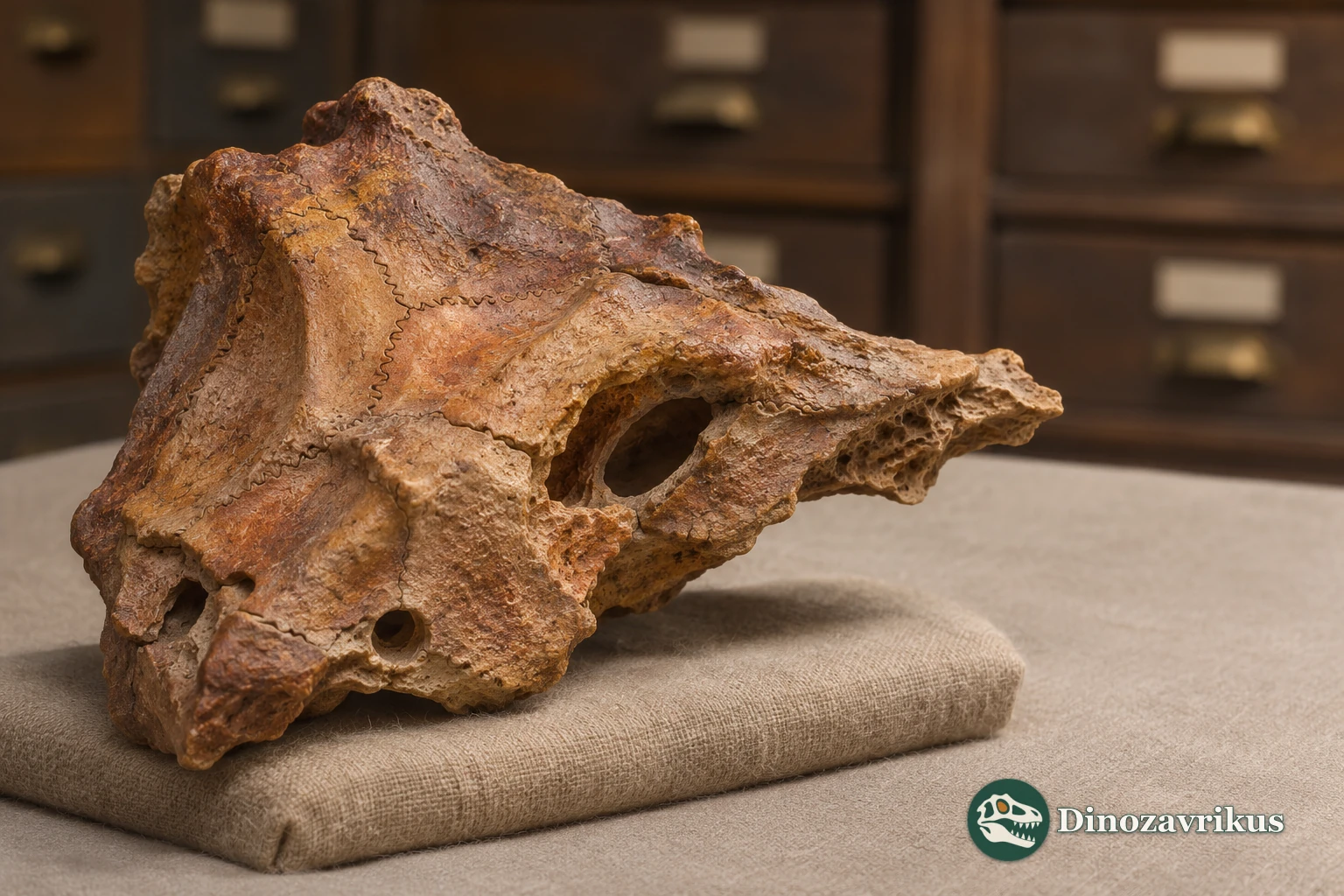
CT of a Fruita specimen revealed a set of cavities and the enclosed course of a canal along the braincase. They are useful comparisons for anatomy and relationships.
A jaw that was first taken for a turtle
The specimen YPM 1415 was collected at Como Bluff, Wyoming, in 1880. It preserves the meeting point of the two lower jaw branches. Othniel Charles Marsh named it in 1884 and assigned it to a turtle. Later authors suggested it was a dinosaur. John Ostrom re-examined the type in 1971 and recognised a jaw from the crocodile lineage.
The fossils Ursula Göhlich and colleagues described in 2005 came from Fruita, Colorado. A matching spatulate, toothless jaw tip tied the Colorado remains to the Wyoming type. Both sites yield the relevant specimens from the Brushy Basin Member of the upper Morrison Formation.
Evidence for a more upright stance
LACM 5572/150148 preserves part of the skull, a left dentary, trunk vertebrae and parts of the pelvis and hind limbs. Other specimens add ankle and foot bones. The femoral head is round, points towards the body midline and has a distinct neck. Taken with the lower leg and foot, this supports a more erect stance.
The Fruita outcrop also yielded Fruitachampsa, from a different branch of the crocodile lineage. Its bony ear opening is smaller than that of Macelognathus. The two fossils reveal different skull configurations from the same area.
The inside of the braincase
Juan Martín Leardi, Diego Pol and James Clark examined the Fruita braincase with high-resolution CT in 2017. They found five cavities in the quadrate and traced a canal between that bone and the braincase, closed along its outer side. The preserved part of the skull measures about 53 millimetres. Its proportions and strongly domed roof suggest it may have belonged to a young individual.
Their analysis grouped Macelognathus with Hallopus and Almadasuchus in Hallopodidae, close to Crocodyliformes. A 2022 analysis found that assemblage under some settings and recovered other branching orders under others. The anatomical evidence establishes the crocodylomorph identity more securely than the exact relationships among those early branches.
Frequently asked questions
When did Macelognathus live?
The known finds date to the Late Jurassic, from the Kimmeridgian through the early Tithonian.
Why did Marsh identify the type as a turtle?
He had only the broad, flattened front of a lower jaw, which lacked teeth at the tip.
Can its whole body length be measured?
The finds consist of separate elements and incomplete skeletons, so a total length cannot be measured directly.
What can the thigh bone tell us?
Its inward-facing head supports a relatively upright stance. It cannot establish how fast the animal moved.