

Palaeontologists once compared Maladioidella with a distinctive two-lobed track left by a burrowing or moving arthropod. The comparison is plausible at some sites. In the El Fabar tunnel in Spain, however, the cranidium and the trace come from widely separated beds.
Quick facts
| Group | Trilobites |
|---|---|
| Age | Late Cambrian, Furongian |
| Region | Europe, Asia |
| Diet | Unknown |
| Type species | Maladioidella splendens |
| Genus named by | Endo, 1937 |
What can the fossils tell us?
Welsh cranidia were distorted after burial. Restoring their proportions made comparisons with material from other regions more defensible.
Welsh and Swedish material can be tied to rock units. Danish erratics were transported by ice, so their recovery sites are not automatically their Cambrian localities.
The cranidium is Late Cambrian. The track from higher in the El Fabar section is Early Ordovician. Their presence in the same tunnel does not link them directly.
A name reconsidered
Endo established Maladioidella in 1937. Its type species, M. splendens, is from the Furongian Taishan Formation of Liaoning, China. Salter originally named the Welsh species Conocoryphe abdita. Cranidium GSM 19826 from North Wales was later selected as the lectotype.
Adrian Rushton and Nigel Hughes corrected for distortion in Welsh specimens and reassessed their similarities to forms from Siberia and Iran. They placed the species in Maladioidella. Its head includes a glabella that tapers towards the front, while the oval pygidium has three distinct rings before the terminal piece. In comparisons of the Late Cambrian trilobite Meteoraspis, detached heads and tails help distinguish the species in a similar way.
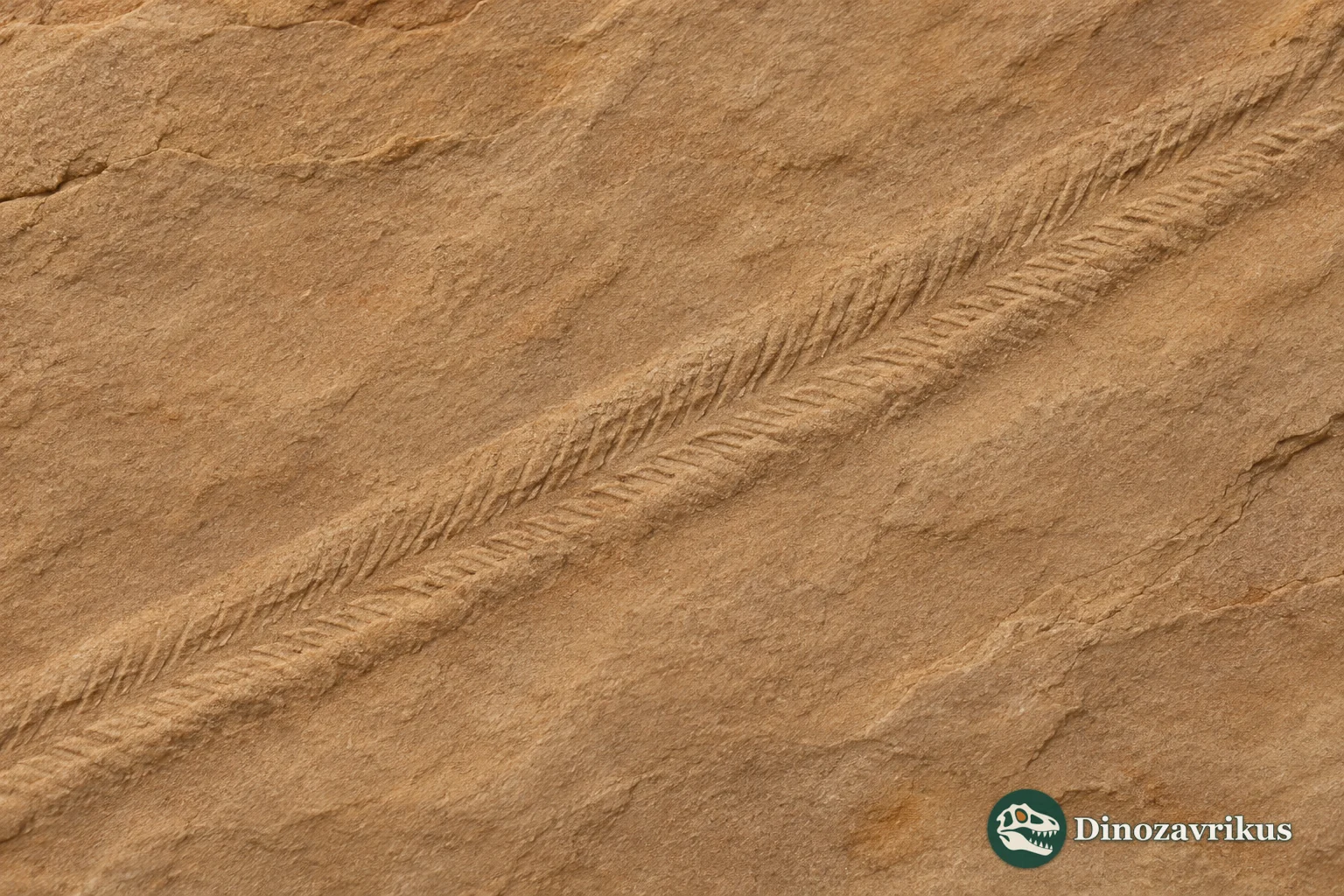
Could it have made Cruziana?
Richard Fortey and Adolf Seilacher proposed an association between Maladioidella cf. colcheni and the trace fossil Cruziana semiplicata. They compared the sizes, stratigraphic occurrences and geographic distributions of the two kinds of fossil. A two-lobed trace with repeated scratch marks records the action of appendages in sediment, without preserving the shell or determining the exact diet.
A slightly deformed cranidium, MGM-175K, was found during construction of the El Fabar tunnel. It was compared with M. colcheni from the Sierra de la Demanda. The reported Cruziana semiplicata in this tunnel is Early Ordovician and about 200 metres higher in the section. This separation led the authors to reject a direct link between the two local finds.
Fossils from Sweden and Denmark
In Sweden, fossils of Maladioidella abdita are known from rock of Furongian age. Material attributed to the same species also occurs in Danish glacial erratics. The ice moved those boulders long after the Cambrian, making the find location a different kind of evidence from a fossil collected in a measured bed.
Frequently asked questions
Where did the type species come from?
Maladioidella splendens was described from the Taishan Formation of Liaoning Province, China.
What is a cranidium?
It is the central part of the head shield, including the glabella and fixed cheeks.
Is Maladioidella known to have made Cruziana?
It has been proposed as a possible maker. In El Fabar, the identified trace is from a younger bed than the cranidium.
Why did researchers restore the Welsh specimens?
Deformation altered their shape. Correcting for it made comparisons with specimens from elsewhere more reliable.