

Meteoraspis is a Cambrian trilobite whose tail shield ends in a pair of spines. Heads and tails record several species with different proportions. The genus is reported from rocks now exposed across the Americas, China, Australia and Antarctica.
Quick facts
| Group | Trilobites |
|---|---|
| Age | Cambrian, Guzhangian to early Furongian |
| Region | North America, South America, Asia, Australia, Antarctica |
| Diet | Unknown |
| Type species | Meteoraspis metra |
| Genus named by | Charles Resser, 1935 |
What can the fossils tell us?
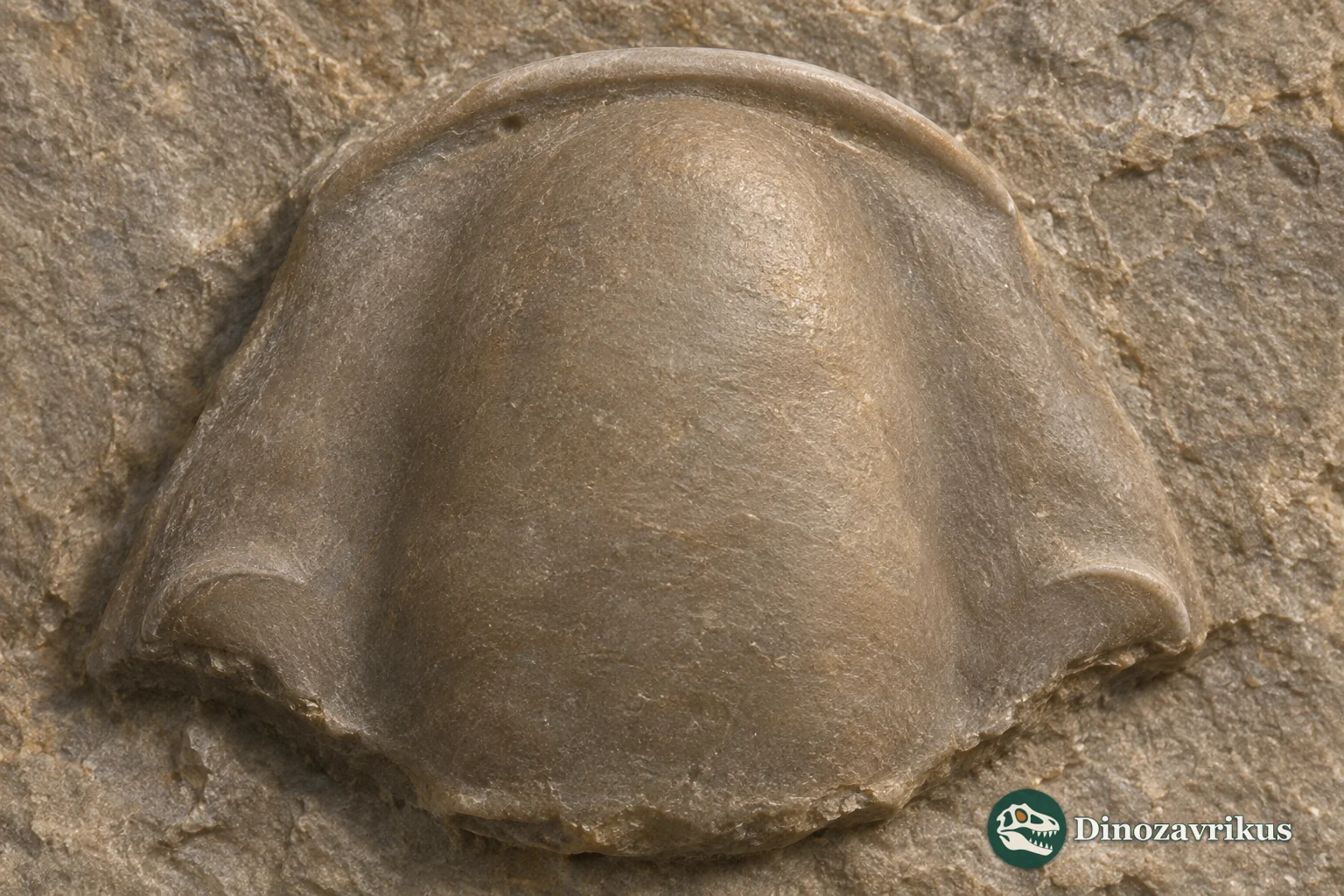
The tail shields assigned to Meteoraspis have two rearward projections. Their breadth and profile help distinguish species. An isolated tail provides no count of the separate trunk segments.
Two pits are characteristic of several North American forms. The early Furongian Antarctic species was described with three. The shape and grooves of the associated shields also enter the diagnosis.
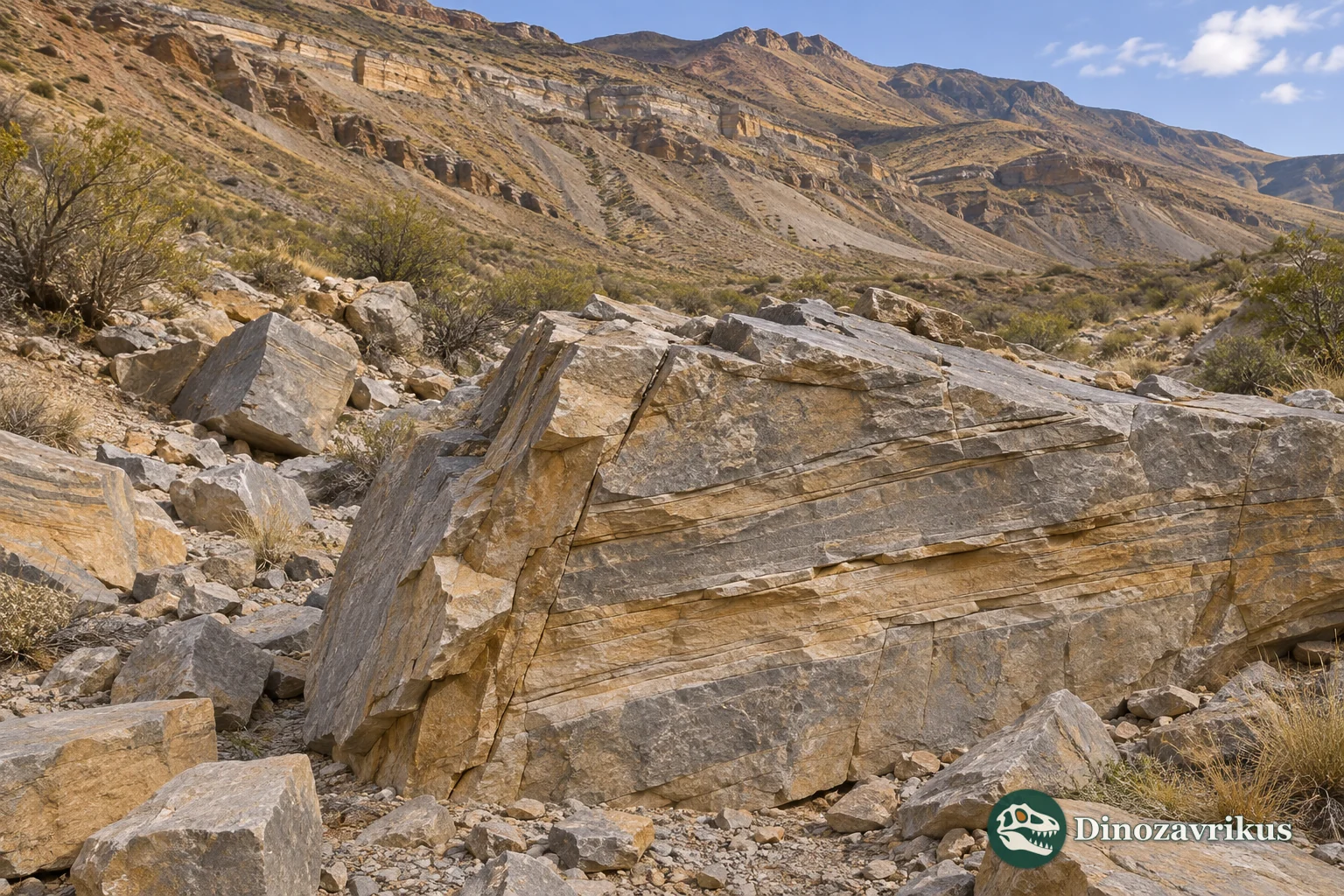
The Argentine fossils occur in a limestone block of the La Cruz Olistoliths. Its trilobites date the limestone to the upper Guzhangian. The block was displaced later.
From Texas to an Argentine limestone block
Walcott described what is now Meteoraspis metra as Ptychoparia? metra in 1890. Charles Resser established Meteoraspis in 1935. Palmer’s revision compares Texas specimens with related North American forms. Genera such as Coosella help palaeontologists correlate beds of comparable age.
In the San Isidro area near Mendoza, Franco Tortello identified M. metra in an allochthonous limestone block of the La Cruz Olistoliths. The accompanying trilobites place the block in the upper Guzhangian Cedaria prolifica Zone. The North American affinities of this assemblage support the proposal that the Argentine Precordillera once lay near Laurentia.
What identifies the shields
In M. metra, the fixed cheeks are narrow and slope towards the eye lobes. The spines of the pygidium point back or slightly inward. Articulated M. borealis provides a reference for the entire exoskeleton, including thirteen trunk segments. It is the basis of the reconstruction.
The front border furrow in several North American species carries two depressions. In M. nevensis, Jago and Cooper described three distinct pits, together with a tail axis carrying three rings in front of the terminal piece. Their account uses a broader diagnosis for the genus, taking features of both head and tail into consideration.
Other Cambrian shelves
The Dolodrook River limestones of Victoria yielded the material that Paterson and Laurie assigned to Meteoraspis etheridgei. They selected the tail shield CPC37364 as the neotype because the original holotype could not be located. The pygidium has a narrower border and narrower spine bases than in the related M. bidens.
The Chinese material includes cranidia assigned to M. orientalis in Guizhou and M. qinghaiensis in Qinghai. These finds and material from northern Victoria Land and Australia document a genus-level range compiled from different species and identifications. The hard shields have not provided direct evidence of feeding.
Frequently asked questions
What distinguishes the tail shield of Meteoraspis?
It bears a pair of rear-facing spines. Their bases, direction and the proportions of the shield differ among species.
Which species defines the genus?
Meteoraspis metra, originally described by Walcott in 1890, is the type species.
Why does the Argentine find matter?
It comes from a trilobite assemblage with strong Laurentian affinities, evidence relevant to the origin of the Argentine Precordillera.
Which species was described from Antarctica?
Meteoraspis nevensis was described from cranidia, a free cheek and pygidia in northern Victoria Land.