

Manchurochelys was an Early Cretaceous turtle from the Jehol Biota of northeastern China. A small specimen could be compared with larger individuals to document changes in shell outline, scute proportions and the degree of ossification at the rim.
Quick facts
| Group | Turtles, sinemydids (Sinemydidae) |
|---|---|
| Age | Early Cretaceous |
| Region | Asia (China: Liaoning and Inner Mongolia) |
| Type species | Manchurochelys manchoukuoensis |
| Holotype | No. 3898, partial shell, presumed lost |
| Carapace length | 78.5 mm in juvenile PMOL-AR00007 |
| Formations | Yixian and Jiufotang |
| Scientific name | Manchurochelys |
| Diet | Exact diet unknown |
What can the fossils tell us?
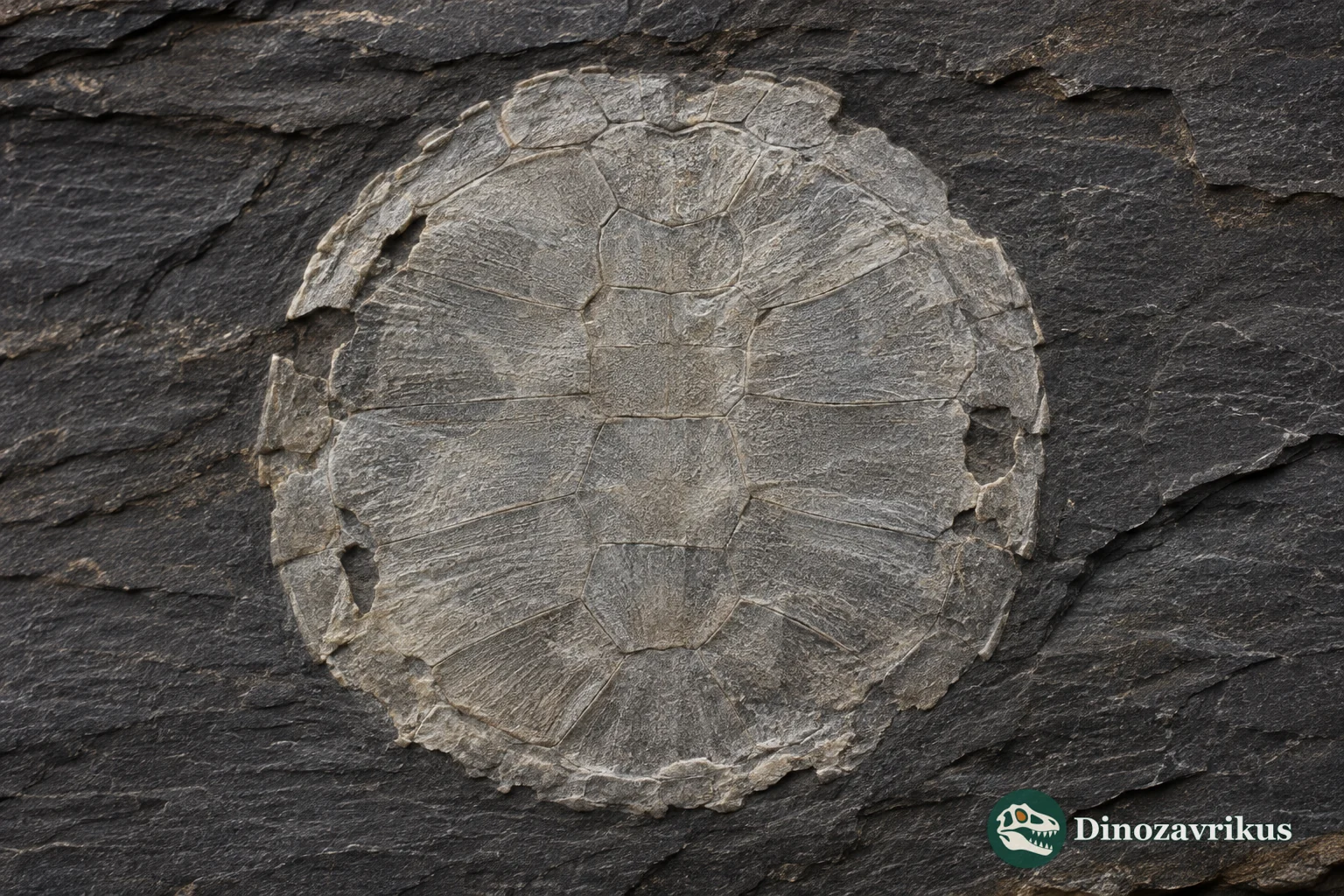
The upper shell of PMOL-AR00007 is nearly circular. Natural openings remained between the rib plates and the bones at the rim.
PMOL-AR00180 from the Jiufotang Formation has a long crest at the back of the skull that could be compared directly with material from the Yixian Formation.
PKUP V1071 preserves the plastron well. The specimen clarifies the anatomy of a region known only in part from the original holotype.
The missing type and later finds
Riuji Endo and Tokio Shikama named the type species in 1942 from a partial shell, specimen no. 3898, from the Yixian area of Liaoning. It appears to have been lost during the Second World War. A later fossil from Liaoning allowed researchers to describe the skull and revisit features of the shell.
PMOL-AR00180 from near Chifeng, Inner Mongolia, preserves a long supraoccipital crest, also seen in the referred Liaoning specimen. The Chifeng skeleton comes from the Jiufotang Formation, extending the documented range beyond the Yixian material.
What a juvenile shell looks like
The Yixian juvenile PMOL-AR00007 has a carapace 78.5 mm long, less than half as long as the shell of one documented adult. Its outline is nearly round. Open spaces remain between the rib plates and the bones along the rim. The scutes along the middle of the back are relatively broad.
In the adult material the outline is oval and the side openings are closed. The middle vertebral scutes are relatively longer. These changes make growth stage important when identifying a turtle from its shell. In the related Ordosemys, a circular outline could persist beyond the juvenile stage.
The lower shell and evolutionary relationships
Lan Li, Chang-Fu Zhou and Márton Rabi described another near-complete Yixian skeleton, PKUP V1071, in a study published online in 2021. Its well-preserved plastron expands on the partial evidence of the holotype and allows the lower shell to be studied as a unit.
Comparative studies place the genus among sinemydids, on the stem leading to modern hidden-necked turtles. The placement draws on several parts of the skeleton, including the skull. The fossils document changes in the shell during growth, while the exact diet is still unknown.
Frequently asked questions
How big was the juvenile's shell?
The carapace of PMOL-AR00007 measures 78.5 mm, less than half the length recorded for one adult.
What happened to the openings in the shell?
They are open in the juvenile and filled by bone in the known adult specimens.
Where are the fossils from?
They are recorded from the Yixian Formation in Liaoning and the Jiufotang Formation near Chifeng in Inner Mongolia.
Which fossil clarified the anatomy of the plastron?
The nearly complete Yixian specimen PKUP V1071 preserves a well-exposed lower shell.