

Ordosemys was a freshwater turtle from the Early Cretaceous of northern China. A rounded shell and broad scutes along the back help recognise it. Fossils from Jilin show how different parts of the shell closed at different growth stages.
Quick facts
| Group | Turtles, sinemydids (Sinemydidae) |
|---|---|
| Age | Early Cretaceous |
| Region | Asia (northern China) |
| Type species | Ordosemys leios |
| Holotype | IVPP V9534-1, skeleton from the Ordos Basin |
| Scientific name | Ordosemys |
| Diet | Exact diet unknown |
What can the fossils tell us?
IVPP V9534-1 comes from the Luohandong Formation. Later finds in Shandong were compared with the type species.
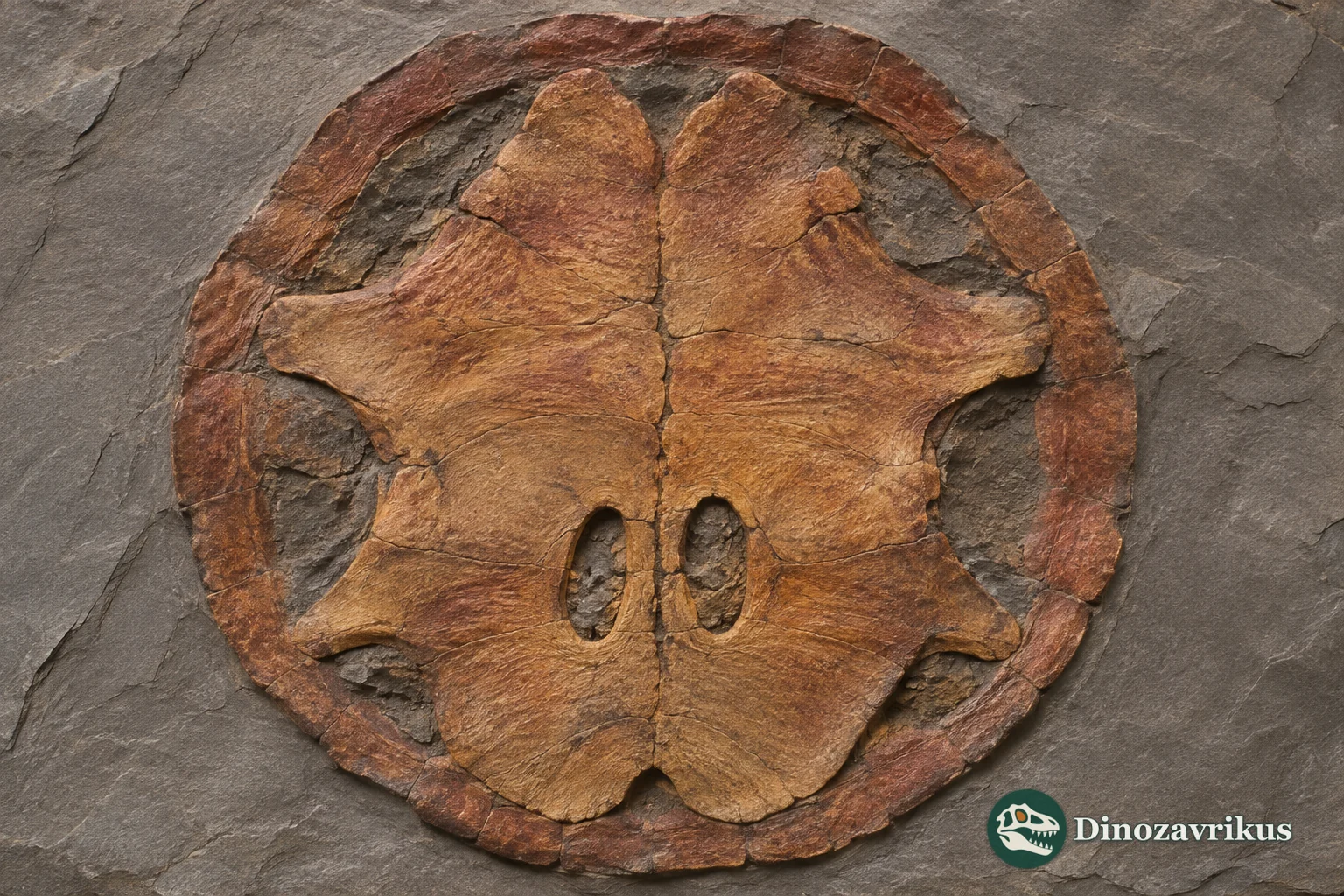
In the juvenile XL-008, gaps separate the rib-bearing and outer bones. Impressions left by the adult XL-009 show those gaps had closed.
The adult shell still had gaps among the plates of the plastron. Their shape and position are useful points for comparisons.
A turtle named for the Ordos Basin
Donald Brinkman and Jian-Hua Peng described Ordosemys leios in 1993. The holotype IVPP V9534-1 was found in the Luohandong Formation of Inner Mongolia’s Ordos Basin. It preserves an associated skeleton, with parts of the head eroded.
The carapace is nearly circular and the vertebral scutes along its centre are broad. An additional bone called a preneural lies in front of the neural series in the type species. This combination helps separate it from other Early Cretaceous turtles in comparisons that include Asian sinemydids such as Kirgizemys.
How closure varied over the shell
Three fossils from the Hengtongshan Formation of southern Jilin were assigned to O. liaoxiensis. The juvenile XL-008, had an estimated carapace length of about 13 centimetres. It retained broad openings between the rib-bearing plates and the outer rim. The adult XL-009 lost much of its upper shell, but impressions show these openings had ossified.
The adult retained openings in the lower shell. Within the rear half of the plastron one gap is bordered by two different pairs of bones. Its shape can change during growth, so shell anatomy is compared as a combination of characters when identifying the fossils.
From Shandong to Xinjiang
The type species was subsequently reported from the Mengyin Formation of Shandong. The shell resemblance prompted a new comparison of the ages of the Mengyin and Luohandong formations. The turtle occurrence is one line of evidence for correlation between the two basins.
O. liaoxiensis is also known from lake deposits of the Yixian Formation in Liaoning. O. brinkmania is represented by material from the river deposits of the Tugulu Group in Xinjiang. Referrals of some other species, including O. donghai, remain debated because relevant shell characters differ or are missing.

Frequently asked questions
Where was the earliest named species found?
The holotype of Ordosemys leios comes from the Early Cretaceous Luohandong Formation in the Ordos Basin of Inner Mongolia.
Were the shell gaps injuries?
They were natural openings between bones. Several of the carapace openings closed during growth.
Where is Ordosemys liaoxiensis known from?
It occurs in the Yixian Formation of Liaoning and in the Hengtongshan Formation of southern Jilin.
What did Ordosemys eat?
Its precise diet remains unknown. Fossils occur in freshwater sediments.