

Marambiornis was a small fossil penguin from Seymour Island near the Antarctic Peninsula. Penguins of very different sizes inhabited this region during the Late Eocene. Its most distinctive feature is an elongated, relatively slender tarsometatarsus, the bone connecting the lower leg with the toes.
Quick facts
| Group | Penguins |
|---|---|
| Locality | Seymour Island, Antarctica |
| Age | Late Eocene |
| Main material | Two right tarsometatarsi |
| Genus named | Andrzej Myrcha and colleagues, 2002 |
What can the fossils tell us?
The holotype is the complete right tarsometatarsus IB/P/B-0490. Its proportions and vascular openings distinguish it from other penguins in the same deposits.
A femur and a lower-leg fragment were later compared with Marambiornis. For the latter, attribution to a small Delphinornis could not be excluded.
An inner circumferential layer was described in the studied tarsometatarsus. Its presence alone does not identify the individual as female.
Two specimens from Seymour Island
Andrzej Myrcha and colleagues named the genus Marambiornis and its species Marambiornis exilis in 2002, during a revision of Eocene Antarctic penguins. The generic name refers to Marambio, another name for Seymour Island; the Latin species name means thin or slender.
The holotype, IB/P/B-0490, is a complete right tarsometatarsus held in the University of Białystok collection. The paratype, MLP 93-X-1-111, is another right tarsometatarsus, held at the Museo de La Plata. Its hypotarsus, a projection associated with the passage of tendons near the upper end of the bone, is slightly eroded. These are remains of different individuals, not the two feet of one skeleton.
Both specimens came from Telm 7, a subdivision assigned to the La Meseta Formation in the original account. They belong to the Late Eocene part of the island sequence. Their Antarctic location does not mean that these birds inhabited a landscape identical to the ice-bound coast occupied by Antarctic penguins today.
What makes the foot distinctive
Identification depends on more than the overall size of the bone. The researchers compared its elongation, vascular openings near the upper end, grooves and joint surfaces. Together, these characters distinguished Marambiornis from Delphinornis and Mesetaornis, other penguins represented in the Antarctic fossil assemblage.
Slenderness refers primarily to the tarsometatarsus. It does not by itself establish running speed, the length of the complete leg or body mass. A precise standing height is unavailable. Small penguins occurred in different lineages: the much younger Patagonian Eretiscus was also small, but similarity in size alone does not demonstrate a close relationship.
In 2006, Piotr Jadwiszczak tentatively referred a complete right femur, IB/P/B 0434, and a distal left tibiotarsus, IB/P/B 0406, to Marambiornis. For the lower-leg fragment, he explicitly acknowledged possible attribution to a small Delphinornis. Combining them with the type tarsometatarsi therefore does not produce a securely identified complete skeleton.
Looking inside the bone
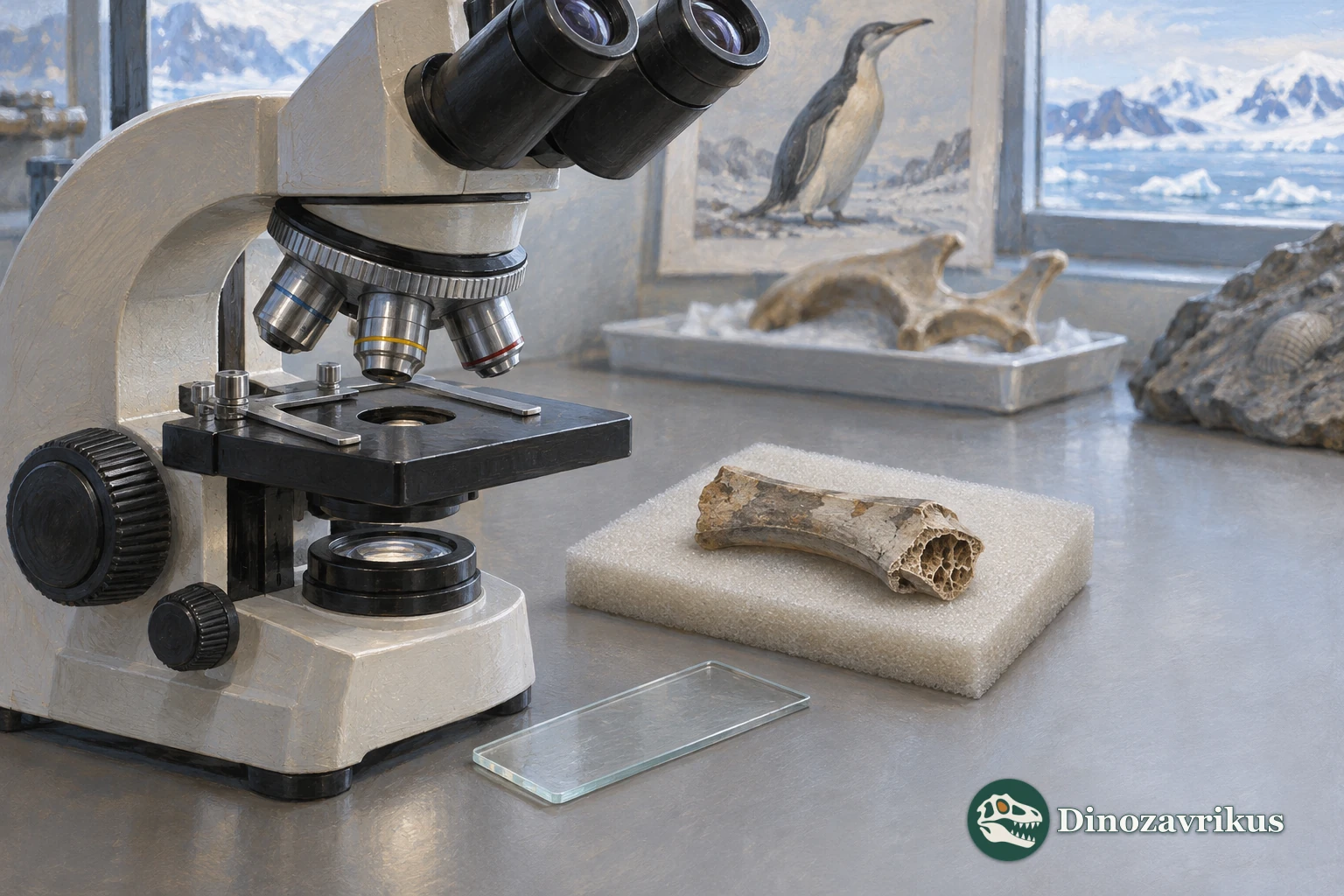
A 2026 investigation examined thin sections of Eocene penguin bones. The Marambiornis specimen MLP-PV 93-X-1-111CH showed a well-developed inner circumferential layer surrounding the marrow cavity. This records the organisation and remodelling of bone tissue, information that cannot be obtained from the outer surface alone.
The authors found no medullary bone in any of the specimens examined. In living female birds this temporary tissue can provide calcium during eggshell formation. An inner circumferential layer, however, is not the same structure as medullary bone. Its presence does not establish that this particular Marambiornis was female, nor does it identify a breeding season.
A marine coast without a complete portrait
The marine deposits of Seymour Island preserve a diverse assemblage of early penguins. Marambiornis probably obtained its food in the water, as expected for a member of this group. Two foot bones cannot reveal its particular prey species, diving depth or colony organisation.
The illustration uses general penguin anatomy as a starting point. Soft tissues, details of the bill and plumage colours remain conjectural. Vegetation in the coastal scene conveys the difference between an Eocene setting and today’s icy landscape; it does not reproduce a documented nesting site.
Frequently asked questions
Was Marambiornis the smallest penguin?
There is no basis for that record. It was small compared with large Eocene Antarctic penguins, but precise whole-body dimensions are unavailable.
Has its skull been found?
The type description is based on tarsometatarsi. No securely associated skull establishes the shape of its head, so details in the reconstruction are conjectural.
Why are two right foot bones informative?
They allow the same skeletal element to be compared in different individuals and its diagnostic features checked. Bones from other body regions require separate justification before they can be assigned to the species.
Can the fossil bird’s sex be identified?
The described tarsometatarsus does not provide a secure sex determination. Its inner circumferential layer is not a uniquely female feature.