

Megalochelys was a giant land tortoise of South and Southeast Asia. The largest shells in published comparisons approach two metres in length. A bony projection at the front of the lower shell helps identify the genus alongside its size and other shell features.
Quick facts
| Group | Turtles, land tortoises (Testudinidae) |
|---|---|
| Age | Pliocene and early Pleistocene for the material discussed |
| Region | Asia (India, Thailand and Indonesia) |
| Type species | Megalochelys atlas, also published as M. sivalensis |
| Type material | BMNH 40603, anterior plastral bones |
| Scientific name | Megalochelys |
| Carapace length | Around 2 m in the largest reported specimens |
| Diet | Exact diet unknown |
What can the fossils tell us?
Measured shells and estimates from incomplete specimens give lengths of around two metres at the upper end. These figures refer to the carapace.
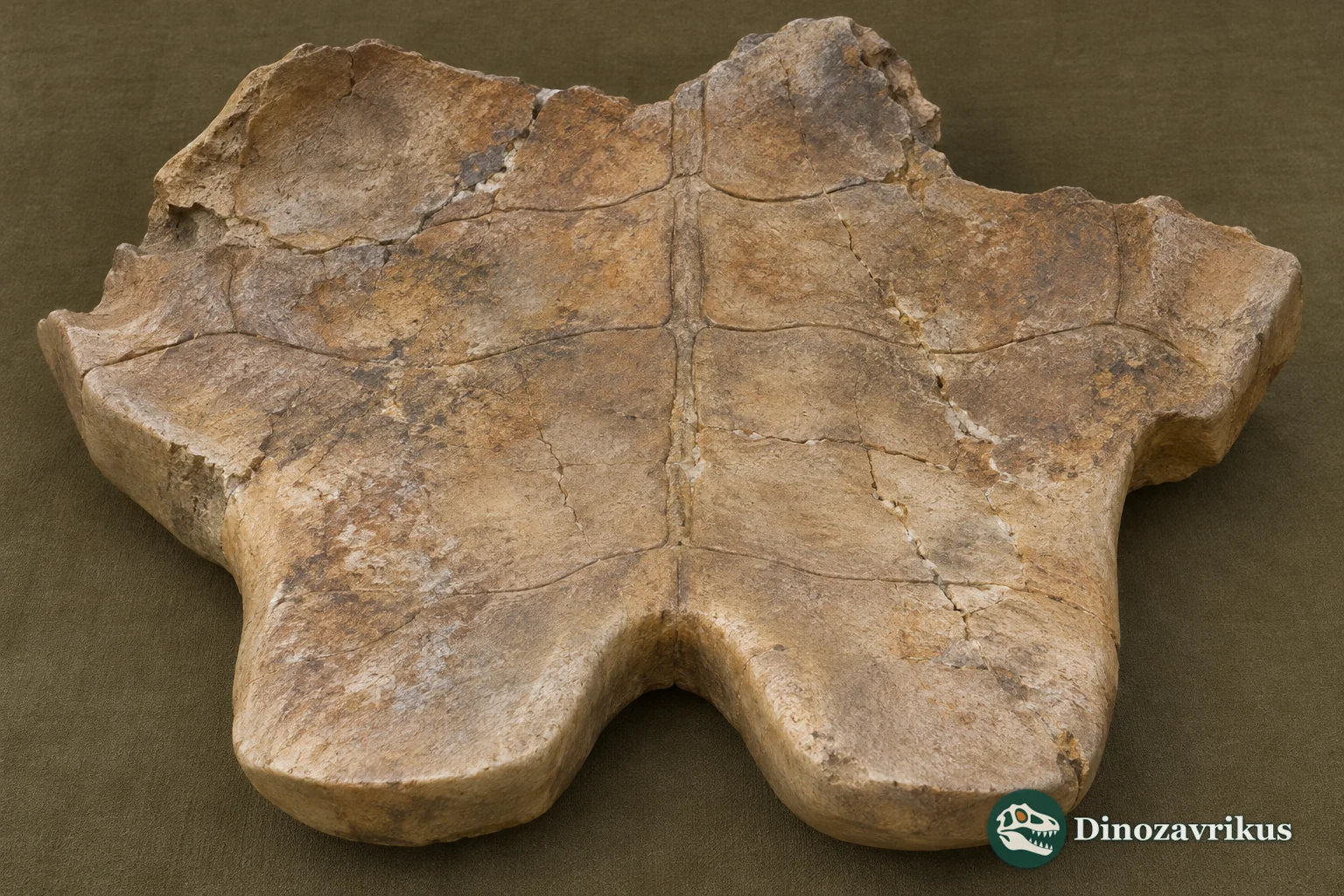
The paired bones at the front of the lower shell form a strong projection. Its shape and proportions vary across specimens.
Both historical names were proposed for the same material. Authors differ on whether the earlier species name meets the requirements for availability.
Two names for the Siwalik tortoise
Hugh Falconer and Proby Cautley reported a giant Siwalik tortoise in 1837 under the name Megalochelys sivalensis. In 1844 they described the material in more detail and proposed the name Colossochelys atlas. Richard Lydekker singled out the incomplete anterior plastral bones BMNH 40603 as type material in his catalogue of the British Museum collection.
Several accounts use Megalochelys atlas, treating the original publication of the species name sivalensis as insufficient. A later nomenclatural assessment argued that the early name M. sivalensis was already available. The two interpretations concern the same Siwalik tortoise.
Features that identify incomplete shells
The Tha Chang sandpits of Thailand yielded thick bones from the upper and lower shell. Researchers identified them using a strong projection on the epiplastra, the arrangement of scute boundaries and a single supracaudal scute over the tail. The projection differs between specimens, and the study assigned the remains to Megalochelys without naming a species.
Europe’s giant Titanochelon also had a heavy shell. Comparisons of the actual bones and the lines left by the horny scutes allow researchers to tell such large tortoises apart.
Evidence from Java and the upper end of the size range
An Early Pleistocene find from the Bumiayu area of central Java includes parts of a large carapace and limb bones. The largest specimens cited in the comparison have an upper shell around two metres long. Estimates for a whole shell can differ substantially from the length of the portion that survives. The weight of a living tortoise is harder to estimate from that material.
Frequently asked questions
What part of the animal reached two metres?
The upper shell in the largest published specimens and reconstructions of incomplete carapaces.
Where did the name Colossochelys come from?
Falconer and Cautley proposed it in 1844 for Siwalik specimens they had already reported.
What are epiplastra?
A pair of bones at the front of the lower shell. In Megalochelys they made a distinct projection.
Do all Asian finds belong to the Siwalik species?
Some material, including the Thai shells from Tha Chang, has been identified to genus only.